
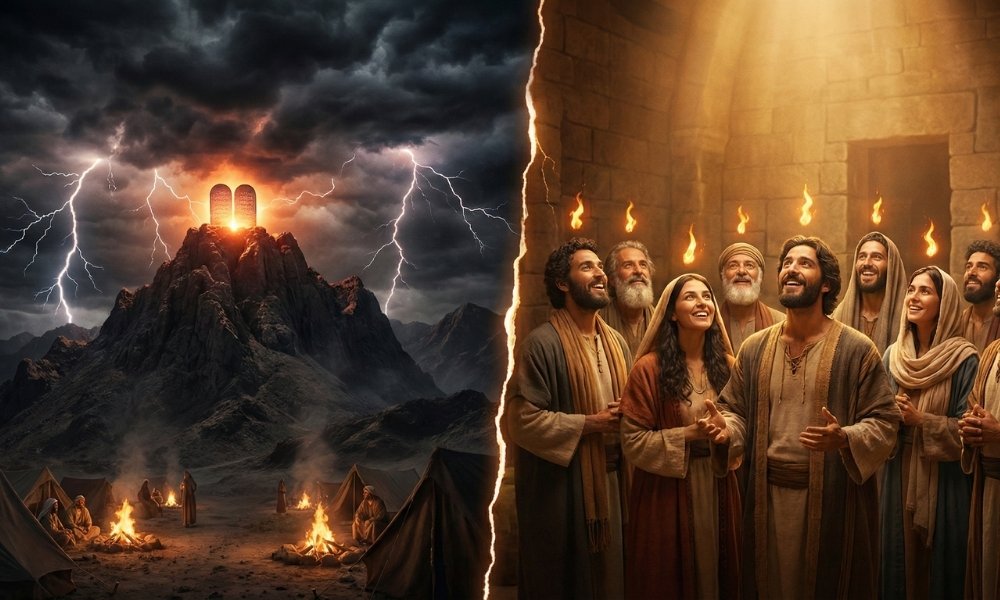
The Feast of Weeks (Shavuot), known in the New Testament as Pentecost, is the climax of the spring festival season. Occurring exactly 50 days after the Feast of Firstfruits, it marks the end of the grain harvest (wheat) and commemorates the single most important event in Jewish history: the giving of the Torah at Mount Sinai. In the Christian tradition, this feast is transformed into the birthday of the Church. Just as Moses ascended the mountain to receive the Law on tablets of stone, Jesus ascended to heaven to pour out the Holy Spirit, writing the Law on the hearts of believers. It is the feast of fullness, harvest, and the empowering presence of God.
Quick Facts
- Name: Feast of Weeks (Shavuot), Pentecost (“Fifty”), Feast of Harvest
- Date: 6th of Sivan (Late May / Early June)
- Timing: 50 days (7 weeks + 1 day) after Firstfruits
- Agricultural Tie: The Wheat Harvest (Conclusion of the Grain Season)
- Key Ritual: Offering two loaves of leavened bread
- Historical Event: The Giving of the Law (Torah) at Mt. Sinai
- Prophetic Fulfillment: The Outpouring of the Holy Spirit (Acts 2)
- Associated Book: The Book of Ruth
Name Meaning
“Shavuot” is the Hebrew plural for “Weeks,” referring to the command to count seven full weeks from the barley harvest to reach this date. “Pentecost” is the Greek word for “Fiftieth,” referring to the 50th day of that count. It is also called “Atzeret” (Conclusion) in rabbinic literature, viewed as the closing ceremony of the Passover season.
Biblical Era / Context
Time: Late Spring. The weather is transitioning from the rainy season to the dry summer.
Setting: One of the three “Pilgrimage Festivals” (Exodus 23:14). Jerusalem would be packed with Jews from “every nation under heaven” (Acts 2:5), explaining the massive, diverse crowd present when the Spirit fell.
Cultural Context: Agriculturally, this was the celebration of the “ingathering.” If Passover was the planting of freedom, Shavuot was the harvest of nationhood. Spiritually, it was considered a “wedding day” between God (the Groom) and Israel (the Bride) at Sinai.
Key Rituals & Requirements
The Two Loaves (Shtei HaLechem): Unlike Passover, where leaven was forbidden, at Shavuot the priest waved two loaves of wheat bread baked with yeast (Leviticus 23:17). This unique exception is rich in symbolism (see below).
The Reading of Ruth: The Book of Ruth is read publicly in the synagogue because the story takes place during the barley and wheat harvests (Ruth 2:23) and tells the story of a Gentile (Ruth) being grafted into the family of Israel—a perfect picture of the Church born at Pentecost.
All-Night Study (Tikkun Leil Shavuot): Jewish tradition involves staying up all night studying the Torah to rectify the error of the Israelites who were “sleeping” when Moses went up to receive the Law.
Main Life Events (History & Fulfillment)
Mount Sinai (The Law): According to Jewish calculation, the Israelites arrived at Sinai and received the Ten Commandments exactly 50 days after leaving Egypt. The mountain was covered in fire, smoke, and loud voices (Exodus 19).
- Result: 3,000 people died for worshipping the Golden Calf shortly after.
The Upper Room (The Spirit): In Acts 2, the disciples were gathered on Pentecost. The Spirit descended with “tongues of fire” and the sound of a “mighty rushing wind.”
- Result: 3,000 people were saved and baptized that day (Acts 2:41), reversing the curse of Sinai.
Major Relationships
Ruth & Boaz: The love story set during this harvest season typifies the “Kinsman-Redeemer” (Christ) marrying the Gentile bride (The Church).
Moses & Jesus: Moses brought the Law on stone tablets; Jesus sent the Spirit to write the Law on human hearts (Jeremiah 31:33).
Notable Passages
Leviticus 23:15-16: “From the day after the Sabbath… count off seven full weeks. Count off fifty days up to the day after the seventh Sabbath, and then present an offering of new grain to the LORD.”
Acts 2:1-4: “When the day of Pentecost came, they were all together in one place. Suddenly a sound like the blowing of a violent wind came from heaven… All of them were filled with the Holy Spirit…”
Exodus 19:18: “Mount Sinai was covered with smoke, because the LORD descended on it in fire.”
Legacy & Impact
The Birth of the Church: Pentecost is widely regarded as the “birthday” of the Christian Church. It marks the moment the Holy Spirit permanently indwelt believers, empowering them for global mission.
reversal of Babel: At the Tower of Babel, God confused languages to scatter the people. At Pentecost, God used the gift of tongues to unite people of different languages in the Gospel.
Harvest Theology: Jesus said, “The harvest is plentiful but the workers are few” (Matthew 9:37). Pentecost equipped the “workers” to go out and bring in that harvest.
Symbolism / Typology
The Leavened Loaves: Why use yeast, which usually symbolizes sin?
- Jew and Gentile: The two loaves may represent the two groups (Jews and Gentiles) comprising the Church. Though they are made holy, they still possess “leaven” (a sin nature) and are accepted only by grace.
- Ordinary Life: Passover is unleavened (crisis/haste), but Shavuot is leavened (daily life). The Spirit sanctifies us in our ordinary, daily existence.
Fire and Wind: Both elements (Sinai and Acts) represent the presence of God. Fire purifies and illuminates; Wind (Ruach/Pneuma) represents the invisible, powerful movement of the Spirit.







Leave a Reply