
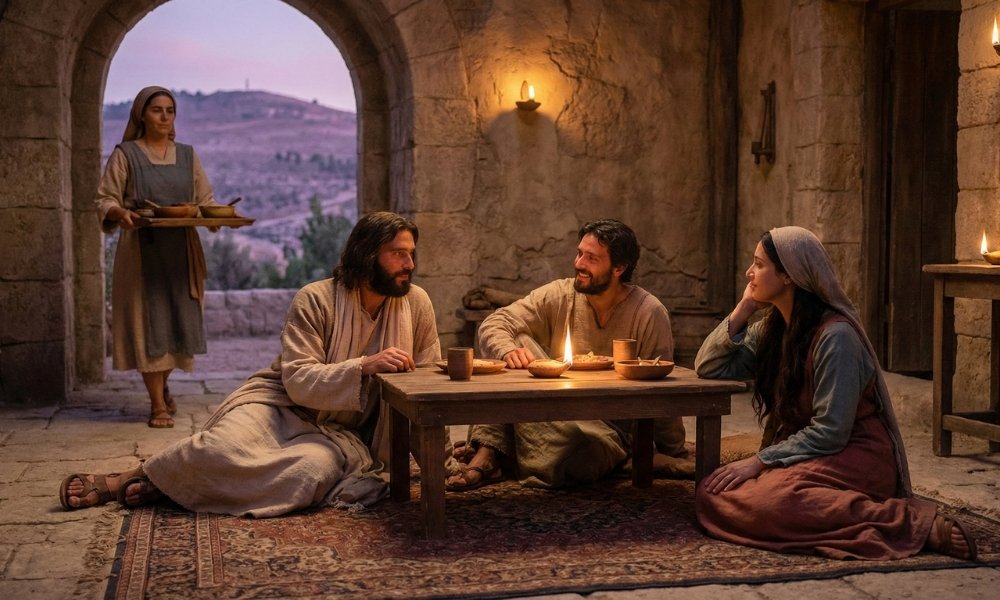
Bethany was a small, humble village located on the southeastern slope of the Mount of Olives, just two miles from Jerusalem. In the New Testament, it serves as a crucial sanctuary for Jesus—a “home away from home” where He found friendship, rest, and hospitality away from the hostility of the religious leaders in the capital. It is best known as the home of the siblings Mary, Martha, and Lazarus, the site of one of Jesus’ greatest miracles (the raising of Lazarus), and the location of His final ascension into heaven.
Quick Facts
- Name: Bethany (Greek: Bethania; Hebrew/Aramaic origin)
- Meaning: “House of Figs” (Beit-Te’ena) or “House of the Poor/Afflicted” (Beit-Aniya)
- Location: Eastern slope of the Mount of Olives, approx. 2 miles (3 km) from Jerusalem
- Modern Name: Al-Eizariya (Arabic for “The Place of Lazarus”)
- Key Figures: Jesus, Mary, Martha, Lazarus, Simon the Leper
- Key Events: Raising of Lazarus, Anointing of Jesus, The Ascension
- Primary Reference: Gospels (Luke 10, John 11–12, Mark 14)
Name Meaning
House of the Poor: While traditionally translated as “House of Figs,” recent scholarship (including the Dead Sea Scrolls) suggests the name Beit-Aniya likely means “House of the Poor” or “House of Affliction.” This supports the theory that the village may have housed a hospice or an Essene community dedicated to caring for the sick and destitute (hence the presence of “Simon the Leper”).
Geography / Setting
Proximity to Jerusalem: It was situated on the road leading up from Jericho to Jerusalem. Being only about 15 furlongs (less than 2 miles) from the city, it allowed Jesus to visit the Temple daily during Passion Week and retreat to safety at night.
Topography: Tucked behind the crest of the Mount of Olives, it is out of direct sight of the Temple Mount, providing a sense of seclusion and privacy.
Major Roles / Importance
Jesus’ Judean Headquarters: While Capernaum was Jesus’ base in Galilee, Bethany was His base in Judea. It was the one place where He was welcomed not just as a Rabbi or Messiah, but as a personal friend.
The Contrast to Jerusalem: Jerusalem represented conflict, debate, and eventual rejection. Bethany represented acceptance, service, and worship.
Gateway to the Passion: It was the staging ground for the Triumphal Entry and the place where Jesus was anointed for His burial.
Main Events
Mary and Martha: Jesus visits the sisters. Martha is distracted by serving, while Mary sits at Jesus’ feet. Jesus affirms Mary’s choice, prioritizing spiritual intimacy over busyness (Luke 10:38–42).
The Raising of Lazarus: Jesus arrives four days after Lazarus’ death. He declares “I am the resurrection and the life” and commands Lazarus to come out of the tomb, a miracle that directly precipitated the Sanhedrin’s plot to kill Him (John 11).
The Anointing: Days before the crucifixion, during a dinner at the home of Simon the Leper, Mary breaks an alabaster jar of expensive nard to anoint Jesus’ feet, an act Jesus calls a preparation for His burial (Mark 14, John 12).
The Triumphal Entry: Jesus sends two disciples from the vicinity of Bethany/Bethphage to retrieve the donkey for His entry into Jerusalem (Mark 11:1).
The Ascension: Luke 24:50 records that Jesus led His disciples “out as far as Bethany,” blessed them, and was taken up into heaven.
Major Relationships
The Siblings (Lazarus, Martha, Mary): This family represents the closest thing Jesus had to a best friend or an adopted family. The text uniquely states that “Jesus loved Martha and her sister and Lazarus” (John 11:5).
Simon the Leper: A resident of Bethany who hosted a feast for Jesus. He was likely a former leper healed by Jesus, further suggesting the village was a place for the outcast.
Notable Passages
John 11:25: “Jesus said to her, ‘I am the resurrection and the life. The one who believes in me will live, even though they die.’”
Luke 10:41–42: “Martha, Martha… you are worried and upset about many things, but few things are needed—or indeed only one. Mary has chosen what is better, and it will not be taken away from her.”
John 12:3: “Then Mary took about a pint of pure nard, an expensive perfume; she poured it on Jesus’ feet and wiped his feet with her hair.”
Legacy & Impact
Modern Identity: The town still exists today as Al-Eizariya, preserving the name of Lazarus for 2,000 years. It serves as a geographical testimony to the miracle performed there.
Theology of Friendship: Bethany reminds the church that God desires not just obedience, but intimacy and friendship. It is the place where God “took off his sandals” and rested.
Symbolism / Typology
The Sanctuary: Bethany symbolizes the refuge of the believing heart in a hostile world.
Resurrection: As the site of Lazarus’ raising, it foreshadows the Easter victory and the future resurrection of all believers.
Preparation: It is the place where the Church (typified by Mary) recognizes the worth of Christ and pours out its best (the perfume) before the world understands the sacrifice of the Cross.







Leave a Reply