
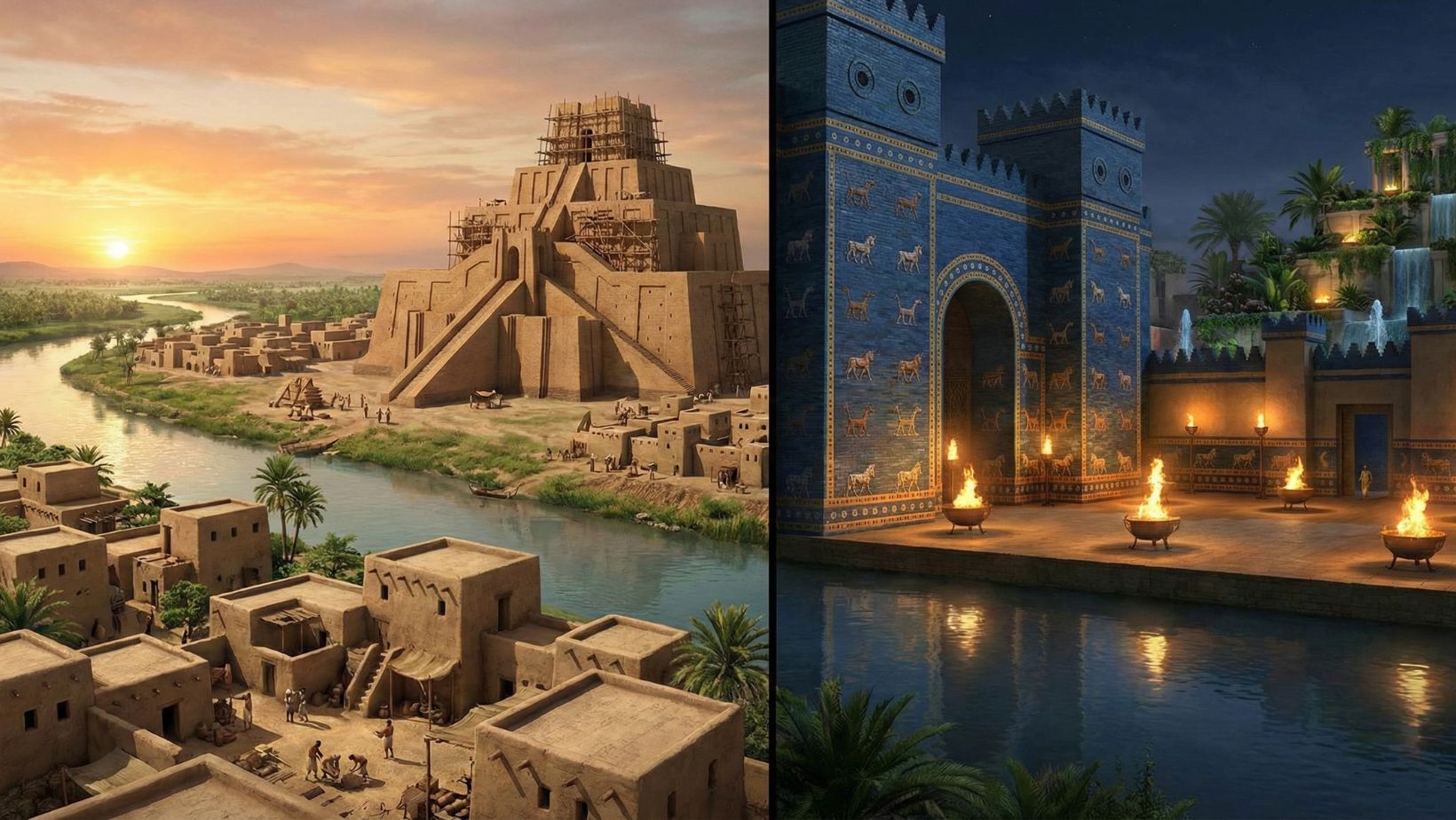
Mesopotamia is widely recognized by historians and theologians alike as the “Cradle of Civilization.” In the biblical narrative, it is the primary stage for the opening chapters of human history and the closing chapters of the Kingdom of Judah. It is the land of beginnings—hosting the Garden of Eden, the first cities, and the Tower of Babel—and the land of exile, where Daniel prophesied and Ezekiel saw visions of God’s glory. Geographically defined by the Tigris and Euphrates rivers, this region birthed the empires of Assyria and Babylon, serving as the instrument of God’s judgment and the origin point of the Patriarch Abraham.
Quick Facts
- Name: Mesopotamia (Greek: Mesopotamia; Hebrew: Aram-Naharaim or Shinar)
- Location: Modern-day Iraq, eastern Syria, and southeastern Turkey
- Rivers: The Tigris (Hiddekel) and the Euphrates (Perat)
- Biblical Origin: Settled by descendants of Noah after the Flood (Genesis 11:2)
- Key Empires: Sumer, Akkad, Assyria, Babylon, Persia
- Key Cities: Ur, Babylon, Nineveh, Haran, Erech (Uruk)
- Major Deities: Marduk (Babylon), Ashur (Assyria), Nanna/Sin (Moon god of Ur)
- Key Events: Creation, The Flood, Tower of Babel, Call of Abraham, The Exile
- Symbolism: Human origin, rebellion (Babel), judgment, and future restoration
Name Meaning
Mesopotamia: Derived from the Greek words mesos (middle) and potamos (river), literally meaning “The Land Between the Rivers.”
Shinar: The Hebrew term often used in Genesis to refer to the southern alluvial plain of Babylonia (Sumer/Akkad).
Aram-Naharaim: Hebrew for “Aram of the Two Rivers,” referring to the northern region (Upper Mesopotamia) associated with Abraham’s family in Haran.
Lineage / Origins
Ancestry: Following the Great Flood, the Ark rested in the mountains of Ararat (north of Mesopotamia). Humanity migrated down to the plain of Shinar. The region is primarily associated with the lineage of Shem (Semites) and Ham (Nimrod).
Founder: The Bible credits Nimrod, a descendant of Ham, as the first “mighty one” on earth who established the first kingdom in Shinar, including the cities of Babel, Erech, and Accad (Genesis 10:8–10).
Biblical Era / Context
Time: Covers the entire Old Testament span, from the pre-historic events of Genesis 1–11 to the post-exilic return under Persian rule (Ezra/Nehemiah).
Setting: A flat, fertile plain that required irrigation canals to farm. Lacking stone and timber, they built with mud bricks and bitumen (tar), a detail accurately recorded in the Tower of Babel account (Genesis 11:3).
Cultural Context: The birthplace of writing (cuneiform), astronomy, mathematics, and codified law. It was a highly urbanized society compared to the nomadic lifestyle of the early Hebrew patriarchs.
Major Roles / Identity
The Cradle: The location of the Garden of Eden (Genesis 2:10–14 lists the Tigris and Euphrates).
The Testing Ground: The site of the Tower of Babel, representing the first organized human rebellion against God’s command to disperse.
The Ancestral Home: Abraham and Sarah were called out of this sophisticated, idolatrous culture (Ur of the Chaldeans) to walk by faith in Canaan.
The Rod of Anger: Later Mesopotamian empires (Assyria and Babylon) were used by God to discipline Israel and Judah for their idolatry.
Key Characteristics
Fertility: The silt from the rivers made the land incredibly productive, supporting massive populations.
Polytheism: The region was saturated with pantheons of gods. Cities often had a patron deity and a massive temple tower called a Ziggurat (likely the architectural style of the Tower of Babel).
Imperialism: Unlike the tribal structure of early Israel, Mesopotamia gave rise to the world’s first true empires, seeking to conquer and assimilate surrounding nations.
Main Historical Events in Scripture
The Garden of Eden: God plants a garden in the east, sourced by a river dividing into the Tigris and Euphrates (Genesis 2).
The Tower of Babel: Humanity gathers in the plain of Shinar to build a tower to the heavens; God confuses their languages (Genesis 11).
The Call of Abraham: God calls Abram from Ur (southern Mesopotamia) to Haran (northern Mesopotamia) and finally to Canaan (Genesis 11–12).
The Assyrian Captivity: The Northern Kingdom of Israel is conquered and exiled by the Assyrian Empire (centered in Nineveh) in 722 BCE (2 Kings 17).
The Babylonian Captivity: The Southern Kingdom of Judah is taken into exile by Nebuchadnezzar (centered in Babylon) starting in 605 BCE (2 Kings 25).
The Writing on the Wall: Belshazzar sees the hand of God, marking the end of Babylonian rule and the rise of the Medes and Persians (Daniel 5).
Major Relationships
Israel: Mesopotamia is the “womb” from which Israel came (Abraham) and the “grave” to which they were sent in judgment (Exile).
Egypt: The geopolitical rival. Israel was often caught in the middle of the power struggle between the Mesopotamian powers of the North/East and the Egyptian power of the South.
Daniel & Ezekiel: Prophets who ministered inside Mesopotamia, demonstrating that Yahweh’s glory was not tied to the soil of Israel but could be found by the River Chebar (Ezekiel 1).
Notable Passages
Genesis 11:4: The hubris of Shinar — “Come, let us build ourselves a city, with a tower that reaches to the heavens, so that we may make a name for ourselves.”
Acts 7:2: Stephen’s speech — “The God of glory appeared to our father Abraham while he was still in Mesopotamia, before he lived in Haran.”
Psalm 137:1: The lament of the exiles — “By the rivers of Babylon we sat and wept when we remembered Zion.”
Jeremiah 50:18: Judgment on the empires — “I will punish the king of Babylon and his land as I punished the king of Assyria.”
Legacy & Impact
Legal Traditions: The Code of Hammurabi (a Mesopotamian king) shares structural similarities with the Mosaic Law, though the Mosaic Law is distinct in its moral focus and protection of the weak.
Creation Parallels: Mesopotamian texts like the Enuma Elish and the Epic of Gilgamesh contain flood and creation accounts that parallel Genesis, highlighting the shared historical memory of the ancient world.
The “World” System: In the New Testament (Revelation), “Babylon” (the jewel of Mesopotamia) becomes the ultimate symbol of the anti-God world system.
Extra-Biblical References
The Epic of Gilgamesh: An ancient epic from Uruk containing a flood narrative with striking similarities to Noah’s flood.
Sennacherib’s Prism: A clay prism from Nineveh detailing the Assyrian king’s siege of Jerusalem, confirming the biblical account of Hezekiah (though spinning the outcome).
The Ishtar Gate: The reconstructed gate of Babylon (now in Berlin) gives us a glimpse of the splendor Daniel would have witnessed.







Leave a Reply