
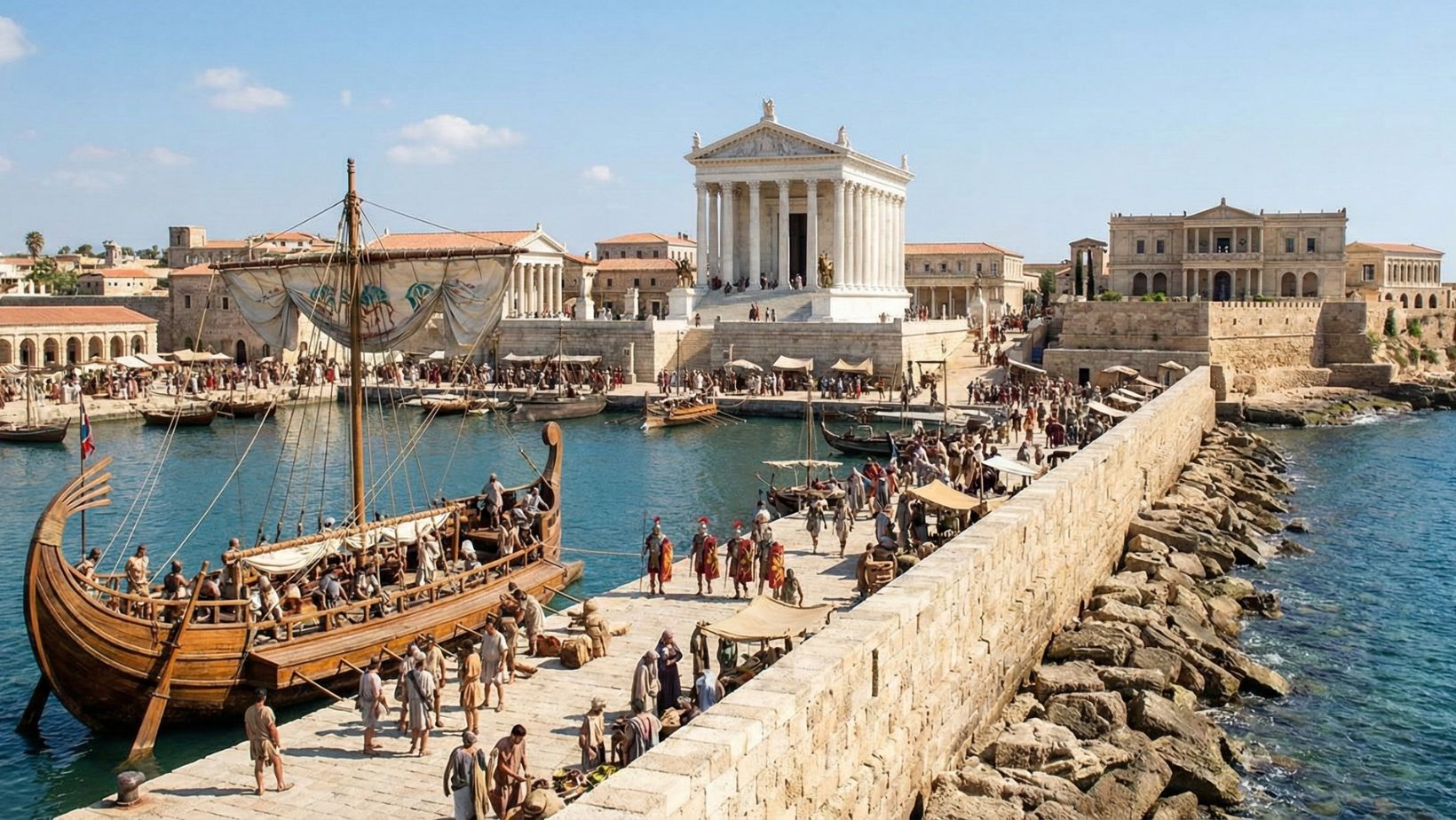
Caesarea Maritima (distinct from Caesarea Philippi) was the magnificent, Roman-built capital of Judea, serving as the bridge between the Jewish world and the Roman Empire. Constructed by Herod the Great on the Mediterranean coast, it was an engineering marvel featuring a deep-sea harbor, palaces, hippodromes, and aqueducts. In the New Testament, Caesarea is pivotal as the birthplace of the Gentile mission—it was here that the Holy Spirit first fell upon non-Jews (Cornelius and his household). It also served as the prison where the Apostle Paul was held for two years, making his defense before governors and kings before sailing to Rome.
Quick Facts
- Name: Caesarea Maritima (named in honor of Caesar Augustus)
- Location: Mediterranean coast of Israel, about 30 miles north of Joppa (Tel Aviv)
- Builder: Herod the Great (built c. 22–10 BCE)
- Status: The Roman administrative capital of the province of Judea
- Key Architecture: The artificial harbor (Sebastos), Roman Theater, Hippodrome, Aqueduct
- Key Events: Baptism of Cornelius, Death of Herod Agrippa I, Paul’s Imprisonment
- Key Residents: Pontius Pilate, Philip the Evangelist, Cornelius the Centurion
- Significance: The door through which the Gospel went to the Gentiles
Name Meaning
Caesarea: Named explicitly to honor Caesar Augustus, the Roman Emperor who gave Herod the land. The harbor was named Sebastos (the Greek form of Augustus).
Note: It is often called “Caesarea Maritima” (Caesarea by the Sea) to distinguish it from “Caesarea Philippi,” which is inland at the base of Mt. Hermon.
Lineage / Origins
Founder: Herod the Great transformed a small Phoenician station called “Strato’s Tower” into a world-class Greco-Roman city.
Engineering Feat: Herod used hydraulic concrete (pozzolana) imported from Italy to build massive breakwaters underwater—a technological masterpiece of the ancient world that allowed large ships to dock where no natural harbor existed.
Biblical Era / Context
Time: The city dominates the narrative of the Book of Acts (c. 30–62 AD).
Setting: A thoroughly pagan, Romanized city on the edge of the Holy Land. It had temples to Rome and Augustus, contrasting sharply with the Jewish Jerusalem in the hills.
Political Hub: This was the official residence of the Roman Prefects/Procurators (including Pontius Pilate and Felix). They would only travel to Jerusalem during major Jewish festivals to keep the peace.
Major Roles / Identity
The Gentile Doorway: It was in Caesarea that Peter baptized the Roman Centurion Cornelius, marking the official opening of the Church to Gentiles (Acts 10).
The Administrative Center: It was the seat of Roman military and political power in the region. When Paul was arrested in Jerusalem, he was transferred to Caesarea for safety and trial because that is where the Governor lived.
The Home Base: Philip the Evangelist settled here (Acts 8:40) and raised four prophetess daughters, hosting Paul on his journeys.
Key Characteristics
Cosmopolitan: A melting pot of Jews, Greeks, Romans, and Samaritans, often leading to ethnic tensions (which eventually sparked the Great Jewish Revolt in 66 AD).
Luxury: The city featured a hippodrome for chariot races, a theater for plays (which still stands today), and a palace with a freshwater swimming pool on a promontory jutting into the sea.
Water Supply: Since there were no rivers nearby, Herod built a dual aqueduct system bringing water from springs at the foot of Mount Carmel, over 6 miles away.
Main Historical Events in Scripture
Philip’s Arrival: After baptizing the Ethiopian Eunuch, Philip preached his way up the coast and settled in Caesarea (Acts 8:40).
Conversion of Cornelius: Peter receives a vision in Joppa, then travels up the coast to Caesarea to meet Cornelius, a “God-fearing” Roman centurion. The Holy Spirit falls on the Gentiles, shocking the Jewish believers (Acts 10).
The Death of Herod Agrippa I: In the theater of Caesarea, Herod Agrippa dressed in a shining silver robe and accepted the crowd’s praise as a god. He was immediately struck down by an angel and “eaten by worms” (Acts 12:19–23). Josephus (Jewish historian) confirms this account in detail.
Paul’s Trials: Paul was imprisoned here for two years under governors Felix and Festus. He delivered his famous defense before King Agrippa II (“Paul, you are out of your mind! Your great learning is driving you mad!”), eventually appealing to Caesar (Acts 23–26).
Agabus’ Prophecy: The prophet Agabus came to Caesarea, took Paul’s belt, and bound his own hands and feet, warning Paul of his coming arrest in Jerusalem (Acts 21:10–11).
Major Relationships
Peter & Cornelius: The meeting that changed history—a Jewish fisherman and a Roman soldier finding unity in Christ.
Paul & The Governors: Paul had to navigate the corrupt Roman legal system here, interacting with Felix (who wanted a bribe), Festus (who wanted to please the Jews), and Agrippa (who was intrigued but cynical).
Pontius Pilate: Archaeology confirms Pilate lived here. The “Pilate Stone,” discovered in the theater in 1961, is the only physical archaeological evidence of Pilate’s existence and title.
Notable Passages
Acts 10:34: Peter at Cornelius’ house: “I now realize how true it is that God does not show favoritism but accepts from every nation the one who fears him and does what is right.”
Acts 26:28: Agrippa to Paul: “Do you think that in such a short time you can persuade me to be a Christian?”
Acts 12:21–23: The judgment of Herod: “Immediately, because Herod did not give praise to God, an angel of the Lord struck him down…”
Legacy & Impact
The Pilate Stone: A limestone block found reused in the theater stairs bears the inscription “Pontius Pilate, Prefect of Judea,” validating the biblical record.
Eusebius: The great early church historian (c. 300 AD) was the Bishop of Caesarea. His library there was one of the greatest in the ancient world.
Origen: The famous theologian established a school in Caesarea, producing the Hexapla (a massive comparative Bible edition).
Symbolism / Typology
The Bridge: Caesarea represents the interface between the Law (Jerusalem) and the World (Rome). It is the place where the gospel “translated” from a Jewish sect to a global faith.
Human Glory vs. Divine Glory: The contrast between Herod the Great’s engineering triumph and Herod Agrippa’s gruesome death highlights the fragility of human power when it ignores God.







Leave a Reply