
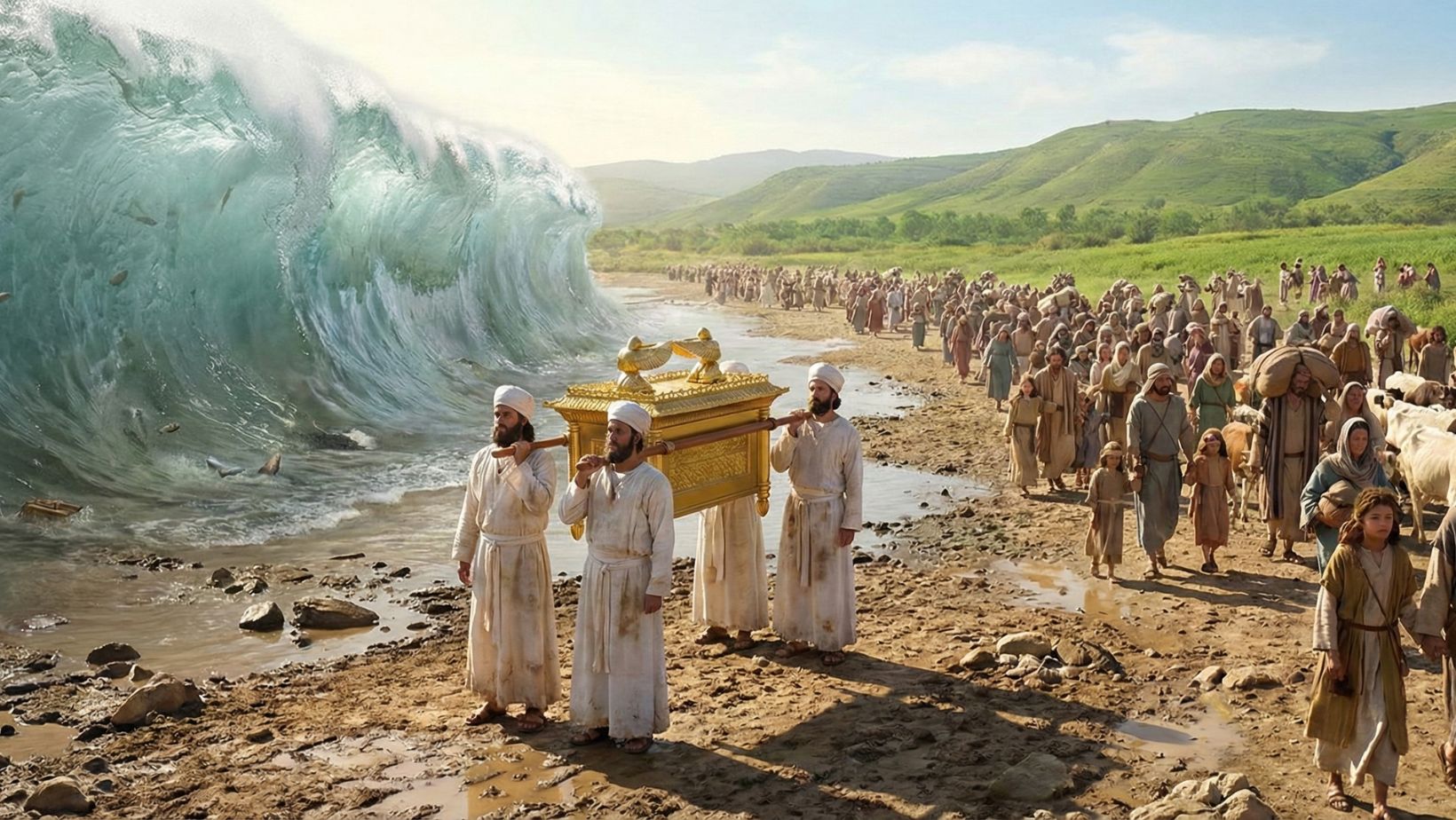
The Crossing of the Jordan River is a pivotal miraculous event in Israelite history, marking the official end of the forty-year wilderness wandering and the beginning of the conquest of Canaan. Under Joshua’s leadership, God parted the flooding river waters, allowing the nation to cross on dry ground—a miracle explicitly designed to exalt Joshua in the sight of Israel, just as the Red Sea crossing had exalted Moses. This event demonstrated God’s power over nature, His faithfulness to the Abrahamic covenant, and His presence among His people through the Ark of the Covenant.
Quick Facts
- Event: Miraculous parting of the Jordan River
- Scripture: Joshua Chapters 3 and 4
- Location: The Jordan River, opposite Jericho (waters stopped at Adam)
- Time: Spring (Harvest time/flood stage), 10th day of the 1st month (Nisan)
- Key Leader: Joshua
- Central Object: The Ark of the Covenant
- Memorial: Twelve stones set up at Gilgal; twelve stones placed in the river
- Result: Israel entered the Promised Land; Canaanite kings lost heart
- Symbol: The Ark of the Covenant carried by priests into the water
Geography / Physical Setting
River State: The Bible notes the Jordan was at “flood stage” (overflowing its banks) due to the spring harvest and melting snows from Mount Hermon, making a natural crossing impossible.
Location of Miracle: The flow of water was cut off “a great distance away, at a town called Adam” (near modern Damia Bridge), approximately 15-20 miles upstream, creating a massive wall of water.
Crossing Point: The people crossed opposite Jericho, entering the plains of Moab near Shittim and arriving at Gilgal.
Biblical Context
Preceding Event: The spies return from Jericho with a report that the land’s inhabitants are melting in fear (Joshua 2).
The Command: Joshua orders the people to consecrate themselves, saying, “Tomorrow the LORD will do amazing things among you” (Joshua 3:5).
Succeeding Event: The Israelites camp at Gilgal, circumcise the new generation, celebrate the Passover, and the manna ceases (Joshua 5).
Sequence of Events
The Approach: The officers commanded the people to follow the Ark of the Covenant, maintaining a distance of about 2,000 cubits (roughly half a mile) so they could see the path.
The Step of Faith: Unlike the Red Sea (which parted before they entered), the Jordan only parted after the priests carrying the Ark stepped into the brim of the water.
The Crossing: The priests stood firm on dry ground in the middle of the riverbed while the entire nation passed through.
The Memorials: Twelve men (one from each tribe) took twelve stones from the middle of the river to build a memorial at Gilgal. Joshua also set up twelve stones in the middle of the river where the priests stood.
The Return: When the priests carrying the Ark came up out of the river, the waters immediately returned to their flood stage.
Key Figures & Roles
Joshua: Exercised faith and command; God used this event to “exalt him” so Israel would revere him as they did Moses.
The Priests: Demonstrated immense courage and physical endurance, standing still with the heavy Ark in the riverbed until the entire nation crossed.
The Twelve Men: Chosen representatives who carried the memorial stones on their shoulders.
The Canaanite Kings: Upon hearing the news, their “hearts melted” and they lost the spirit to fight (Joshua 5:1).
Key Themes & Virtues
Consecration: The requirement for the people to be holy before God performed the miracle.
Obedience: The detailed adherence to specific instructions regarding the Ark and the order of march.
Memory/Legacy: The establishment of the stone memorial so future generations would ask, “What do these stones mean?”
Divine Presence: The Ark going first symbolized God leading His people into the unknown and clearing the way.
Notable Passages
Joshua 3:5: “Consecrate yourselves, for tomorrow the LORD will do amazing things among you.”
Joshua 3:13: “And as soon as the priests who carry the ark of the LORD—the Lord of all the earth—set foot in the Jordan, its waters flowing downstream will be cut off and stand up in a heap.”
Joshua 4:24: “He did this so that all the peoples of the earth might know that the hand of the LORD is powerful and so that you might always fear the LORD your God.”
Symbolism / Typology
Death and Resurrection: Descending into the river bed (symbolizing death/chaos) and ascending out to the Promised Land serves as a type of baptism (Romans 6:4).
The Believer’s Victory: Just as the Red Sea represents salvation from the penalty of sin (Egypt), the Jordan represents the believer’s crossing into the victorious, Spirit-filled life (Canaan), leaving the flesh behind.
Christ the Forerunner: The Ark (God’s presence) entering the waters of judgment first parallels Jesus entering death to make a safe path for us to follow.
The Stones: A physical reminder that faith requires memory; we must remember past deliverances to face future battles.







Leave a Reply