
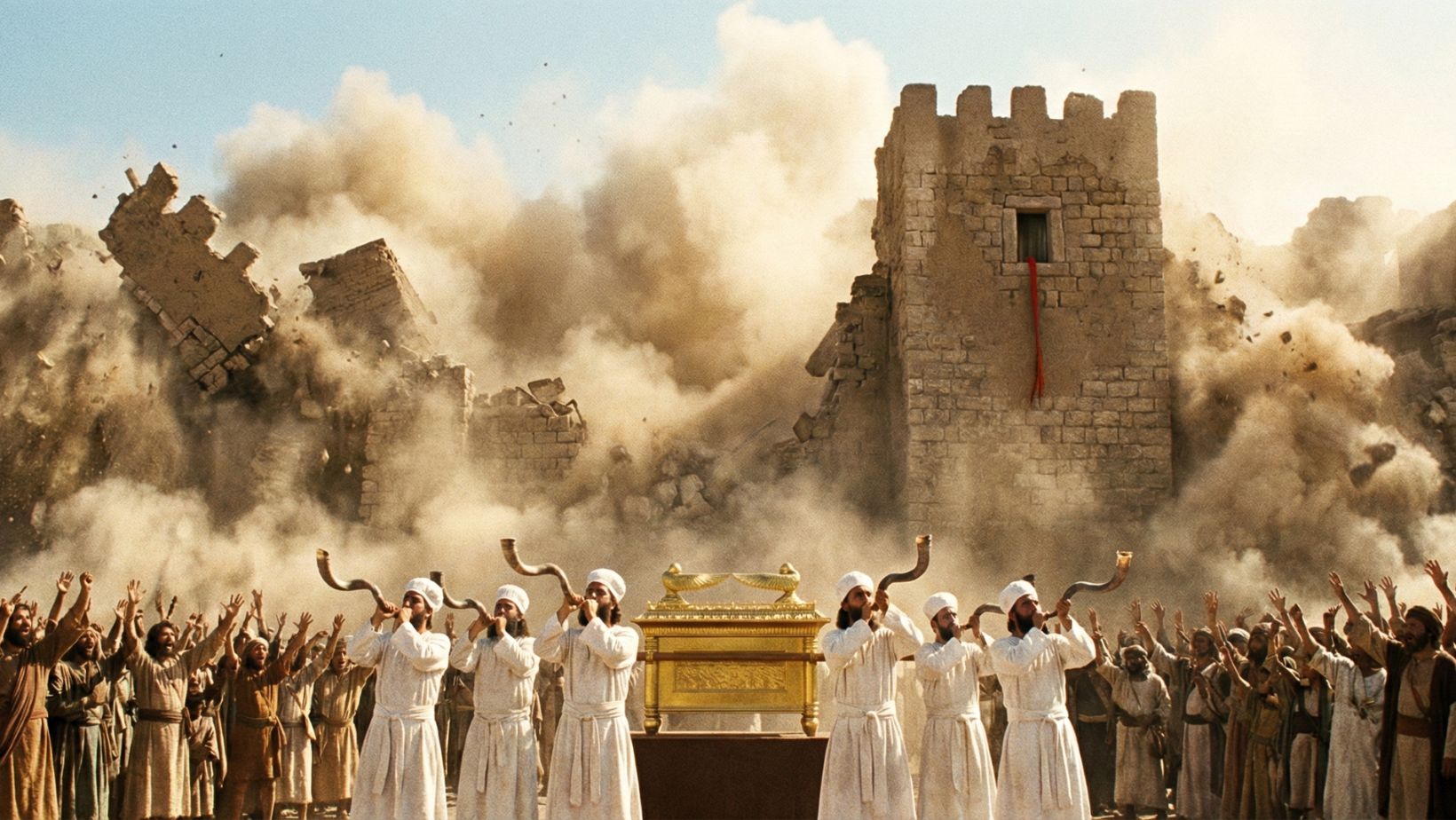
The Fall of Jericho is the first major battle of the Israelite conquest of Canaan, distinguished not by military strategy but by a miraculous display of divine power. Following the crossing of the Jordan, the Israelites faced Jericho, a heavily fortified city that stood as the gateway to the Promised Land. Instead of a siege ramp or battering rams, God commanded a liturgical procession—seven days of silent marching with the Ark of the Covenant, culminating in a blast of trumpets and a great shout that caused the massive stone walls to collapse instantly. This event established that the conquest would be won by faith and obedience to Yahweh, not by human strength.
Quick Facts
- Event: The miraculous destruction of Jericho’s walls
- Scripture: The Book of Joshua, Chapter 6
- Location: Jericho (Tell es-Sultan), near the Jordan River
- Time: Shortly after the Passover, ~1406 BCE (Early Date) or ~1200s BCE
- Leader: Joshua
- Key Weapon: The Ark of the Covenant and Shofars (Ram’s Horns)
- Survivor: Rahab and her family
- Outcome: Total destruction of the city; walls fell flat
- Theological Rule: Herem (The Ban) — the city was devoted to destruction as a firstfruit offering
Biblical Context
The Obstacle: Jericho was a formidable, walled city described as “tightly shut up” that controlled the routes into the hill country. It represented the first great test of Israel’s faith in Canaan.
The Commander: Before the battle, Joshua encountered the “Commander of the Army of the Lord,” who reminded him that this was God’s battle, not Israel’s.
The Purpose: As the “firstfruits” of the land, Jericho was to be completely dedicated to God. No plunder was allowed for the soldiers; the city was to be burned, and the valuables put into the Lord’s treasury.
The Divine Strategy
God gave Joshua specific, unorthodox instructions that tested the patience and discipline of the army:
The Formation: Armed men led the way, followed by seven priests blowing shofars (ram’s horns), then the Ark of the Covenant, and finally the rear guard.
The Silence: For six days, the people were commanded to march in total silence—no war cry, no talking—only the sound of the trumpets and marching feet.
The Number Seven: The strategy revolved around the number seven (7 priests, 7 trumpets, 7 days, 7 circuits on the final day), symbolizing divine completeness and perfection.
Sequence of Events
Days 1–6: The army marched around the city once each day in silence, then returned to camp. This likely unnerved the inhabitants of Jericho, who watched from the walls.
Day 7: The army rose at dawn and marched around the city seven times.
The Climax: On the seventh circuit, the priests gave a long blast on the shofars. Joshua commanded, “Shout! For the Lord has given you the city!”
The Miracle: The massive walls fell down flat (literally “fell under themselves”), allowing every soldier to charge straight in and take the city.
Key Figures & Roles
Joshua: Demonstrated absolute authority and faith, enforcing silence and strict obedience upon a nation unused to warfare.
The Priests: Acted as the primary “strikeforce,” using spiritual weapons (the Ark and horns) rather than swords to breach the defenses.
Rahab: The Canaanite prostitute who had hidden the Israelite spies. Because of her faith and the scarlet cord tied in her window, her section of the wall famously did not fall, and she and her family were rescued.
Achan: An Israelite soldier who secretly stole a robe, silver, and gold, violating the “ban” and bringing disaster upon Israel in the subsequent battle at Ai.
Archaeological Context
Tell es-Sultan: Excavations at the site of ancient Jericho have revealed a collapsed mudbrick wall that fell outward, creating a natural ramp against the lower stone retaining wall.
The Burn Layer: Archaeologists found a heavy layer of ash and debris, consistent with the biblical account that the Israelites burned the whole city and everything in it.
Unlooted Grain: Large jars full of charred grain were found, indicating the city fell quickly (not a long starvation siege) and that the grain was not looted, aligning with the command not to take plunder.
Legacy & Spiritual Significance
Faith over Sight: The New Testament notes that “by faith the walls of Jericho fell.” The victory came through trusting God’s illogical plan.
The Power of Worship: The presence of the Ark and the blowing of shofars turned the battlefield into a sanctuary, signaling that God holds sovereign title over the land.
Grace for the Outsider: The salvation of Rahab proves that God’s judgment is not arbitrary; anyone who fears Him—even a Canaanite prostitute—can be saved and grafted into His people.
The Curse: Joshua pronounced a curse on anyone who would rebuild Jericho as a fortified city, a prophecy grimly fulfilled centuries later by Hiel of Bethel.







Leave a Reply