
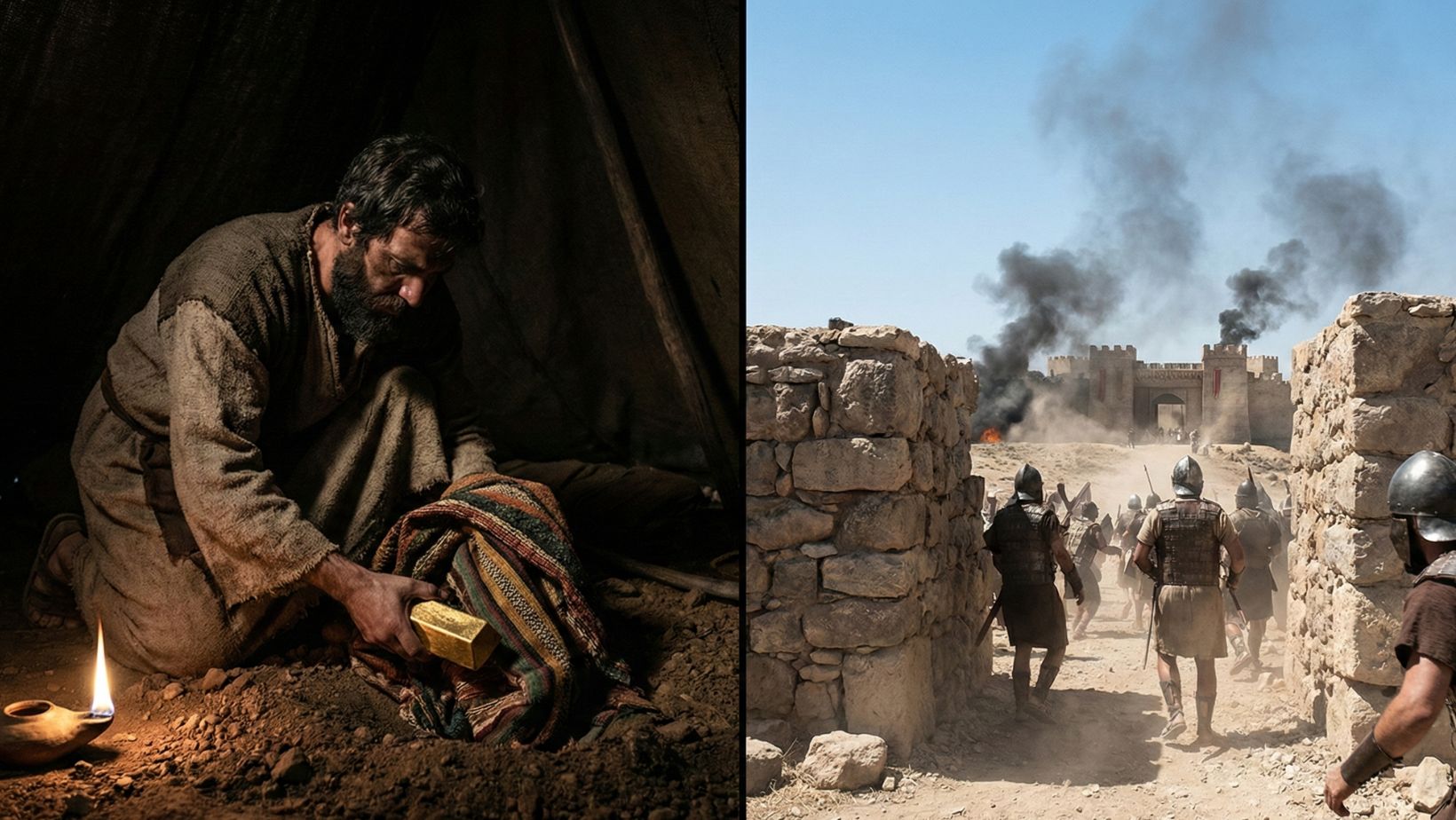
The narrative of Achan’s sin and the subsequent conquest of Ai is a pivotal moment in the Israelites’ journey into the Promised Land, marking the stark contrast between the consequences of disobedience and the blessing of obedience. Recorded in Joshua 7 and 8, this account follows immediately after the miraculous victory at Jericho. It serves as a sobering reminder that God’s covenant required absolute holiness and that the private sin of one individual could have catastrophic corporate consequences for the entire nation. The story moves from tragedy and defeat in the Valley of Achor to strategic military triumph and covenant renewal at Ai.
- Event: The Sin of Achan & The Conquest of Ai
- Scripture Reference: Joshua 7–8
- Date: ~1400 BCE (Early Conquest Period)
- Key Characters: Achan, Joshua, Phinehas (Priest), King of Ai
- Locations: Jericho, Ai (near Beth Aven), Valley of Achor
- The Stolen Items: A Babylonian robe, 200 shekels of silver, a 50-shekel bar of gold
- Casualties: 36 Israelite soldiers (in the first battle)
- Key Theme: The severity of hidden sin and the restoration of God’s favor
- Legacy: Establishment of the “Valley of Achor” (Valley of Trouble)
Name Meanings and Significance
Achan: His name (Hebrew: Achan) is closely related to the word achar, meaning “trouble” or “troubler.” In 1 Chronicles 2:7, he is actually referred to as “Achar, the troubler of Israel.”
Valley of Achor: Named after Achan’s judgment, this means “Valley of Trouble.” However, in later prophetic literature (Hosea 2:15), it is prophesied to become a “door of hope,” symbolizing how God can redeem even the most shameful failures.
Ai: The name means “The Ruin” or “Heap of Ruins.”
Historical & Biblical Context
The Ban (Herem): God had placed a specific command on the city of Jericho: it was “devoted to destruction” (herem). All living things were to be killed, and all spoils (gold, silver, bronze, iron) were to be consecrated to the Lord’s treasury. Taking these items was not just theft; it was a sacrilegious violation of God’s holiness.
Military Overconfidence: Following the massive victory at Jericho, the Israelites were confident. Spies reported that Ai was small and required only a few thousand men to conquer. They neglected to consult the Lord seriously and relied on military estimates rather than divine guidance.
The Sin of Achan (The Tragedy)
The Covetous Act: During the fall of Jericho, while the rest of Israel obeyed the command to destroy the city, Achan saw a beautiful robe from Shinar (Babylon), along with silver and gold. Overcome by covetousness, he took them and buried them inside his tent.
The Defeat at Ai: Unaware of the sin, Joshua sent about 3,000 men to attack Ai. The men of Ai routed the Israelites, chasing them from the city gate and killing about 36 soldiers. The hearts of the Israelites “melted and became like water.”
The Investigation: Joshua tore his clothes and fell facedown before the Ark of the Covenant. God revealed that Israel had sinned. through a process of casting lots (likely using the Urim and Thummim), the tribe of Judah was taken, then the clan of the Zerahites, then the family of Zimri, and finally Achan.
The Confession and Judgment: Achan confessed, saying, “It is true! I have sinned against the Lord.” The stolen items were recovered from his tent. To purge the sin from the community, Achan and his family (who likely knew of the hidden loot) were stoned and burned in the Valley of Achor.
The Conquest of Ai (The Victory)
Divine Restoration: Once the sin was dealt with, God’s presence returned. He told Joshua, “Do not be afraid; do not be discouraged.” This time, God allowed them to keep the plunder of Ai for themselves—meaning if Achan had waited just one more battle, he could have had wealth legitimately.
The Strategy (The Ambush): God gave Joshua a specific military stratagem, distinct from the miracle at Jericho.
- The Decoy: Joshua took the main army and approached the city openly.
- The Ambush: He hid a select force (30,000 or 5,000 men, depending on the text section) behind the city to the west.
- The Feigned Retreat: When the King of Ai saw Joshua’s main force, he emptied the city to pursue them, thinking they were fleeing as before.
- The Trap: Once the city was empty, Joshua signaled with his javelin. The ambush force entered the city, set it on fire, and the army of Ai was trapped between the two Israelite forces.
Key Lessons & Themes
Corporate Solidarity: The text says, “Israel has sinned” (Joshua 7:11), even though only Achan took the items. In the biblical worldview, the sin of the individual affects the health of the entire community. One person’s disobedience can hinder the blessing of the whole group.
The Progression of Sin: Achan’s confession outlines the classic steps of sin: “I saw… I coveted… I took… I hid” (Joshua 7:21). This mirrors the fall of Eve in Genesis 3 and serves as a warning against the lust of the eyes.
God’s Omniscience: Achan believed he could hide his sin in the ground, but nothing is hidden from God. The casting of lots demonstrates that God can pinpoint sin with terrifying accuracy.
Restoration through Repentance: Victory was only possible after the sin was exposed and judged. The story teaches that spiritual defeat often requires self-examination and repentance before progress can continue.
Typology & Symbolism
Achan vs. Jesus: Achan represents the “old man” or Adam, whose disobedience brings death to many. He hid a “Babylonian garment,” symbolizing the allure of the world system. Jesus represents the obedient Son who, rather than hiding sin, exposes it and pays the price to restore the community.
The Valley of Achor: In Hosea 2:15, God promises that the Valley of Achor will be a “door of hope.” This prefigures the Gospel: the very place of our greatest trouble and judgment becomes the entry point for hope when we deal with our sin honestly before God.







Leave a Reply