
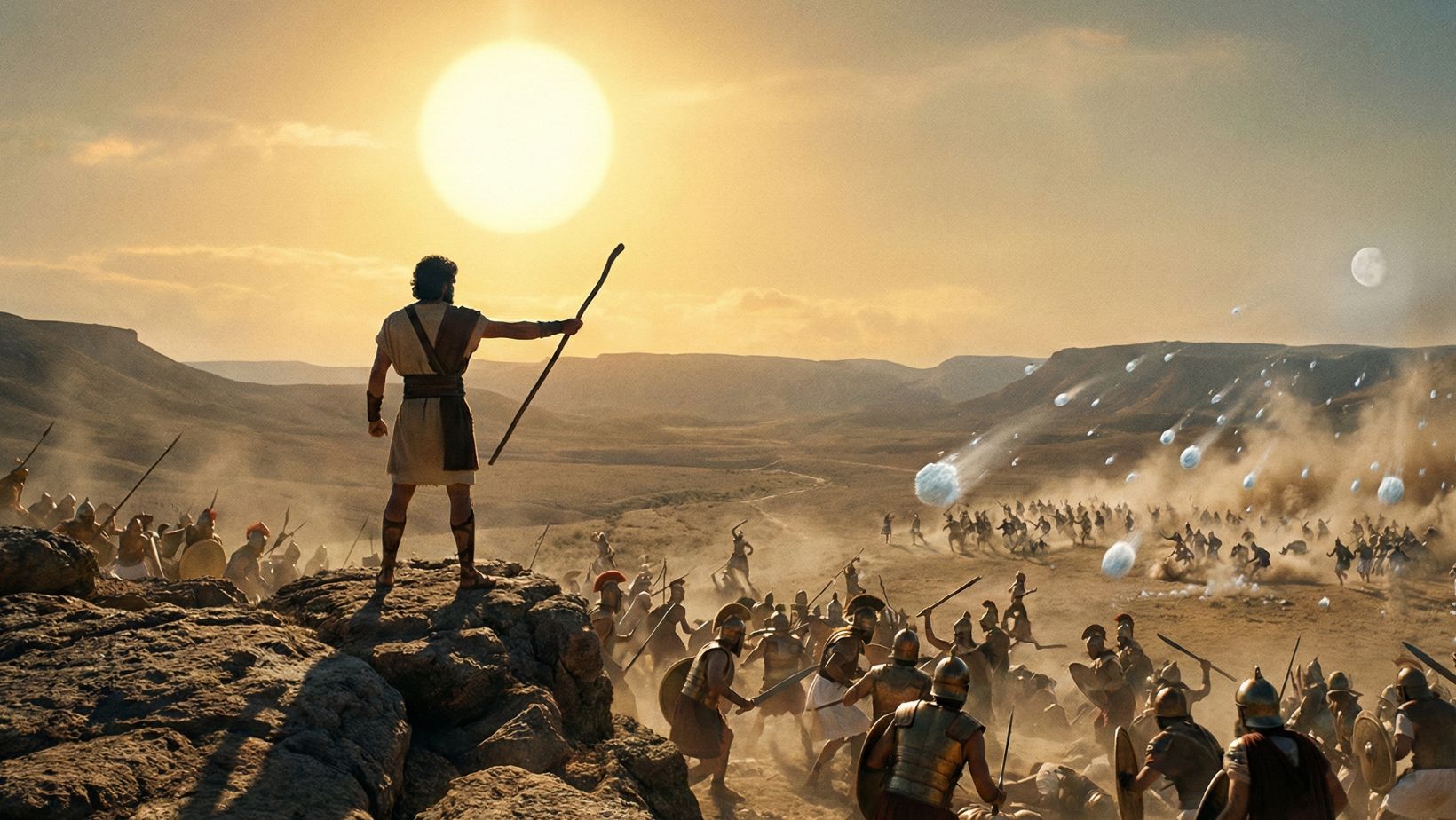
The miracle of the sun standing still is one of the most astonishing and debated events in the Old Testament, recorded in Joshua 10. It occurs during a pivotal battle where Joshua honors his covenant with the Gibeonites by defending them against a coalition of five Amorite kings. In the heat of battle, realizing he needed more daylight to secure a total victory, Joshua prayed a bold prayer. God responded by halting the celestial bodies, demonstrating His supreme authority over creation and fighting directly for His people.
- Event: The Sun Stands Still
- Scripture Reference: Joshua 10:1–15
- Date: ~1400 BCE (Conquest Era)
- Key Characters: Joshua, The Five Amorite Kings (Adoni-Zedek leading), The Army of Israel
- Location: Gibeon (sunrise) and the Valley of Aijalon (moonset)
- The Miracle: The sun stopped in the sky for “about a full day”
- Secondary Miracle: Huge hailstones killed more enemies than the sword
- Key Verse: “There has never been a day like it before or since, a day when the LORD listened to a human being. Surely the LORD was fighting for Israel.” (Joshua 10:14)
Historical & Biblical Context
The Amorite Coalition: Following the Gibeonite treaty, Adoni-Zedek, the King of Jerusalem, was alarmed. Gibeon was a large, royal city with mighty warriors. If they defected to Israel, the balance of power shifted. He formed a coalition with four other kings (Hebron, Jarmuth, Lachish, and Eglon) to attack Gibeon, intending to punish the traitors and draw Joshua into battle.
The Forced March: The Gibeonites sent a desperate plea to Joshua at Gilgal: “Do not abandon your servants.” Despite having been deceived by them earlier, Joshua honored his oath. He marched his army all night from Gilgal (an ascent of about 4,000 feet over 20 miles) to launch a surprise dawn attack.
The Battle & The Miracles
The Surprise Attack: The sudden appearance of Israel stunned the Amorite coalition. The Lord threw them into confusion, and Israel defeated them at Gibeon.
The Hailstones: As the enemy fled down the pass of Beth Horon, God escalated the battle. The text records that God hurled large hailstones from the sky. These stones killed more soldiers than the swords of the Israelites did, highlighting that this was a divine victory, not just a military one.
Joshua’s Prayer: As the battle raged and the sun began to dip, Joshua realized the enemy might escape in the darkness to regroup in their fortified cities. He spoke to the Lord and then declared to Israel: “Sun, stand still over Gibeon, and you, moon, over the Valley of Aijalon.”
The Phenomenon: The Bible states, “The sun stopped in the middle of the sky and delayed going down about a full day.” This allowed Israel to pursue and completely destroy the Amorite coalition.
Interpretations of the Phenomenon
The nature of this miracle has been debated for centuries by theologians and scientists:
1. Literal Stoppage of Rotation: The traditional view is that God, who created the universe, miraculously paused the earth’s rotation (or the movement of the sun/moon relative to earth) without catastrophic physical effects. This emphasizes God’s omnipotence.
2. Atmospheric Refraction: Some suggest God used light refraction to make the sun appear to linger, prolonging the daylight hours.
3. Solar Eclipse/Omens: A more recent scholarly view (based on linguistic analysis of the Hebrew word dom) suggests the prayer was for the sun to “be silent” or “stop shining”—implying a solar eclipse. In ancient Near Eastern culture, an eclipse was a terrifying omen against the ruling kings. However, the text explicitly says the sun “did not hurry to set,” favoring the prolonged day interpretation.
4. Poetic Hyperbole: Some view the account as a poetic description of a day that felt incredibly long because so much was accomplished, citing the “Book of Jashar” (a lost poetic source mentioned in the text).
Regardless of the mechanics, the theological point is clear: God manipulated the natural order to secure victory for His people.
Key Lessons & Themes
The Power of Bold Prayer: Joshua didn’t ask for strength; he asked for the universe to pause. This encourages believers to pray big, audacious prayers when they align with God’s will.
God as the Divine Warrior: The text emphasizes that “The Lord fought for Israel.” From the confusion of the enemy to the hailstones and the sun, the victory belonged to God.
Integrity in Leadership: Joshua risked his army and marched all night to save the Gibeonites—people who had lied to him. This shows that a righteous leader keeps their word, even when it is inconvenient.
Total Victory: The extended day ensured that the victory was complete. God is interested in the total eradication of sin and opposition, not partial measures.
Comparison / Typology
Joshua & Jesus: The name Joshua is the Hebrew form of Jesus (Yeshua). Just as Joshua defeated the enemies of God’s people and brought light to the darkness of battle, Jesus defeated sin and death, the ultimate enemies.
Light vs. Darkness: The Amorite kings relied on the cover of darkness to escape. God’s intervention forced the battle to happen in the light. This parallels the spiritual truth that evil often hides in darkness, but God’s truth exposes it (John 3:19–21).







Leave a Reply