
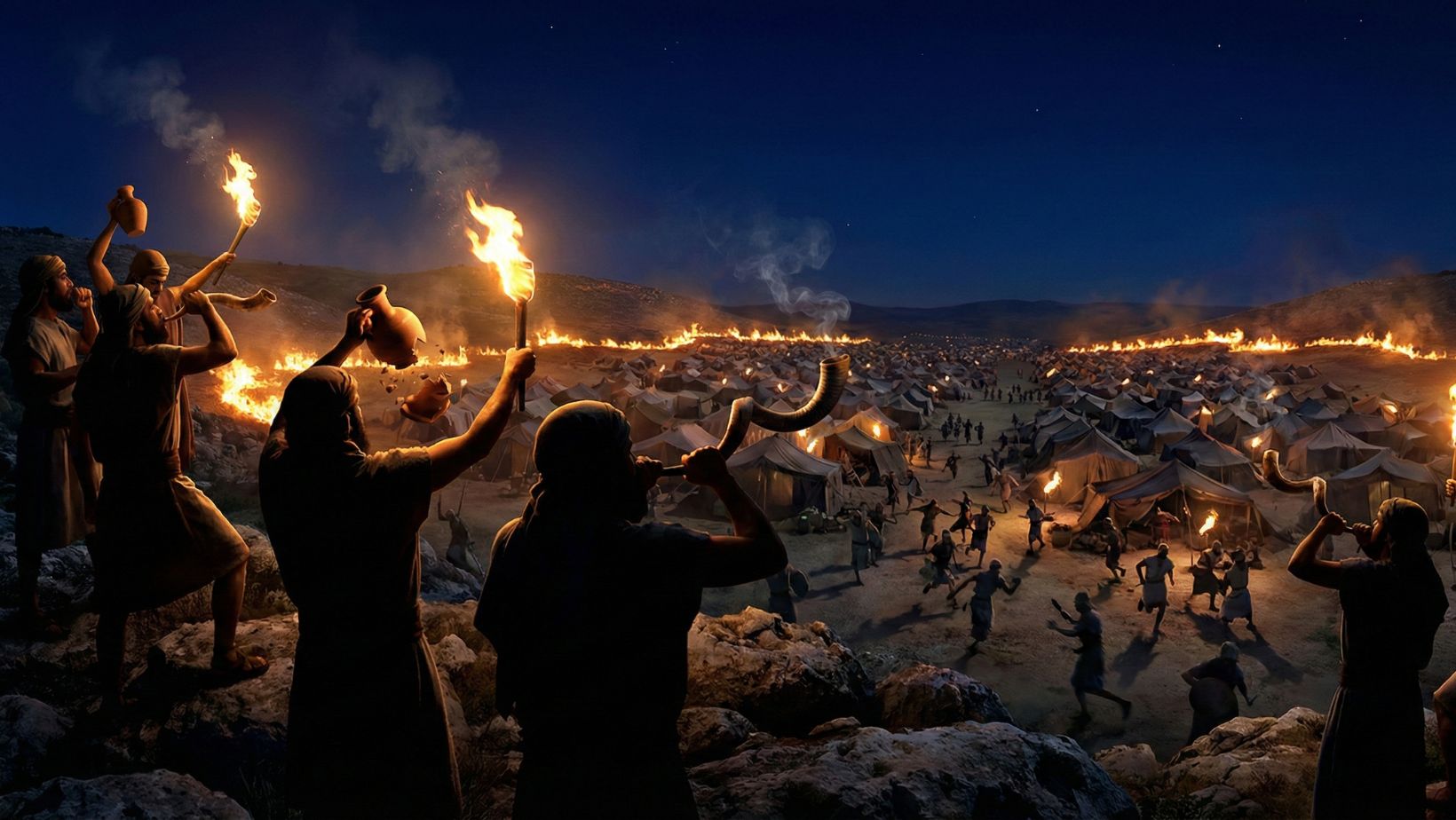
The story of Gideon and his 300 men is one of the most famous military narratives in the Bible, found in Judges 6–8. It serves as the definitive Old Testament illustration of the principle that God’s power is made perfect in weakness. Gideon, a timid man from the smallest clan in Manasseh, is called by God to liberate Israel from the oppressive Midianites. However, to ensure that Israel could not boast in its own strength, God systematically reduced Gideon’s army from 32,000 men down to a mere 300. This tiny band, armed not with swords but with trumpets, torches, and clay jars, routed a massive coalition of desert raiders through psychological warfare and divine intervention.
Quick Facts
- Leader: Gideon (also called Jerubbaal)
- Enemy: Midianites, Amalekites, and “People of the East”
- Battle Location: The Spring of Harod (Israelite camp) vs. Valley of Jezreel (Midianite camp)
- Original Army Size: 32,000 men
- Final Army Size: 300 men
- Key Weapons: Trumpets (Shofars), empty jars, torches
- Battle Cry: “A sword for the LORD and for Gideon!” (Judges 7:20)
- Outcome: Panic among the enemy, leading to self-destruction and flight
Name Meaning
“Gideon” means “Hewer” or “One who cuts down.” This proved prophetic in two ways: he cut down his father’s altar to Baal, and later cut down the Midianite army.
“Jerubbaal” is the name given to him by the townspeople, meaning “Let Baal contend with him,” after Gideon destroyed the local pagan altar.
Lineage / Context
Tribe: Manasseh (Western half). Gideon described his clan as the weakest in Manasseh and himself as the least in his family.
The Oppression: For seven years, the Midianites would invade during harvest time like “swarms of locusts,” stripping the land of crops and livestock, forcing Israelites to hide in mountain clefts and caves.
The Call: Gideon was threshing wheat in a winepress (a hole in the ground) to hide from the Midianites when the Angel of the LORD appeared to him.
The Selection of the 300
God commanded the reduction of the army to prevent Israel from claiming, “My own hand has saved me” (Judges 7:2).
1. The Fear Test: Gideon proclaimed that anyone trembling with fear should go home. 22,000 men left; 10,000 remained.
2. The Water Test: At the water’s edge, God separated the men based on how they drank.
- The Kneelers: Those who got down on their knees to drink (9,700 men) were sent home.
- The Lappers: Those who cupped water to their mouths “as a dog laps,” staying on their feet (300 men), were chosen. This posture likely indicated alertness and readiness for battle.
Major Roles / Identity
The Reluctant Warrior: Gideon frequently asked for signs (the wet and dry fleece) to confirm God’s will, showing a struggle between doubt and faith.
The Strategic Commander: Despite his initial fear, Gideon executed a brilliant night attack that utilized noise and light to simulate a massive surrounding army.
The Iconoclast: His first act of leadership was destroying the idols in his own backyard, establishing that spiritual cleansing precedes public victory.
The Battle Strategy (Judges 7)
Time: The “middle watch” of the night (just after midnight), when the enemy guards had just changed and were likely drowsy.
Formation: Gideon split the 300 men into three companies to surround the enemy camp on three sides.
Equipment: Every man held a trumpet in one hand and an empty jar with a torch inside it in the other.
Execution: At the signal, they smashed the jars (revealing the light), blew the trumpets, and shouted.
The Result: The sudden crash, the ring of fire surrounding the valley, and the noise of 300 trumpets convinced the Midianites they were surrounded by a massive legion. In the chaos, God “caused the men throughout the camp to turn on each other with their swords.”
Notable Passages
Judges 6:12: The greeting — “The LORD is with you, mighty warrior.” (Ironically spoken while Gideon was hiding).
Judges 7:2: The reason for the 300 — “The people with you are too many for Me to give the Midianites into their hand, lest Israel boast over Me, saying, ‘My own hand has saved me.’”
Judges 7:20: The attack — “They blew the trumpets and smashed the jars that were in their hands… and they cried out, ‘A sword for the LORD and for Gideon!’”
Legacy & Impact
Divine Sovereignty: The battle serves as a permanent theological reminder that numbers are irrelevant to God.
Peace: The victory resulted in 40 years of peace for Israel.
The Snare: Unfortunately, after the victory, Gideon made a golden ephod from the enemy’s plunder, which the Israelites eventually worshipped as an idol—a tragic end to a story of deliverance (Judges 8:27).
New Testament Reference: Gideon is listed in the “Hall of Faith” in Hebrews 11:32.
Symbolism / Typology
Broken Vessels: The strategy of breaking clay jars to reveal the light within is often compared to 2 Corinthians 4:7 (“We have this treasure in jars of clay”). It symbolizes that our human outer self must be broken/humbled for the light of God to shine through.
The Barley Loaf: In a dream overheard by Gideon, a round loaf of barley bread tumbled into the Midianite camp and flattened a tent. Barley was the food of the poor/livestock. This symbolized Gideon’s humble army destroying the wealthy, powerful tent-dwellers of Midian.







Leave a Reply