
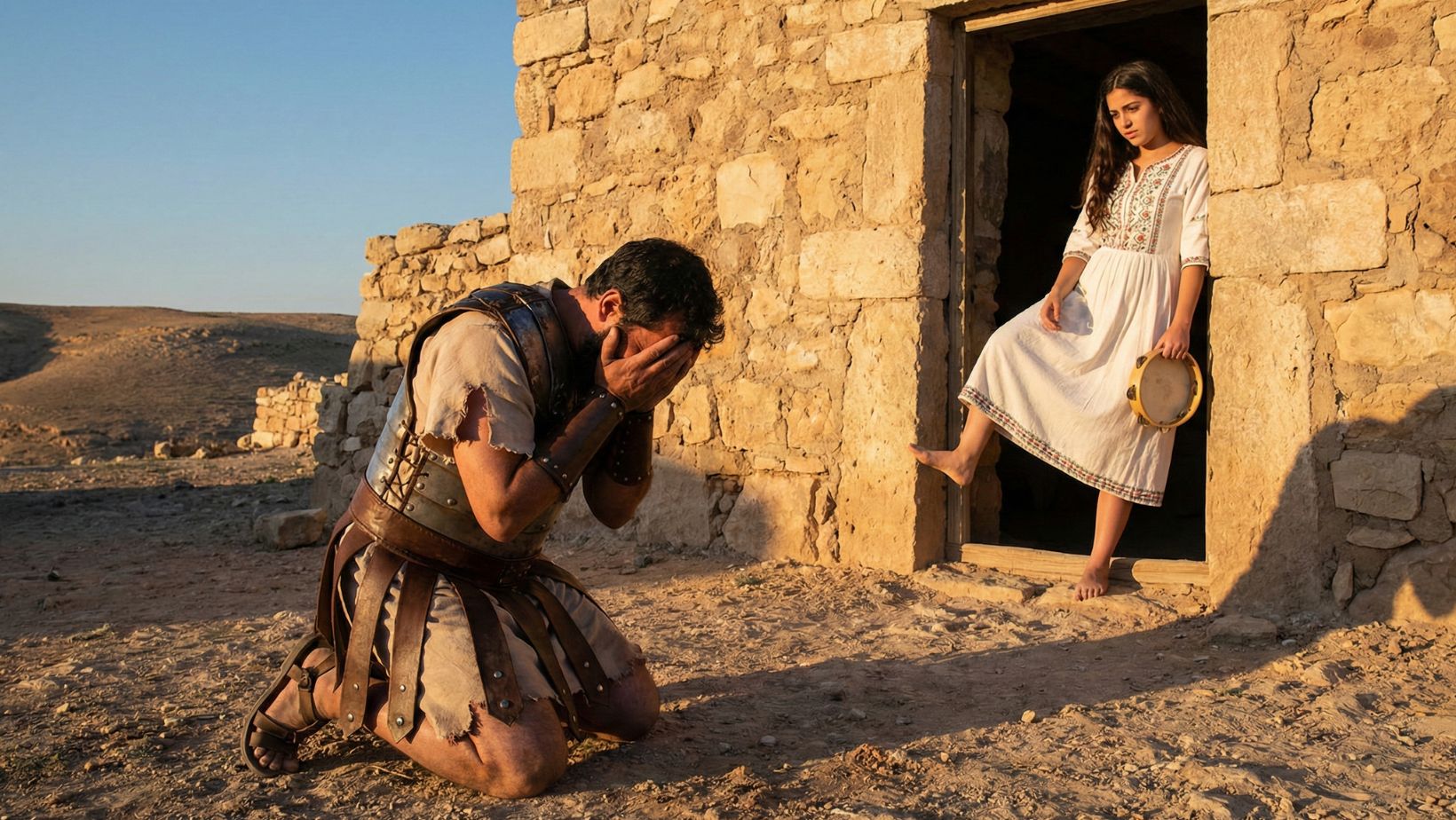
The story of Jephthah’s vow is one of the most tragic and perplexing narratives in the Old Testament (Judges 11). Jephthah was a “mighty warrior” of Gilead, but he was also an outcast—the son of a prostitute, rejected by his half-brothers. When the Ammonites threatened Israel, the elders begged Jephthah to return and lead them. In his desperation to secure a victory and perhaps prove his worth to God and his people, Jephthah made a rash, unnecessary vow that turned his military triumph into a personal catastrophe. His story serves as a sombre warning against bargaining with God and the devastating consequences of reckless speech.
Quick Facts
- Judge: Jephthah (Hebrew: Yiftach, meaning “He opens” or “He sets free”)
- Region: Gilead (East of the Jordan River)
- Enemy: The Ammonites
- Family: Son of a prostitute; father of an only child (a daughter)
- The Vow: To sacrifice “whatever comes out of the door of my house”
- The Victim: His unnamed daughter
- Key Scripture: Judges 11:29–40
- Outcome: Victory over Ammon, followed by the loss of his lineage
Context: The Outcast Leader
Rejection: Jephthah was driven away by his legitimate brothers because of his illegitimate birth. He fled to the land of Tob and led a band of “scoundrels” (social outcasts/mercenaries).
Recall: When the Ammonites made war on Israel, the elders of Gilead realized they lacked a military leader. They swallowed their pride and asked Jephthah to return as their commander.
Negotiation: Jephthah agreed, but only on the condition that he would become their permanent head if Yahweh gave him victory.
The Rash Vow (Judges 11:30-31)
Seeking to guarantee his victory (and his new status as head of Gilead), Jephthah tried to manipulate God with a transaction.
The Promise:
“If you give the Ammonites into my hands, whatever comes out of the door of my house to meet me when I return in triumph from the Ammonites will be the LORD’s, and I will sacrifice it as a burnt offering.”
The Flaw: Jephthah likely anticipated an animal would wander out. However, ancient Near Eastern houses often had courtyards where animals were kept, but family members also frequented the entrance to greet returning warriors with timbrels and dancing.
The Tragic Outcome
The Victory: God’s Spirit came upon Jephthah, and he devastated the Ammonites, capturing 20 cities.
The Return: As Jephthah returned to his home in Mizpah, the first person to exit his house was not a goat or sheep, but his daughter, his only child, dancing with tambourines to celebrate his victory.
The Reaction: Jephthah tore his clothes in grief, crying, “Alas, my daughter! You have brought me very low… for I have opened my mouth to the LORD, and I cannot take back my vow.” (Judges 11:35).
The Daughter’s Response: In a display of shocking piety and filial loyalty, she accepted the consequences, asking only for two months to roam the hills and weep for her virginity with her friends.
The Interpretive Debate: Death or Dedication?
Scholars and theologians have debated for centuries regarding what actually happened to the daughter.
View 1: The Literal Sacrifice (Majority View)
- Argument: The text explicitly says he promised a “burnt offering” (olah) and that he “did to her as he had vowed.”
- Implication: Jephthah, influenced by the pagan culture around him (where child sacrifice to Molech was known), committed a horrific act of syncretism. The tragedy is that God never asked for this; Jephthah’s ignorance of the Torah (which forbids human sacrifice) led to his ruin.
View 2: Perpetual Virginity (Minority View)
- Argument: Human sacrifice was an abomination to Yahweh. Proponents argue she was dedicated to service at the Tabernacle (like Samuel) and remained unmarried.
- Evidence: The text focuses heavily on her weeping for her virginity (not her life) and notes that she “knew no man.”
- Counter-point: A “burnt offering” implies death, and this view is often seen as an attempt to soften the Bible’s “texts of terror.”
Legacy & Impact
The End of a Line: Regardless of whether she died or was committed to celibacy, Jephthah’s lineage ended. He had no other sons or daughters. He sacrificed his future for a temporary victory.
The Commemoration: It became a custom in Israel for young women to go out for four days every year to commemorate the daughter of Jephthah (Judges 11:40).
Civil War: Jephthah’s violent tendency continued; he later slaughtered 42,000 fellow Israelites from the tribe of Ephraim in a civil dispute (the famous “Shibboleth” incident).
Symbolism / Typology
Faith vs. Works: Jephthah is listed in Hebrews 11 (Hall of Faith), likely for his trust in God for victory, not for his vow. His story illustrates that a man can have genuine faith yet be deeply flawed and theatrically misguided.
The Cost of Words: The narrative stands as a grim commentary on Ecclesiastes 5:2: “Do not be quick with your mouth, do not be hasty in your heart to utter anything before God.”







Leave a Reply