
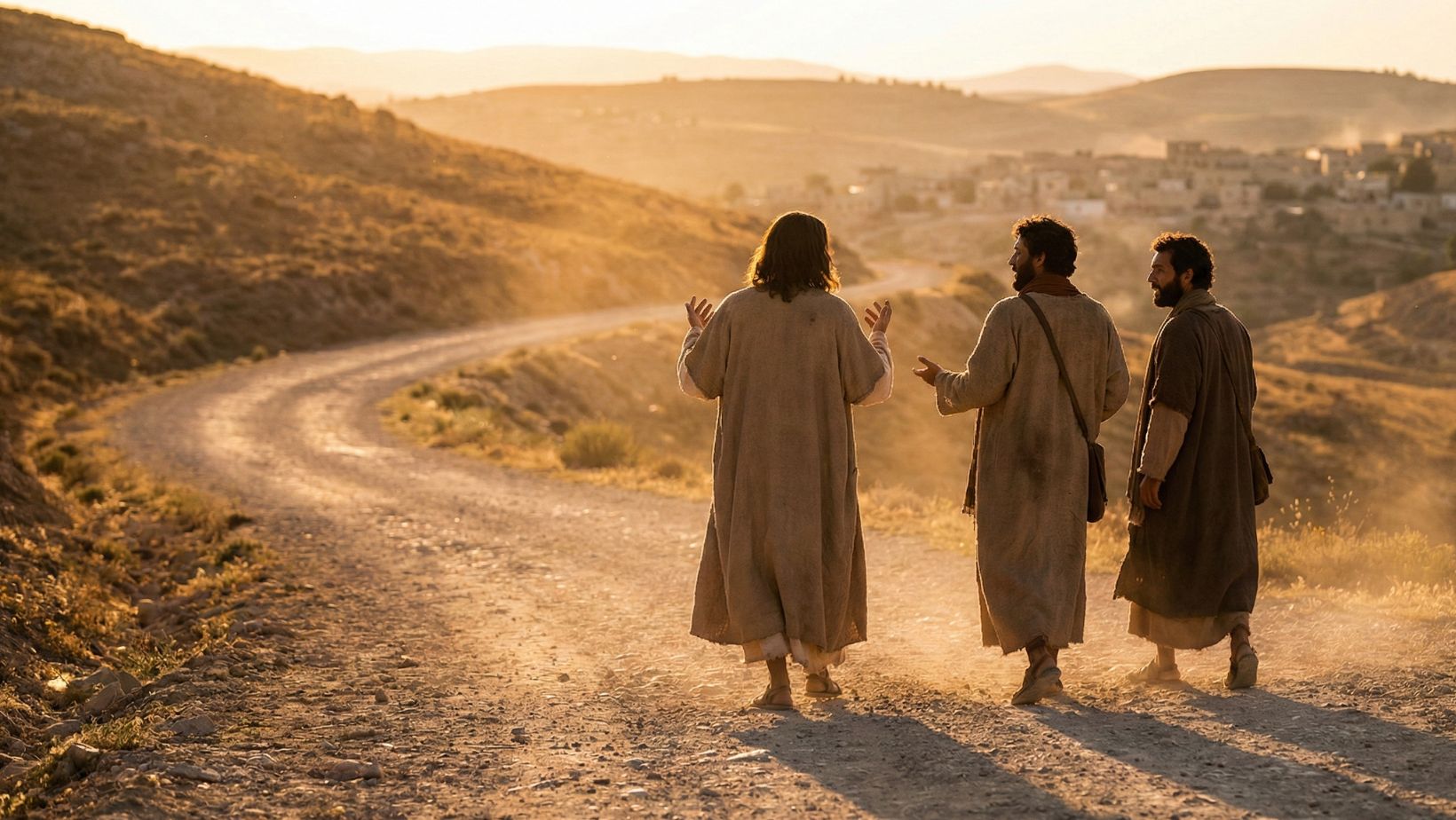
The disciples on the road to Emmaus represent the journey of every believer—from confusion and sorrow to spiritual awakening and burning conviction. Their encounter, recorded exclusively in the Gospel of Luke, captures one of the most intimate post-resurrection appearances of Jesus Christ. Cleopas and his unnamed companion begin their journey leaving Jerusalem in despair, believing the Messiah’s mission had failed, only to have the Scriptures opened to them by a stranger. Their story highlights the transformative power of the Word and the breaking of bread, marking the shift from grief to the joyous proclamation that “The Lord has risen indeed.”
Quick Facts
- Names: Cleopas and an unnamed companion (possibly his wife, Mary, or the author Luke)
- Nation/Group: Jewish disciples of Jesus (part of the wider circle, not the Twelve)
- Era: First Century (Resurrection Sunday)
- Location: The road from Jerusalem to Emmaus (approx. 7 miles / 11 kilometers)
- Scripture: Luke 24:13–35
- Key Virtues: Hospitality, teachability, zeal
- Symbol: The Breaking of Bread / A Winding Road
- Legacy: Witnesses of the Resurrection; the first to understand the Messianic prophecies in totality
Name Meaning
Emmaus: Derives from the Hebrew Hammat, meaning “Warm Spring.” This location serves as the setting for their spiritual warming. Cleopas: A Greek name, likely a contraction of Cleopatros, meaning “Glory of the Father.” The Companion: Remains anonymous in the text, allowing the reader to place themselves in the story as the second traveler walking with Jesus.
Lineage / Family Background
Cleopas: Little is known definitely of his background, though church tradition (via historian Hegesippus) sometimes identifies him as the brother of Joseph (Jesus’ earthly father), which would make him Jesus’ uncle. Others associate him with “Clopas” mentioned in John 19:25.
The Companion: Theories abound regarding the identity of the second disciple. Some scholars suggest it was Cleopas’s wife (Mary of Clopas), seeing the pair as a married couple offering hospitality. Others suggest it was Luke the Evangelist himself, concealing his name out of humility.
Biblical Era / Context
Time: The afternoon of the very day Jesus rose from the dead (Easter Sunday).
Political Climate: Intense fear and confusion in Jerusalem. The leader of their movement had been executed by Rome, and rumors of an empty tomb were causing unrest among the disciples.
Geographic Setting: A journey of roughly 60 stadia (about 7 miles) from Jerusalem down to the village of Emmaus.
Major Roles / Identity
Despairing Disciples: Represented the crushed hopes of those who believed Jesus was merely a political or national redeemer.
Hosts: They displayed the virtue of hospitality by urging the stranger to stay with them because night was falling.
Witnesses: They became pivotal witnesses to the connection between Old Testament prophecy and the suffering Messiah.
Messengers: Despite the late hour and fatigue, they immediately returned to Jerusalem to confirm the Resurrection to the Eleven.
Key Character Traits
Hospitality: “Stay with us, for it is nearly evening…” (Luke 24:29). Their invitation to the stranger was the catalyst for their revelation.
Honesty: They did not hide their sadness or their loss of hope when questioning the stranger.
Spiritual Hunger: Their hearts “burned within them” as the Scriptures were opened, showing a deep responsiveness to God’s truth.
Responsiveness: Once they recognized Jesus, they acted immediately, running miles back to Jerusalem in the dark to share the news.
Main Life Events
The Departure: Leaving Jerusalem in sadness, discussing the crucifixion and the confusing reports of the empty tomb (Luke 24:13–14).
The Encounter: Jesus joins them on the walk but is supernaturally “kept from recognizing him” (Luke 24:15–16).
The Conversation: They express their shattered expectations: “We had hoped that he was the one who was going to redeem Israel” (Luke 24:21).
The Sermon: Jesus rebukes their slowness of heart and interprets the Scriptures, explaining why the Messiah had to suffer (Luke 24:25–27).
The Meal: At supper in Emmaus, Jesus takes bread, gives thanks, and breaks it. In this action, their eyes are opened, and He disappears (Luke 24:30–31).
The Return: Transforming from sad walkers to joyful runners, they return to Jerusalem to tell the Eleven, “It is true! The Lord has risen!” (Luke 24:33–34).
Major Relationships
Jesus: Initially seen as a stranger/traveler, then revealed as the Risen Lord and Teacher.
The Eleven Apostles: The Emmaus disciples were part of the wider group associated with the Apostles and returned to validate the Apostles’ growing realization of the Resurrection.
Each Other: Cleopas and his companion share a bond of shared grief that transforms into shared joy.
Notable Passages
Luke 24:21: The voice of lost hope — “But we had hoped that he was the one who was going to redeem Israel.”
Luke 24:27: The hermeneutical key — “And beginning with Moses and all the Prophets, he explained to them what was said in all the Scriptures concerning himself.”
Luke 24:32: The internal witness — “Were not our hearts burning within us while he talked with us on the road and opened the Scriptures to us?”
Luke 24:35: The moment of recognition — “Then the two told what had happened on the way, and how Jesus was recognized by them when he broke the bread.”
Legacy & Impact
The Model of Liturgy: The structure of the Emmaus encounter (Liturgy of the Word followed by Liturgy of the Eucharist) is seen by many theologians as the blueprint for early Christian worship.
Hermeneutics: This event established the Christocentric reading of the Old Testament—teaching the church that all Scripture points to the suffering and glory of Christ.
Proof of Resurrection: Their testimony added to the cumulative evidence that Jesus was alive, not just a spirit, but capable of walking, talking, and breaking bread.
Symbolism / Typology
The Road: Symbolizes the spiritual journey of the believer, often starting in confusion or sadness and moving toward revelation.
Blindness vs. Sight: Represents the inability to see God’s hand in suffering until revealed through the lens of Scripture.
The Setting Sun: Symbolizes the darkness of the world and the end of the age, contrasted with the light of Christ’s presence at the table.
Breaking of Bread: A Eucharistic symbol; Christ is often recognized not just in intellectual discourse but in the communal act of thanksgiving and communion.
Extra-Biblical References
Historical Tradition: Early church historians like Eusebius mention Cleopas. Tradition holds that Cleopas was martyred for his faith in the same house where he hosted Jesus.
Art History: The “Supper at Emmaus” is a favorite subject of Renaissance and Baroque art (e.g., Caravaggio, Rembrandt), often emphasizing the dramatic moment of recognition.







Leave a Reply