
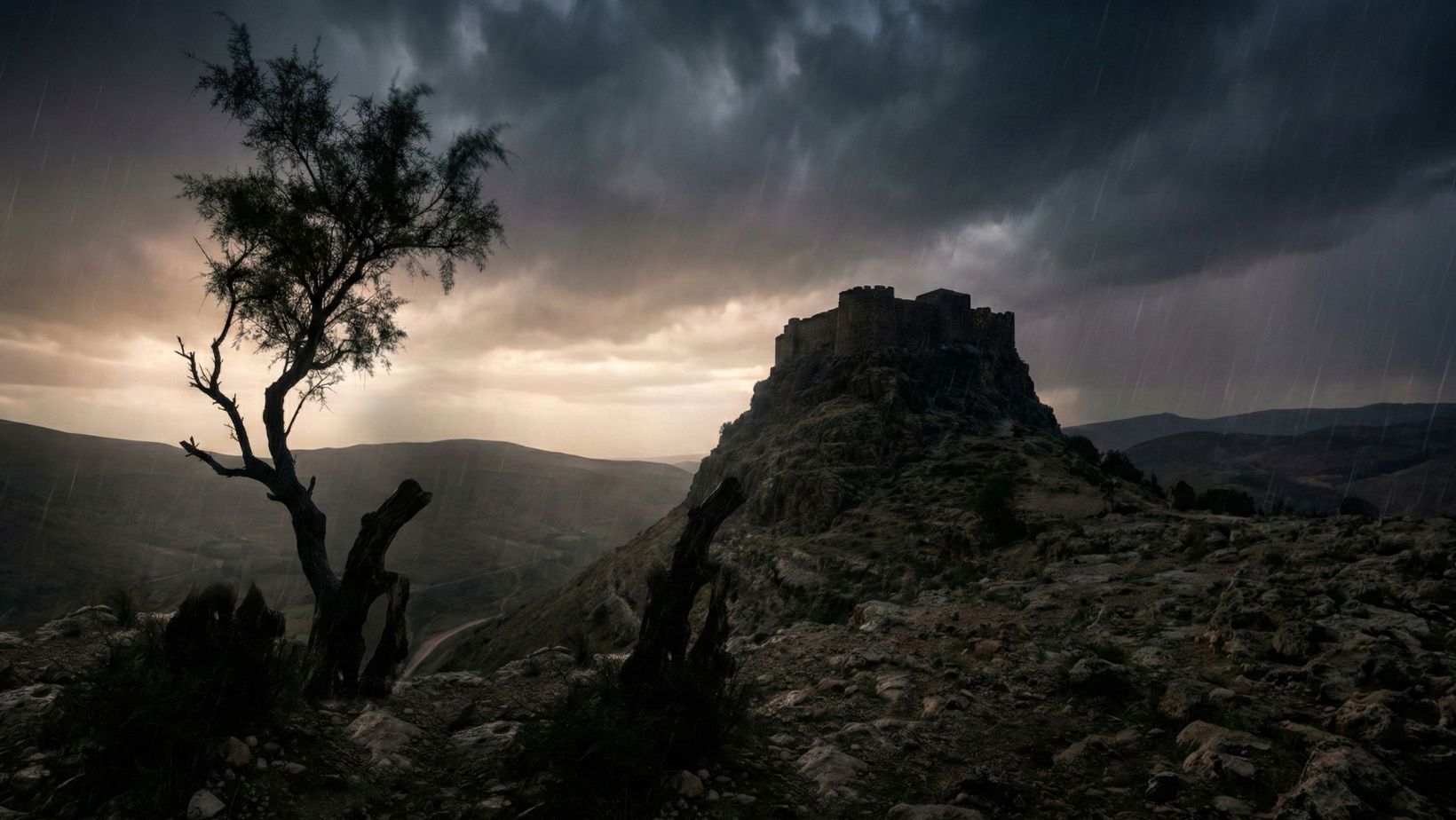
Gibeah is a city defined by a stark and disturbing dual legacy. In the biblical narrative, it serves as both the cradle of Israel’s monarchy and the site of its darkest moral failure. Located in the hill country of Benjamin, it is famously known as Gibeah of Saul, the first capital of the Kingdom of Israel. However, centuries before Saul, Gibeah was the setting for the horrific events of Judges 19—a crime so heinous it sparked a civil war that nearly extinguished the tribe of Benjamin. It stands in Scripture as a monument to the heights of human political ambition and the depths of human depravity.
Quick Facts
- Name: Gibeah (Hebrew: Giv’ah)
- Region: Territory of Benjamin (Central Highlands)
- Distance: Approx. 3 miles (5 km) north of Jerusalem
- Key Figures: King Saul, Jonathan, The Levite and his Concubine
- Modern Location: Tell el-Ful (Hill of Beans), north of modern Jerusalem
- Symbol: The Royal Spear / The Divided Concubine
- Reputation: “The Days of Gibeah” (a prophetic idiom for deep corruption)
Name Meaning
Gibeah: The word simply means “Hill” or “Height.” It comes from a common Hebrew root describing the topography of the central mountain range. Because of its generic meaning, it is often qualified in Scripture (e.g., “Gibeah of Benjamin” or “Gibeah of Saul”) to distinguish it from other high places like Gibeon or Geba.
Geography / Historical Context
Strategic Watchtower: Gibeah sits on a prominent conical hill commanding a 360-degree view of the surrounding plateau. This made it an ideal military outpost and administrative center.
The King’s Fortress: Excavations at Tell el-Ful have revealed a fortress with casemate walls dating to the late Iron Age I (c. 1000 BCE), consistent with the rustic palace of King Saul. It was not a sprawling metropolis like Babylon, but a fortified military chieftain’s base.
Major Roles / Identity
The City of Atrocity: In the era of the Judges, Gibeah functioned as a “second Sodom.” Its inhabitants displayed a lack of hospitality and sexual violence that rivaled the cities of the plain, marking the nadir of Israel’s spiritual decline.
The First Capital: Under Saul, Gibeah was the political center of Israel. It was here that Saul held court under the tamarisk tree, planning battles against the Philistines.
The Prophetic Warning: For prophets like Hosea, Gibeah became a byword for Israel’s entrenched sin. To say, “You have sinned as in the days of Gibeah,” was the ultimate condemnation.
Key Biblical Events
The Crime of Gibeah (Judges 19): A Levite and his concubine, traveling home, stopped in Gibeah for the night. The men of the city surrounded the house, demanding to rape the Levite. Instead, the concubine was pushed out to them. She was abused all night and died on the doorstep. The Levite cut her body into twelve pieces and sent them to the tribes of Israel, sparking national outrage.
The Benjaminite Civil War (Judges 20): Because the tribe of Benjamin refused to hand over the perpetrators in Gibeah, the other eleven tribes declared war. The ensuring conflict resulted in the death of 25,000 Benjaminites, leaving only 600 survivors and nearly wiping out the tribe.
The Rise of Saul (1 Samuel 10–11): After being anointed king, Saul returned to his home in Gibeah. When the Ammonites threatened Jabesh Gilead, the Spirit of God came upon Saul at Gibeah, and he rallied Israel to victory, solidifying his kingship.
The Execution of Saul’s Sons (2 Samuel 21): Years after Saul’s death, a famine struck Israel due to Saul’s bloodguilt against the Gibeonites. To make atonement, seven of Saul’s male descendants were handed over and hanged “before the Lord at Gibeah of Saul.”
Notable Passages
Judges 19:30: “Everyone who saw it said, ‘Such a thing has never been seen or done, not since the day the Israelites came up out of Egypt.’”
1 Samuel 10:26: “Saul also went to his home in Gibeah, accompanied by valiant men whose hearts God had touched.”
1 Samuel 22:6: “Now Saul heard that David and his men had been discovered. And Saul was seated, spear in hand, under the tamarisk tree on the hill at Gibeah, with all his officials standing at his side.”
Hosea 9:9: “They have sunk deep into corruption, as in the days of Gibeah. God will remember their wickedness and punish them for their sins.”
Legacy & Impact
The Corruption of Power: Gibeah represents the failure of human leadership. It was the home of the first king, yet that king (Saul) ended in madness and paranoia within its walls.
The Need for a True King: The horror of Judges 19 ends with the refrain, “In those days Israel had no king.” The chaos of Gibeah was the final argument for the establishment of the monarchy—though ironically, the first king from Gibeah failed to solve the heart issue.
Archeological Curiosity: In the 1960s, King Hussein of Jordan began building a royal palace on top of the ancient site of Gibeah (Tell el-Ful), but construction was halted by the Six-Day War. The skeleton of the unfinished modern palace still stands atop the ruins of Saul’s ancient fortress—a fitting symbol of interrupted reigns.







Leave a Reply