
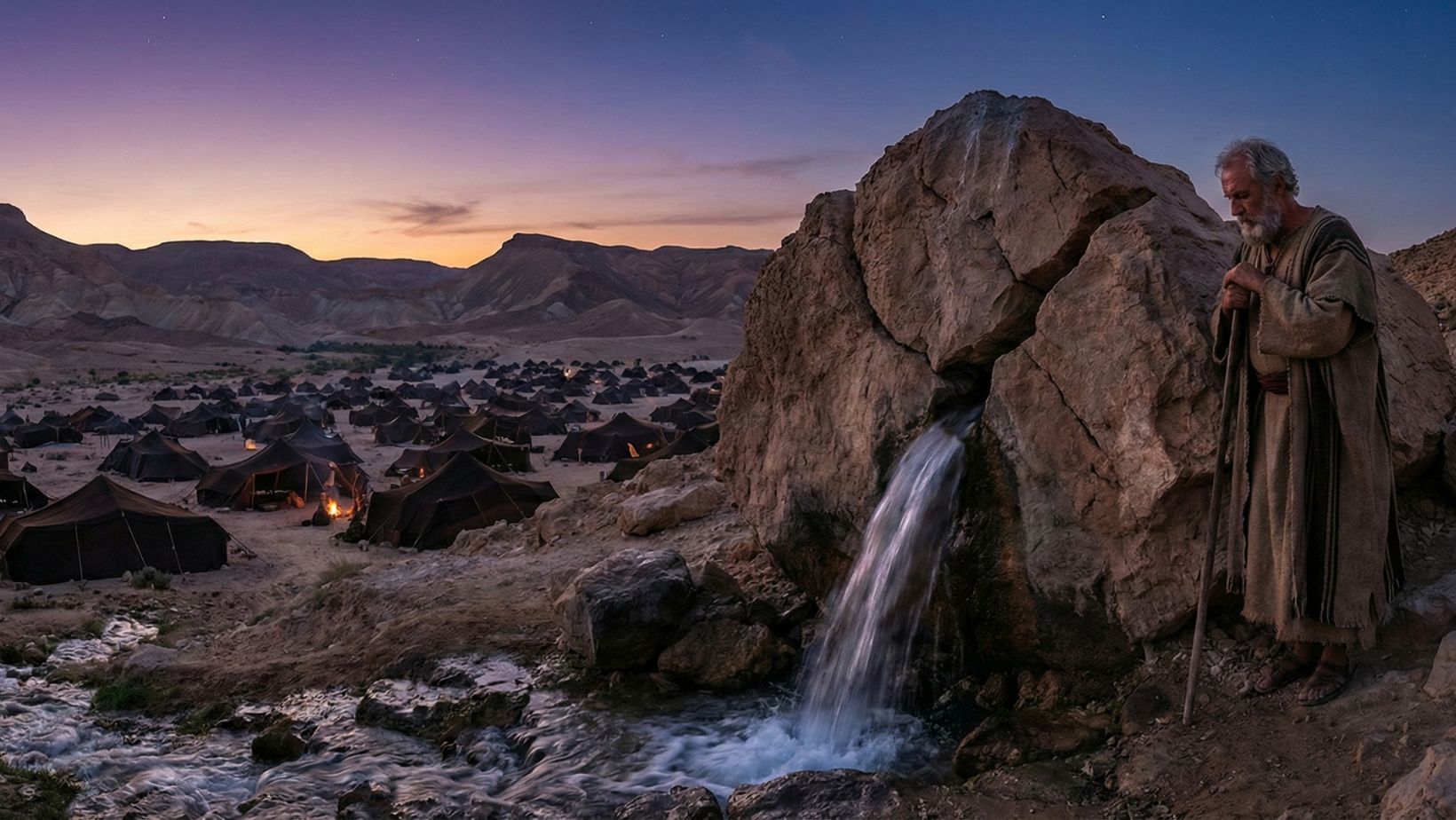
Kadesh-Barnea is arguably the most critical and tragic location in the wilderness wanderings of Israel. Situated on the southern border of the Promised Land, it was meant to be the launching pad for conquest. Instead, it became the site of Israel’s greatest failure of faith. It was here that the twelve spies were sent out, and here that the people rebelled, refusing to enter Canaan out of fear. As a result, Kadesh-Barnea marked the turning point where an 11-day journey transformed into a 40-year sentence of wandering. It stands in Scripture as a solemn reminder of the consequences of unbelief and the proximity of God’s promises to our fears.
Quick Facts
- Name: Kadesh-Barnea (Hebrew: Qadesh Barnea)
- Alternate Name: En-Mishpat (“Spring of Judgment”)
- Region: The Wilderness of Zin / Northern Sinai / The Negev
- Key Figures: Moses, Aaron, Miriam, Joshua, Caleb, The Twelve Spies
- Key Events: The report of the spies; The 40-year sentence; Moses striking the rock; Miriam’s death
- Modern Location: Widely identified with the oasis Ain el-Qudeirat (Sinai Peninsula)
- Symbol: The Stumbling Stone / The Oasis of Judgment
Name Meaning
Kadesh: Derived from the Semitic root q-d-sh, meaning “Holy,” “Sanctuary,” or “Set Apart.” This implies it was an ancient sacred site or sanctuary long before Israel arrived.
Barnea: The etymology is uncertain, but it is often interpreted to mean “Wilderness of Wandering” or “Son of Wandering.”
En-Mishpat: In Genesis 14:7, it is called En-Mishpat, meaning “Spring of Judgment,” foreshadowing the divine judgments that would later occur there involving Moses and the nation.
Geography / Historical Context
The Oasis: Kadesh-Barnea is not a single well but a large oasis area capable of sustaining a massive population (the Israelites and their livestock) for an extended period. It features the largest spring in the northern Sinai.
The Borderland: It sat directly on the southern edge of Canaan (the Promised Land) and the western border of Edom. It was the “threshold” of the land flowing with milk and honey.
Major Roles / Identity
The Pivot Point: Kadesh divides the book of Numbers. Everything before Kadesh is preparation for entry; everything after (until the second generation rises) is the consequence of refusal.
The Home Base: Although the Bible says Israel “wandered,” they spent a significant portion of the 38 post-rebellion years centered around the Kadesh area (Deuteronomy 1:46).
The Courtroom: True to its ancient name “Spring of Judgment,” God issued two massive rulings here: the judgment against the generation of soldiers (who would die in the wilderness) and the judgment against Moses and Aaron (who would not enter the land).
Key Biblical Events
The Mission of the Spies (Numbers 13): Moses sent twelve spies from Kadesh to scout Canaan. They returned after 40 days with fruit (grapes of Eshcol) but also a report of giants. Ten spies terrified the people, while only Joshua and Caleb argued for faith.
The Great Rebellion (Numbers 14): The people wept at Kadesh, tried to appoint a new leader to return to Egypt, and threatened to stone Moses. God intervened, declaring that because they refused to enter, they would wander one year for every day the spies were gone—40 years total.
The Death of Miriam (Numbers 20:1): The prophetess Miriam, sister of Moses, died and was buried in Kadesh.
The Water from the Rock (Numbers 20:2–13): Years later, the people quarreled again due to lack of water. God told Moses to speak to the rock. In anger, Moses struck the rock twice. Water gushed out, but God declared that because Moses did not uphold God’s holiness, he would not lead the assembly into the Promised Land.
Notable Passages
Deuteronomy 1:2: “It takes eleven days to go from Horeb to Kadesh Barnea by the Mount Seir road.” (This verse highlights the tragedy: they were only 11 days away from the promise, yet it took a lifetime to get there).
Numbers 14:22–23: “Not one of those who saw my glory and the signs I performed in Egypt and in the wilderness but who disobeyed me and tested me ten times—not one of them will ever see the land I promised on oath to their ancestors.”
Numbers 20:12: “But the LORD said to Moses and Aaron, ‘Because you did not trust in me enough to honor me as holy in the sight of the Israelites, you will not bring this community into the land I give them.’”
Psalm 95:8: “Do not harden your hearts as you did at Meribah, as you did that day at Massah in the wilderness.”
Legacy & Impact
The Definition of Unbelief: In the New Testament, the writer of Hebrews (Chapters 3 and 4) uses the events at Kadesh-Barnea as the ultimate theological warning against “falling away” and failing to enter God’s “rest” due to unbelief.
The Southern Boundary: Kadesh-Barnea became a fixed geographical marker. When the borders of the land were drawn for the tribes (Joshua 15) and later in Ezekiel’s vision of the future Kingdom (Ezekiel 47), Kadesh remained the southern anchor point.
The Broken Type: Theologically, many commentators view Moses striking the rock at Kadesh (the second rock incident) as breaking the typology of Christ. The first rock (Exodus 17) was struck (crucified); the second rock was only to be spoken to (prayer based on finished work). By striking it again, Moses obscured the picture of a once-for-all sacrifice.







Leave a Reply