
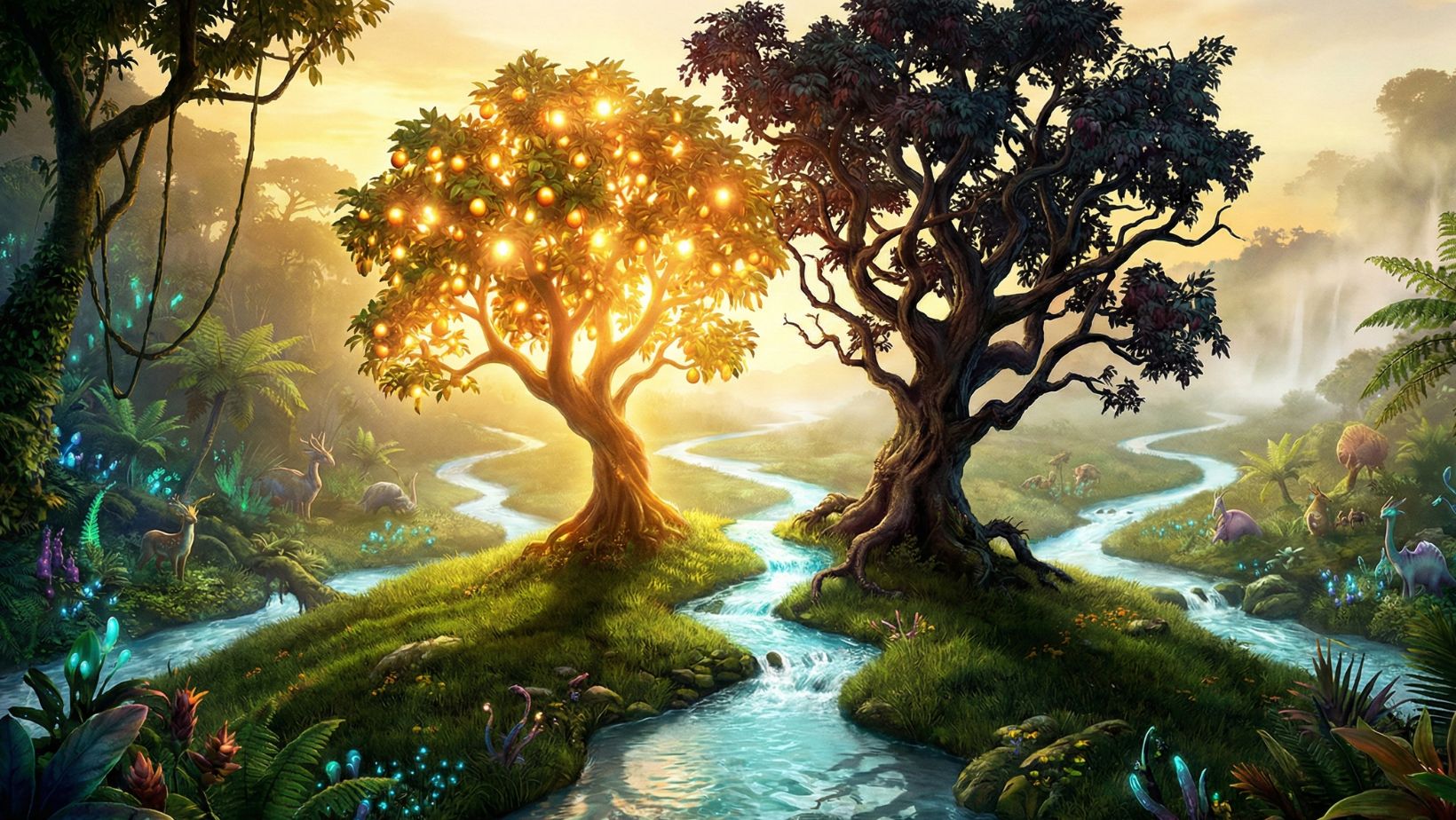
The Garden of Eden is the archetypal sanctuary of God—the place where heaven and earth originally overlapped, and where humanity dwelt in direct, unhindered communion with their Creator. It represents the biblical ideal of Shalom: perfect peace, order, beauty, and abundance. More than just a lush park, Eden was the first Temple, where the first man was placed to serve as a priest. The biblical narrative begins in this Garden and ends in a Garden City (Revelation 21–22), making Eden the foundational blueprint for God’s intent for creation—a paradise lost by sin, but promised to be restored through redemption.
Quick Facts
- Name: Garden of Eden / Gan Eden / Paradise
- Location: “In the East” (Genesis 2:8); associated with four rivers
- Key Inhabitants: Adam, Eve, The Serpent, The Cherubim, The LORD God
- Key Features: The Tree of Life, The Tree of the Knowledge of Good and Evil, The River
- Biblical Role: The cradle of humanity; the site of the first marriage and the first sin
- Symbol: The Closed Gate / The Fruit / The River of Life
Name Meaning
Eden: The Hebrew word ‘Edhen means “delight,” “pleasure,” or “luxury.” Paradise: When the Old Testament was translated into Greek (the Septuagint), the word used for “garden” was paradeisos, a Persian loanword referring to a royal walled park or enclosure. Thus, Eden is the “Royal Park of Delight.”
Geography / Historical Context
The Four Rivers: Genesis 2 describes a river flowing out of Eden that divided into four headwaters: the Pishon, the Gihon, the Tigris (Hiddekel), and the Euphrates.
- The Tigris and Euphrates locate the general region in Mesopotamia (modern Iraq/Turkey).
- The Pishon and Gihon are more mysterious, associated with lands like Cush (Ethiopia/Sudan) and Havilah (Arabia). This suggests Eden was a high central source (a “mountain of God”) that watered the entire world.
The First Temple: Ancient Near Eastern scholars and biblical theologians often view Eden as the first sanctuary. The entrance was likely facing East (as was the Tabernacle and Temple), and the layout of the later Temple (Holy of Holies, Holy Place, Courtyard) mirrors the gradation of holiness found in Eden.
Major Roles / Identity
The Sanctuary of Meeting: It was the place where God “walked in the cool of the day.” There was no separation between the divine and the human.
The Place of Probation: Eden was not just a playground; it was a testing ground. It contained the choice (the two trees) necessary for free will and genuine love to exist.
The Source of Life: Physically, it provided water and food. Spiritually, the Tree of Life represented the sustaining power of God required for immortality.
Key Biblical Events
The Placement of Man: God formed Adam from the dust (outside the garden) and placed him into the garden to “work it and keep it” (Genesis 2:15)—verbs later used for the duties of priests in the Tabernacle.
The First Surgery and Marriage: God caused a deep sleep to fall on Adam, formed Eve from his side, and instituted the covenant of marriage (Genesis 2:21–24).
The Fall: The Serpent tempted Eve to question God’s goodness. Adam and Eve ate the forbidden fruit, resulting in shame, the realization of nakedness, and the hiding from God (Genesis 3).
The Expulsion: To prevent humanity from eating from the Tree of Life and living forever in a sinful state, God exiled them. He placed Cherubim and a flaming sword at the east of the Garden to guard the way (Genesis 3:24).
Notable Passages
Genesis 2:8: “Now the LORD God had planted a garden in the east, in Eden; and there he put the man he had formed.”
Genesis 2:15: “The LORD God took the man and put him in the Garden of Eden to work it and take care of it.”
Ezekiel 28:13: “You were in Eden, the garden of God; every precious stone adorned you…” (A prophecy against the King of Tyre, using Edenic/satanic imagery).
Revelation 22:1–2: “Then the angel showed me the river of the water of life… On each side of the river stood the tree of life… No longer will there be any curse.”
Legacy & Impact
The Temple Motif: The Jewish Temple was decorated with carvings of pomegranates, palm trees, and flowers, and utilized gold and onyx (stones mentioned in Gen 2). This was intentional: the Temple was a “micro-Eden,” a small pocket of restored space where God dwelt with man.
The Theology of Work: Because Adam was told to work the garden before the Fall, the Bible teaches that work is not a curse, but a noble, God-given calling.
The Hope of Restoration: The biblical story is not circular; it is linear. It moves from a Garden (Eden) to a Garden City (New Jerusalem). We do not go “back” to Eden, but forward to a restored and glorified version of it through Christ.
Symbolism / Typology
The Tree of Life: Represents eternal life found only in God. In the New Testament, Christ and His Cross become the source of life; to eat of Him is to live forever.
The River: Symbolizes the Holy Spirit (John 7:38), flowing out from the presence of God to bring life to the barren world.
The Cherubim: These guardians of God’s holiness prevent sinful man from entering His presence casually. The curtain in the Temple (embroidered with Cherubim) served the same function until it was torn by Christ.







Leave a Reply