
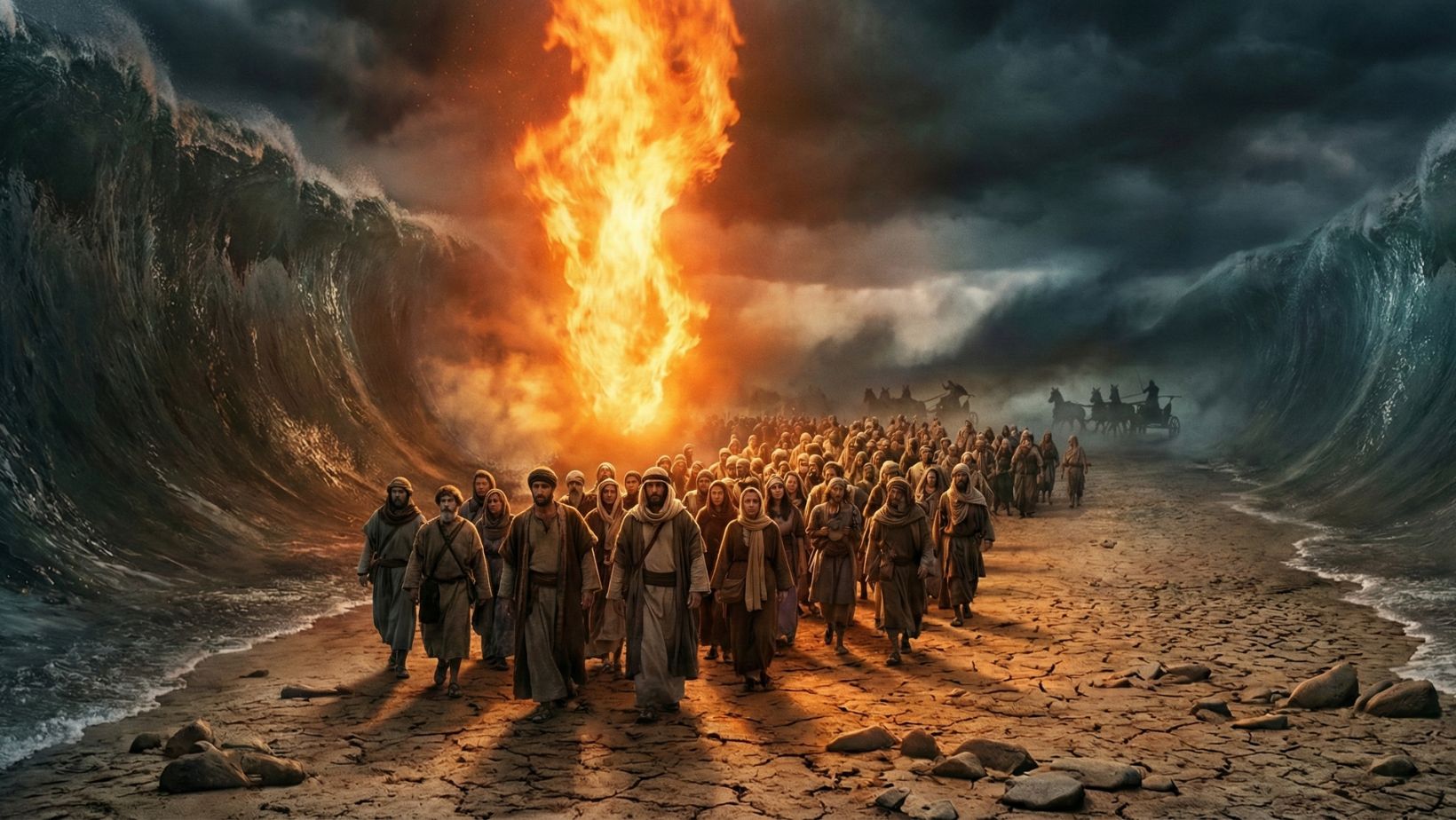
The Red Sea is the setting for the defining miracle of the Old Testament: the Exodus. It represents the ultimate boundary between slavery and freedom, death and life. In the biblical narrative, this body of water served as an impassable barrier that God miraculously parted to deliver the Israelites from the armies of Pharaoh. It is not merely a geographical location but a theological monument, frequently cited throughout Scripture as the supreme evidence of God’s power to save His people and judge their oppressors.
Quick Facts
- Hebrew Name: Yam Suph (meaning “Sea of Reeds” or “Sea of Weeds”)
- Greek Name: Erythra Thalassa (Red Sea — used in the Septuagint and NT)
- Location: The seawater inlet of the Indian Ocean, lying between Africa and Asia (Arabian Peninsula)
- Key Branches: The Gulf of Suez (western arm) and the Gulf of Aqaba (eastern arm)
- Key Event: The Miraculous Crossing (Exodus 14)
- Associated Figures: Moses, Miriam, Pharaoh, King Solomon
- Symbolism: Deliverance, Baptism, the boundary between the old life (sin) and the new life (promise)
Name Meaning
“Yam Suph”: The original Hebrew phrase used in the Old Testament. Yam means “sea,” and Suph likely comes from an Egyptian loanword meaning “reeds,” “rushes,” or “water plants.” This has led some scholars to suggest the crossing happened in a marshy, reed-filled lake north of the modern Red Sea, though the Bible also uses Yam Suph to refer to the deep waters of the Gulf of Aqaba (1 Kings 9:26), which are clearly part of the Red Sea proper.
“Red Sea”: This name comes from the Greek translation (Septuagint). The origin of the color designation is debated—some attribute it to seasonal blooms of red algae (Trichodesmium erythraeum), while others suggest it relates to ancient cardinal directions where “red” symbolized the south.
Geographical / Physical Context
Structure: The Red Sea separates the coasts of Egypt, Sudan, and Eritrea from Saudi Arabia and Yemen. At its northern end, it splits into two “fingers” that flank the Sinai Peninsula:
- Gulf of Suez: The western arm, bordering Egypt.
- Gulf of Aqaba: The eastern arm, bordering Midian (Arabia).
Biblical Geography: The “Sea of Reeds” is the barrier the Israelites encountered after leaving Goshen/Rameses. Later, during the monarchy, the southern port of Elath (on the Gulf of Aqaba) became a crucial naval base for King Solomon.
Biblical Era / Context
The Exodus (c. 1446 or 1260 BCE): The primary context is the liberation of Israel. The sea stood as a trap for the fleeing slaves, pinned between the water and the approaching Egyptian chariots.
The Wilderness Wanderings: After the crossing, Israel spent 40 years in the wilderness of the Sinai Peninsula, often camping near the arms of the Red Sea (Numbers 33).
The United Monarchy (c. 970 BCE): Under King Solomon, the Red Sea shifted from a barrier of fear to a gateway of commerce and wealth.
Major Roles / Identity
The Agent of Deliverance: For Israel, the sea was the womb from which their nation was born. Walking through it signified their transition from Pharaoh’s slaves to Yahweh’s people.
The Agent of Judgment: For Egypt, the sea was a grave. It demonstrated that the gods of Egypt had no power over the elements of Yahweh.
Commercial Highway: In later history, it became Israel’s access point to foreign luxury goods (gold, spices, and exotic animals from Ophir).
Key Characteristics
Impassable Barrier: To the human eye, it represented a dead end and certain destruction.
Instrument of God: The sea obeyed the command of God (via Moses’ staff), displaying nature’s submission to its Creator.
Borderline: It marked the definitive separation from Egypt; once crossed, there was no turning back.
Main Biblical Events
The Plague of Locusts: Before the crossing, God used a strong west wind to drive the plague of locusts out of Egypt and into the Red Sea, where they drowned (Exodus 10:19).
The Parting of the Sea: God drove the sea back with a “strong east wind” all night, creating a wall of water on the right and left. The Israelites crossed on dry ground (Exodus 14:21–22).
Destruction of Pharaoh’s Army: When the Egyptians pursued, the waters returned, covering the chariots and horsemen so that “not one of them survived” (Exodus 14:28).
Song of the Sea: Miriam and Moses led the people in a victory hymn on the banks of the sea, the first recorded song of corporate worship in Scripture (Exodus 15).
Solomon’s Fleet: King Solomon built a fleet of ships at Ezion Geber, on the shore of the Red Sea (Gulf of Aqaba), to trade for gold from Ophir (1 Kings 9:26).
Major Relationships
Moses: The mediator who stretched out his hand over the sea to divide it.
Pharaoh: The archetype of rebellion who met his end in the waters.
Miriam: Led the women in dancing and singing on the shores after the victory.
Solomon: Utilized the sea for economic expansion rather than military escape.
Notable Passages
Exodus 14:13: “Moses answered the people, ‘Do not be afraid. Stand firm and you will see the deliverance the LORD will bring you today.’”
Exodus 15:1: “I will sing to the LORD, for he is highly exalted. Both horse and driver he has hurled into the sea.”
Psalm 106:9: “He rebuked the Red Sea, and it dried up; he led them through the depths as through a desert.”
1 Corinthians 10:1–2: “For I do not want you to be ignorant of the fact, brothers and sisters, that our ancestors… were all baptized into Moses in the cloud and in the sea.”
Legacy & Impact
Historical Memory: The crossing of the Red Sea is the “datum point” for Old Testament theology. Prophets constantly refer back to it (e.g., Isaiah, Psalms) to remind Israel that if God could split the sea, He could handle their current crisis.
Passover Liturgy: It remains a central focus of Jewish Passover celebrations, reciting the miraculous deliverance.
Christian Theology: It is viewed as a precursor to the victory of Christ over death and the liberation of the believer from the slavery of sin.
Symbolism / Typology
Baptism: The Apostle Paul explicitly identifies the Red Sea crossing as a type of baptism (1 Cor 10:2). Just as the Israelites went down into the sea and emerged free from their master (Pharaoh), the believer goes into the water and rises to walk in newness of life, freed from the master of Sin.
Chaos vs. Order: In Ancient Near Eastern thought, the sea represented chaos and death. God parting the sea symbolizes His sovereign control over the chaotic forces of the universe.
The “Way” Made: It symbolizes God making a way where there is no way.
Extra-Biblical References
Archaeological Theories: Scholars debate the exact location of the crossing. Theories range from the “Bitter Lakes” in the north to the Gulf of Aqaba (Nuweiba Beach) in the south. Chariot wheels claimed to be found in the Gulf of Aqaba remain a subject of controversy and lack mainstream archaeological verification.
Geological Explanations: Some scientists propose “wind setdown” (strong winds pushing water back) as the physical mechanism God used, aligning with the biblical description of the “strong east wind.”







Leave a Reply