
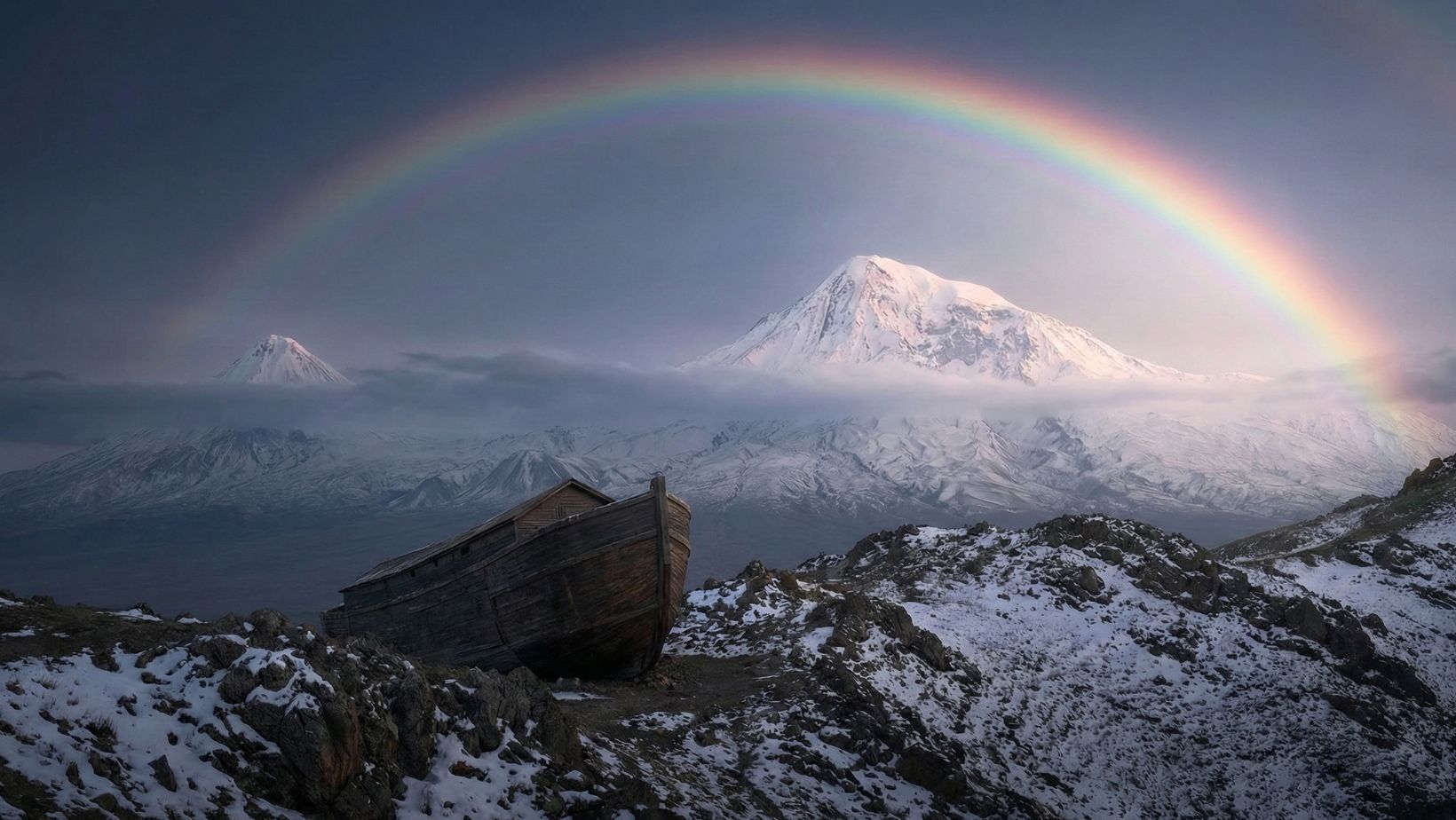
Mount Ararat is one of the most famous and geologically imposing mountains in Scripture, serving as the landing site of Noah’s Ark. It represents the “ground zero” of the post-flood world—the place where humanity was given a second chance. While the Bible refers to the “mountains of Ararat” (a region) rather than a singular peak, tradition has long identified the dormant compound volcano in modern-day Turkey as the specific location where the waters receded and God established His covenant with all living creatures.
Quick Facts
- Biblical Name: Mountains of Ararat
- Current Location: Eastern Turkey (near the borders of Armenia, Azerbaijan, and Iran)
- Physical Height: Greater Ararat is ~5,137 meters (16,854 ft); Lesser Ararat is ~3,896 meters (12,782 ft)
- Geological Type: Dormant compound stratovolcano
- Key Event: Grounding of Noah’s Ark (Genesis 8:4)
- Associated Kingdom: Urartu (ancient Assyrian name for the region)
- Key Figures: Noah, his family (Shem, Ham, Japheth), the animals
- Symbolism: Rest, salvation, new beginnings, and the faithfulness of God
Name Meaning
“Ararat”: (Hebrew: Ararat) is the Hebrew spelling of Urartu, an ancient kingdom that existed in the Armenian Highlands (centered around Lake Van). “Agri Dagh”: The modern Turkish name, meaning “Mountain of Pain” or “Curved Mountain.” “Masis”: The Armenian name, derived from a legendary king, Amalya.
Geographical / Physical Context
The Region: In the biblical context, “Ararat” referred to a kingdom or a mountainous region north of Mesopotamia, not necessarily a single peak. However, the specific Mount Ararat (Agri Dagh) dominates this landscape.
The Mountain: It is a massive, snow-capped volcano with two distinct cones: Greater Ararat and Lesser Ararat. It is the highest peak in the Armenian Highlands.
Accessibility: It is historically described as rugged and inaccessible. The permanent ice cap on the summit has made both climbing and the search for archaeological evidence (the Ark) difficult and dangerous.
Biblical Era / Context
The Great Flood: The mountain appears at the climax of the Flood narrative. As the waters of judgment destroyed the “old world,” Ararat became the first point of contact for the “new world.”
The Assyrian Period: Later in the Old Testament, Ararat is mentioned as a political entity (the Kingdom of Urartu), a rival to the Assyrian Empire, serving as a place of refuge for political exiles (2 Kings 19:37).
Major Roles / Identity
The Haven of Rest: After months of tossing on a shoreless ocean, Ararat provided the stability and safety Noah’s family needed.
The Altar of the Earth: It was the site of the first worship service in the post-flood era. Noah built an altar there, and God smelled the “pleasing aroma” of the sacrifice (Genesis 8:20).
The Place of Covenant: It is the location where the Noahic Covenant was established, signified by the rainbow, promising that God would never again destroy the earth by water.
Key Characteristics
Majestic and Dominant: The mountain rises in isolation from the surrounding plains, making it visible for miles—a fitting symbol for a new beacon of hope.
Volcanic/Ancient: As a stratovolcano, it represents the raw, formative power of the earth.
Political Sanctuary: Beyond the flood, the region was known as a stronghold where people fled to escape the reach of Assyrian kings.
Main Biblical Events
The Ark Rests: “And on the seventeenth day of the seventh month the ark came to rest on the mountains of Ararat” (Genesis 8:4). This marked the turning point of the flood narrative.
The Release of Birds: From the slopes of this mountain region, Noah sent out a raven and a dove to test the habitability of the lower elevations (Genesis 8:6-12).
The First Altar: Upon disembarking, Noah built an altar to the Lord. This act of worship preceded house-building or farming, establishing God’s priority in the new world (Genesis 8:20).
Assassins’ Refuge: Centuries later, Adrammelech and Sharezer, the sons of the Assyrian King Sennacherib, assassinated their father and fled to the “land of Ararat” for safety (2 Kings 19:37; Isaiah 37:38).
Major Relationships
Noah: The patriarch who stepped onto the mountain as the new head of the human race.
God (Yahweh): The mountain is the stage where God transitions from Judge (flood) to Sustainer (covenant).
The Assyrians: The region of Ararat (Urartu) was a northern enemy/neighbor to the Mesopotamian empires.
Notable Passages
Genesis 8:4-5: “The ark came to rest on the mountains of Ararat. The waters continued to recede until the tenth month, and on the first day of the tenth month the tops of the mountains became visible.”
Jeremiah 51:27: “Lift up a banner in the land! Blow the trumpet among the nations! Prepare the nations for battle against her; summon against her these kingdoms: Ararat, Minni and Ashkenaz.” (Here, Ararat is a kingdom summoned to judge Babylon).
Isaiah 37:38: “…they escaped to the land of Ararat.”
Legacy & Impact
The Search for the Ark: For centuries, explorers, theologians, and archaeologists have ascended Mount Ararat hoping to find petrified wood or remains of the Ark. While there have been claims of sightings (the “Ararat Anomaly”), no definitive scientific proof has been verified to date.
Armenian National Identity: Mount Ararat is the national symbol of Armenia (though currently located in Turkey). It appears on their coat of arms and is considered a holy mountain, central to their cultural heritage.
Theological Hope: It stands as a reminder that God provides a “solid rock” amidst the chaos of judgment.
Symbolism / Typology
Resurrection: The Ark resting on the mountain (and the eventual emergence of life from it) is often viewed as a type of resurrection—life emerging from a tomb of water.
The High Ground: Throughout Scripture, mountains are places where heaven meets earth (Sinai, Zion, Transfiguration). Ararat is the first of these “holy mountains” where humanity meets with God.
New Creation: Just as the Spirit hovered over the waters in Genesis 1, the wind (Spirit) passes over the earth in Genesis 8, and life begins anew on Ararat, paralleling the original Creation.
Extra-Biblical References
Epic of Gilgamesh: In the Mesopotamian flood account, the boat lands on “Mount Nimush” (sometimes identified with a peak in the Zagros mountains or the Ararat region).
Josephus: The Jewish historian wrote in Antiquities of the Jews that the remains of the Ark were still shown by the inhabitants of the region in his time (1st Century AD).
Marco Polo: In his travels, he wrote about the “impassable” mountain where Noah’s Ark was said to rest beneath the snow.







Leave a Reply