
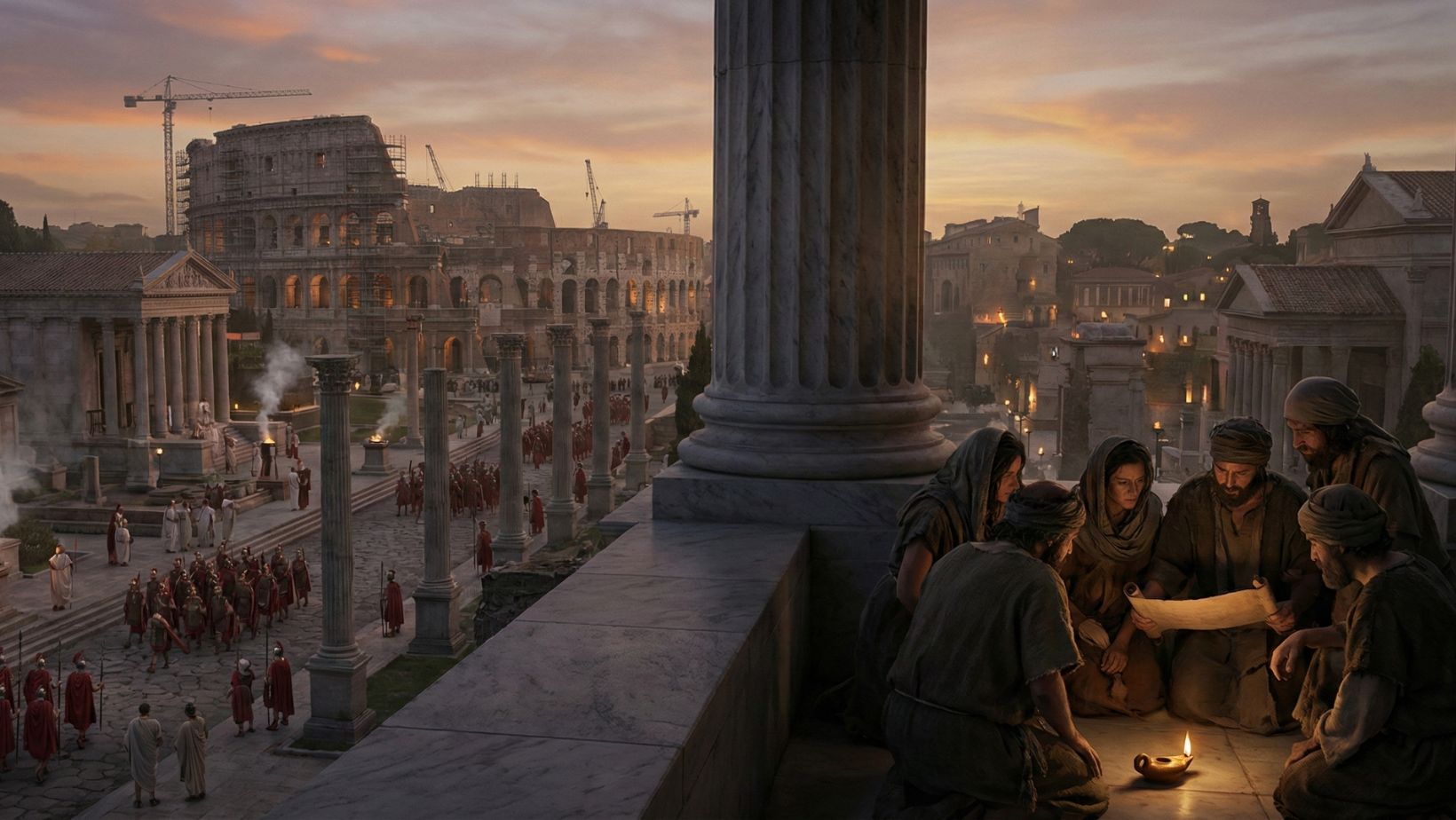
Rome serves as the powerful, looming backdrop for much of the New Testament. It was the “Babylon” of the first century—the epicenter of political power, cultural influence, and eventually, fierce persecution. While Jesus’ ministry took place in the rural Roman backwater of Judea, the trajectory of the Gospel was always headed toward Rome. The Book of Acts ends not in Jerusalem, but with Paul preaching the Kingdom of God in the heart of this imperial capital. Rome represents the ultimate mission field: the center of the known world where the message of Christ confronted the might of Caesar.
Quick Facts
- Biblical Name: Rome (Latin: Roma)
- Location: Central Italy, on the banks of the Tiber River
- Status: Capital of the Roman Empire; the largest city in the ancient world
- Population: Estimated over 1 million in the 1st Century AD
- Key Figures: The Caesars (Augustus, Tiberius, Claudius, Nero), Paul, Peter, Prisca and Aquila
- Biblical Books: Epistle to the Romans, 2 Timothy (written from Rome), 1 Peter (“Babylon”), Acts (final chapters)
- Symbolism: Earthly power, human government, pagan idolatry, and the “End of the Earth” for evangelism
Name Meaning
“Rome”: The etymology is debated but is famously linked to the legend of Romulus, its mythical founder. In Greek, rhome means “strength” or “might,” fitting for the empire that crushed all opposition with iron strength (as prophesied in Daniel 2).
Geographical / Physical Context
Location: Situated on the Italian peninsula along the Tiber River, about 15 miles inland from the Tyrrhenian Sea. It famously sits on “Seven Hills” (Palatine, Aventine, Capitoline, etc.).
Infrastructure: It was a marvel of engineering, boasting aqueducts, the Colosseum (built just after the NT era), the Forum, and a vast network of roads (“All roads lead to Rome”) which inadvertently facilitated the rapid spread of the Gospel.
The Heart of the Empire: As the capital, it was the administrative center for provinces stretching from Britain to Syria. Decisions made here rippled out to affect daily life in Galilee and Jerusalem (e.g., tax decrees).
Biblical Era / Context
The Gospels: Rome is the distant authority. Jesus is born under a decree from Caesar Augustus (Luke 2:1) and crucified under the authority of a Roman governor, Pontius Pilate, representing Caesar Tiberius.
The Book of Acts: Rome is the destination. The narrative arc moves from Jerusalem to Rome. Paul appeals to Caesar, utilizing his Roman citizenship to bring the Gospel to the highest courts.
The Epistles: Rome is the residence of a thriving, diverse church. Paul writes his masterpiece of theology (Romans) to believers he has not yet met, and later writes his “Prison Epistles” (Ephesians, Philippians, Colossians, Philemon) and 2 Timothy while imprisoned there.
Major Roles / Identity
The Iron Beast: In Daniel’s vision, Rome is traditionally interpreted as the fourth beast—terrifying and destructive, breaking everything to pieces (Daniel 7:7).
The Oppressor: To the Jews, Rome was the hated occupier. They looked for a Messiah to overthrow the Roman yoke.
The Mission Field: To the Christians, Rome was the strategic center. If Rome could be reached with the Gospel, the influence would flow to the rest of the world.
The Persecutor: Under Nero (c. 64 AD), Rome shifted from an indifferent judge to an active predator, executing Christians (including Peter and Paul) and serving as the archetype for the “Beast” in Revelation.
Key Characteristics
Power and Order: Pax Romana (Roman Peace) provided stability and safe travel, which aided the apostles, but it was a peace enforced by the sword.
Cosmopolitan: The city was a melting pot of Greeks, Syrians, Jews, and slaves from every conquered nation. The church in Rome reflected this diversity, comprised of both Jews and Gentiles.
Idolatry: The city was filled with temples to Jupiter, Mars, and the Imperial Cult (worship of the Emperor), making the Christian claim that “Jesus is Lord” (Kyrios) a treasonous political statement.
Main Biblical Events
The Expulsion of Jews (c. 49 AD): Emperor Claudius expelled all Jews from Rome due to disturbances over “Chrestus” (likely Christ). This brought Priscilla and Aquila to Corinth, where they met Paul (Acts 18:2).
Paul’s Arrival: After a shipwreck, Paul arrived in Rome as a prisoner. He lived under house arrest for two years, welcoming all who came to him and preaching “without hindrance” (Acts 28:30–31).
Paul’s Martyrdom: Tradition and 2 Timothy 4 suggest Paul was beheaded outside the city walls on the Ostian Road during Nero’s persecution.
Peter’s Ministry: While not recorded in Acts, strong tradition and 1 Peter 5:13 (referencing “Babylon,” a code name for Rome) place Peter in the city, where he was crucified upside down.
Major Relationships
Paul: The Apostle to the Gentiles, whose citizenship allowed him access to the city’s legal system and whose letter to the Romans defined Christian theology.
Peter: The Apostle to the Jews, who eventually shepherded the church in the capital.
Nero: The Emperor (54–68 AD) who embodied the demonic opposition to the faith.
Priscilla & Aquila: Key leaders in the Roman church who risked their necks for Paul.
Notable Passages
Romans 1:7: “To all in Rome who are loved by God and called to be his holy people…”
Acts 28:31: “He proclaimed the kingdom of God and taught about the Lord Jesus Christ—with all boldness and without hindrance!” (The closing verse of Acts).
Romans 13:1: “Let everyone be subject to the governing authorities…” (Paul writing about submission to the very empire that would eventually kill him).
1 Peter 5:13: “She who is in Babylon, chosen together with you, sends you her greetings…”
Legacy & Impact
The Seat of Christianity: Ironically, the empire that tried to destroy the faith became the vehicle for its establishment. Within three centuries, the Emperor Constantine converted, and Rome became the center of Western Christianity.
The Blood of the Martyrs: The Colosseum and Circus Maximus, where Christians were fed to beasts, became symbols of the church’s unconquerable faith. “The blood of the martyrs is the seed of the church” (Tertullian).
Theological Foundation: The Epistle to the Romans, sent to this city, remains the most comprehensive explanation of the Gospel in existence.
Symbolism / Typology
Babylon: In the New Testament (especially Revelation), Rome is styled as “Babylon the Great”—the archetypal city of man that opposes the City of God. It represents seduction, wealth, and persecution.
Citizenship: Rome gave the world the concept of citizenship. Paul uses this to explain that believers are “citizens of heaven” (Philippians 3:20), a higher allegiance than Caesar.
Extra-Biblical References
Tacitus: The Roman historian recorded the Great Fire of Rome (64 AD) and Nero’s scapegoating of the Christians, confirming the brutal penalties they faced.
Suetonius: Mentions the expulsion of Jews by Claudius.
Clement of Rome: An early church father (late 1st Century) who wrote from Rome, confirming the martyrdoms of Peter and Paul.







Leave a Reply