
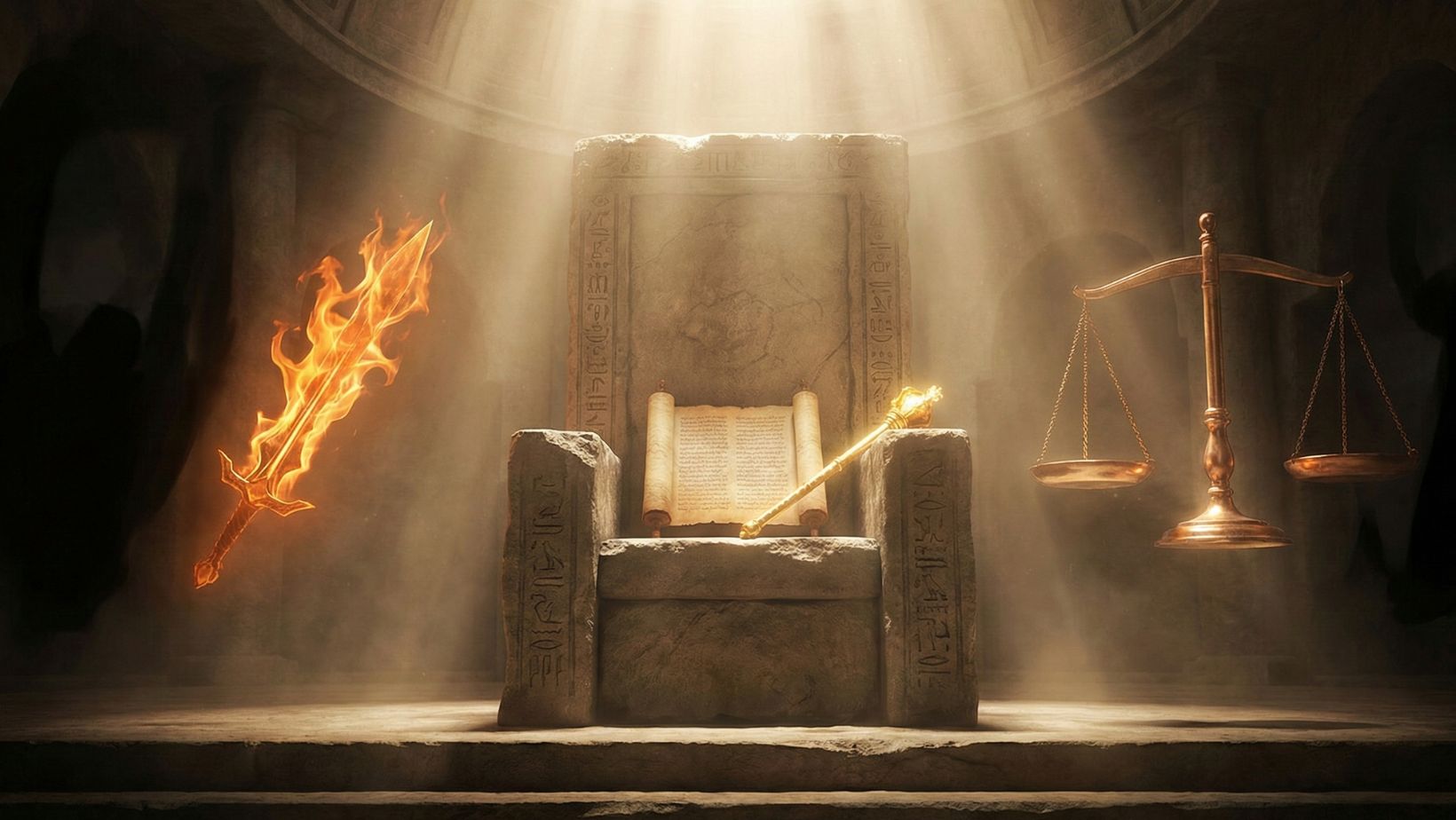
The Justice of God is a foundational attribute of His divine nature, signifying that He is the absolute standard of right and wrong and that He acts in perfect conformity with that standard. Unlike human justice, which can be flawed or biased, God’s justice (often paired with His righteousness) ensures that He always does what is right, rewarding obedience, punishing sin, and defending the oppressed. It is the attribute that necessitates judgment for sin, yet it is also the attribute that drives His plan of redemption, culminating in the Cross where justice and mercy meet.
Quick Facts
- Concept: Divine Justice / Righteousness
- Hebrew Terms: Mishpat (judgment/justice), Tzedakah (righteousness)
- Greek Term: Dikaiosyne
- Category: Moral Attribute (Communicable)
- Key Verse: Deuteronomy 32:4
- Nature: Retributive, Remunerative, and Restorative
- Ultimate Expression: The Atonement of Jesus Christ
- Opposite: Injustice, partiality, corruption
- Symbol: The Throne, The Scales, The Law
Terminology / Definition
Mishpat: This Hebrew term refers to a legal decision, a judgment, or an ordinance. It implies giving everyone their due rights, whether it be punishment for the wicked or protection for the vulnerable (widows, orphans).
Tzedakah: Often translated as “righteousness,” this refers to the ethical standard and moral character of God. Justice is the action; righteousness is the character behind it.
Just: To be “just” means God cannot do wrong; He cannot lie, He cannot contradict His own law, and He cannot let evil go unpunished forever.
Biblical Context / Foundation
Source: God does not conform to an external rule of justice; He is the rule. His nature defines what is just.
The Law: The Mosaic Law (Torah) was a reflection of God’s just nature given to Israel, establishing civil, ceremonial, and moral standards.
The Prophets: The prophets frequently prosecuted Israel for abandoning justice, specifically regarding the mistreatment of the poor (Amos, Micah, Isaiah).
Major Dimensions of Divine Justice
Legislative Justice: God establishes moral laws that are good, perfect, and binding for all humanity.
Retributive Justice: God punishes sin and rebellion. Because He is holy, He cannot look upon iniquity with approval; there is a penalty for violating His law (Romans 6:23).
Restorative Justice: God advocates for the powerless. Biblical justice is not just legalistic; it involves actively righting wrongs, feeding the hungry, and liberating the oppressed (Psalm 146:7–9).
Remunerative Justice: God rewards those who seek Him and live according to His will, not out of debt, but out of gracious promise.
Key Characteristics
Impartiality: God shows no favoritism. He judges princes and paupers by the same standard (Romans 2:11).
Omniscience: Unlike human judges, God knows the secrets of the heart, ensuring His verdicts are based on absolute truth.
Unchanging: His standard of right and wrong does not shift with cultural trends or time.
Inescapable: No one is exempt from accountability before the Creator.
Main Manifestations in History
The Fall: The immediate consequence of spiritual death and expulsion from Eden showed that God keeps His word regarding the penalty of sin.
The Flood: A global judgment against the “wickedness of man” (Genesis 6).
Sodom and Gomorrah: A specific judgment against a culture that had abandoned moral order.
The Exile: God allowed Babylon to conquer Judah as a just consequence for centuries of idolatry and injustice.
The Cross: The supreme demonstration of justice. God could not simply “overlook” sin; the penalty had to be paid. Jesus bore the retributive justice of God so that believers could receive mercy (Romans 3:25–26).
The Final Judgment: The Great White Throne judgment where all wrongs will be righted and evil permanently quarantined (Revelation 20).
Relationship to Other Attributes
Holiness: Justice is the “outworking” of God’s holiness. Because He is set apart from sin, He must judge it.
Mercy: Justice and mercy seem contradictory (one demands punishment, the other withholds it). They are reconciled in Christ, who satisfied the demands of justice so mercy could be extended.
Love: God’s justice is an act of love; a God who did not care about evil or the suffering of victims would not be loving.
Notable Passages
Deuteronomy 32:4: “The Rock, his work is perfect, for all his ways are justice. A God of faithfulness and without iniquity, just and upright is he.”
Micah 6:8: “And what does the LORD require of you? To act justly and to love mercy and to walk humbly with your God.”
Amos 5:24: “But let justice roll on like a river, righteousness like a never-failing stream!”
Romans 3:26: “…so that he might be just and the justifier of the one who has faith in Jesus.”
Legacy & Impact
Human Rights: The concept that every human has inherent value and rights is rooted in the belief of a just Creator who defends the weak.
Judicial Systems: Western legal tradition, particularly the idea of “equality before the law,” draws heavily from the biblical understanding of impartial justice.
Assurance: Believers find comfort knowing that no evil deed goes unseen and that God will eventually settle all accounts.
Atonement Theology: Understanding justice is crucial to understanding the Gospel—without a requirement for justice, there is no need for the Cross.
Symbolism / Typology
The Scales: Representing the weighing of actions and the balance of truth.
The Sword: Symbolizing the power to execute judgment and punish evil (Romans 13:4).
The White Throne: Represents the purity and finality of God’s ultimate verdict.
The City of Refuge: A type of Christ, providing a shelter from strict retribution for those who seek safety in God’s provision.
Extra-Biblical References
Anselm of Canterbury: In Cur Deus Homo, he argued that sin acts as a debt to God’s honor and justice, which only a God-Man (Jesus) could repay.
C.S. Lewis: Often argued that our innate sense of “fairness” is one of the strongest proofs for the existence of a just Lawgiver.







Leave a Reply