
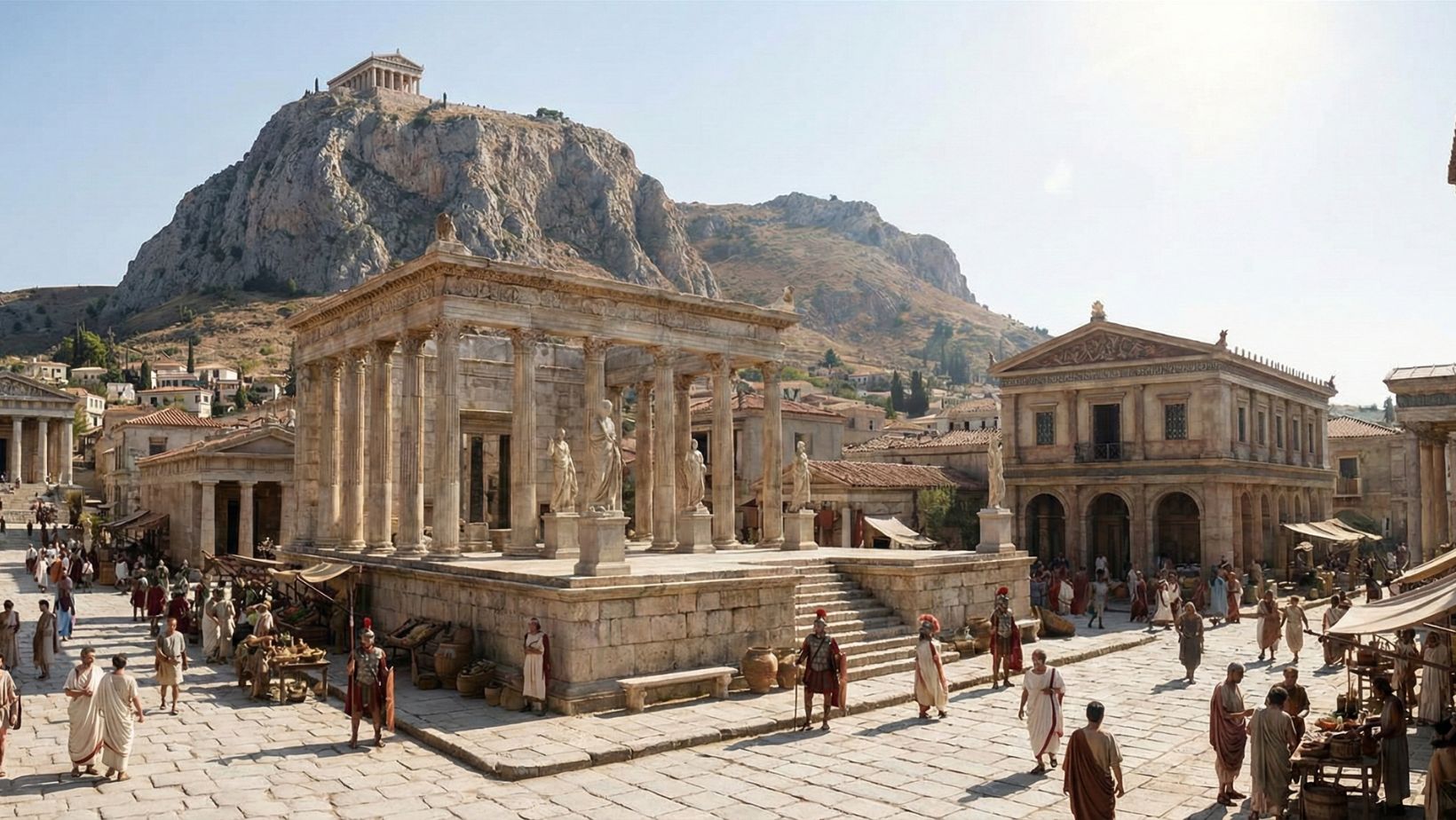
Corinth was one of the most important, wealthy, and culturally complex cities in the New Testament world. Located on a narrow isthmus connecting northern and southern Greece, it was a bustling maritime hub known for its commerce, its cosmopolitan population, and its pervasive immorality. For the Apostle Paul, Corinth represented a strategic center for the spread of the Gospel; he spent eighteen months there establishing a vibrant but troubled church. The letters Paul wrote to the Corinthians reveal the clash between the culture of the world—obsessed with status, wisdom, and pleasure—and the counter-cultural call of the Cross.
Quick Facts
- Location: Southern Greece (Achaia), on the Isthmus of Corinth
- Status: Roman Colony (Capital of the province of Achaia)
- Key Ports: Lechaeum (West/Adriatic) and Cenchreae (East/Aegean)
- Biblical Era: Mid-1st Century AD (Acts 18)
- Associated Figures: Paul, Priscilla & Aquila, Apollos, Timothy, Titus
- Key Features: The Acrocorinth, The Bema (Judgment Seat), Isthmian Games
- Reputation: Wealth, luxury, and sexual immorality
- Biblical Books: Acts 18, 1 & 2 Corinthians, Romans (written from here)
Name Meaning & Reputation
“Corinth” is of uncertain pre-Greek origin. However, the city’s reputation gave rise to the Greek verb korinthiazomai, literally “to act like a Corinthian,” which meant to practice sexual immorality and debauchery. To call a girl a “Corinthian lass” was a euphemism for a prostitute.
Geography / Strategic Importance
The Master of Two Harbors: Corinth sat on a narrow strip of land (the Isthmus) separating the Ionian Sea from the Aegean Sea. Instead of sailing around the dangerous southern cape of Greece, ships were dragged across this 4-mile land bridge on a paved slipway called the Diolkos.
Control of Trade: Because it controlled both north-south land travel and east-west sea trade, Corinth became immensely wealthy through taxation and commerce.
The Acrocorinth: A massive, fortified mountain rising 1,800 feet above the city, serving as a citadel and the site of the Temple of Aphrodite.
Shutterstock
Explore
Historical Context
Destruction and Rebirth: The ancient Greek city was destroyed by Rome in 146 BCE. It lay desolate for a century until Julius Caesar refounded it as a Roman colony in 44 BCE.
Roman Identity: By Paul’s time, Corinth was a “Little Rome” in Greece. The official language was Latin, Roman law prevailed, and the culture was driven by upward mobility, patronage, and status seeking.
Religious Pluralism: It was home to the Imperial Cult (worship of the Emperor), the Temple of Apollo, and the famous Temple of Aphrodite (goddess of love), contributing to the city’s licentious atmosphere.
Biblical Significance
Paul’s Ministry (Acts 18): Paul arrived in Corinth around 50-51 AD. He worked as a tentmaker alongside Aquila and Priscilla (refugees from Rome) and preached first in the synagogue, then in the house of Titius Justus.
The Church: The Corinthian church was a mix of Jews and Gentiles, rich and poor, slaves and free. This diversity caused significant internal conflict regarding social status, spiritual gifts, and food sacrificed to idols.
The “Bema” Incident: The Jews brought Paul before the Roman Proconsul, Gallio, at the Bema (Judgment Seat). Gallio dismissed the case as a religious dispute, effectively legalizing Christianity under Roman law for the time being.
Key Themes in Corinthian Epistles
The Cross vs. Human Wisdom: Corinthians prized rhetoric and philosophy. Paul countered that the “foolishness” of the Cross shames the wisdom of the wise (1 Corinthians 1).
Sexual Purity: In a city where “everything is permissible,” Paul taught that the believer’s body is a temple of the Holy Spirit (1 Corinthians 6).
Unity in Diversity: The church was fractured by cliques. Paul used the metaphor of the “Body of Christ” to teach that every member is necessary (1 Corinthians 12).
Resurrection: Paul wrote his most extensive defense of the physical resurrection (1 Corinthians 15) to counter Greek skepticism about the afterlife.
Major Figures Associated
Paul: The founding father who viewed the church with “godly jealousy.”
Apollos: A learned orator from Alexandria whose polished speaking style fascinated the Corinthians, unintentionally creating a faction rivaling Paul’s.
Aquila & Priscilla: Tentmakers who hosted the church in their home and mentored Apollos.
Erastus: The city treasurer (Director of Public Works). An inscription found in Corinth bearing the name “Erastus” is widely believed to refer to this biblical figure (Romans 16:23).
Notable Passages
Acts 18:9-10: God’s encouragement to Paul — “Do not be afraid; keep on speaking, do not be silent… because I have many people in this city.”
1 Corinthians 13: The “Love Chapter,” written to correct a church that valued spiritual power over spiritual character.
2 Corinthians 5:17: “Therefore, if anyone is in Christ, the new creation has come: The old has gone, the new is here!”
2 Corinthians 12:9: Paul’s thorn in the flesh — “My grace is sufficient for you, for my power is made perfect in weakness.”
Archeology & Physical Remains
The Bema (Tribunal): A raised platform in the marketplace (agora) where officials addressed the public and rendered judgment. This provides the visual background for Paul’s teaching that “we must all appear before the judgment seat of Christ” (2 Corinthians 5:10).
The Erastus Inscription: A pavement stone inscription mentioning “Erastus… laid this pavement at his own expense,” confirming the high social status of some early believers.
Temple of Apollo: Seven archaic columns still stand today, dominating the ruins.
Legacy & Symbolism
The City of Refuge: Corinth proves that no city is “too sinful” for God. It was in this center of vice that God told Paul, “I have many people in this city.”
The Temple of the Spirit: The concept that God dwells in people, not buildings, was a radical challenge to the massive stone temples dominating the Corinthian skyline.
Running the Race: The nearby Isthmian Games (second only to the Olympics) provided the imagery for Paul’s frequent metaphors about running for the prize and disciplining the body.







Leave a Reply