
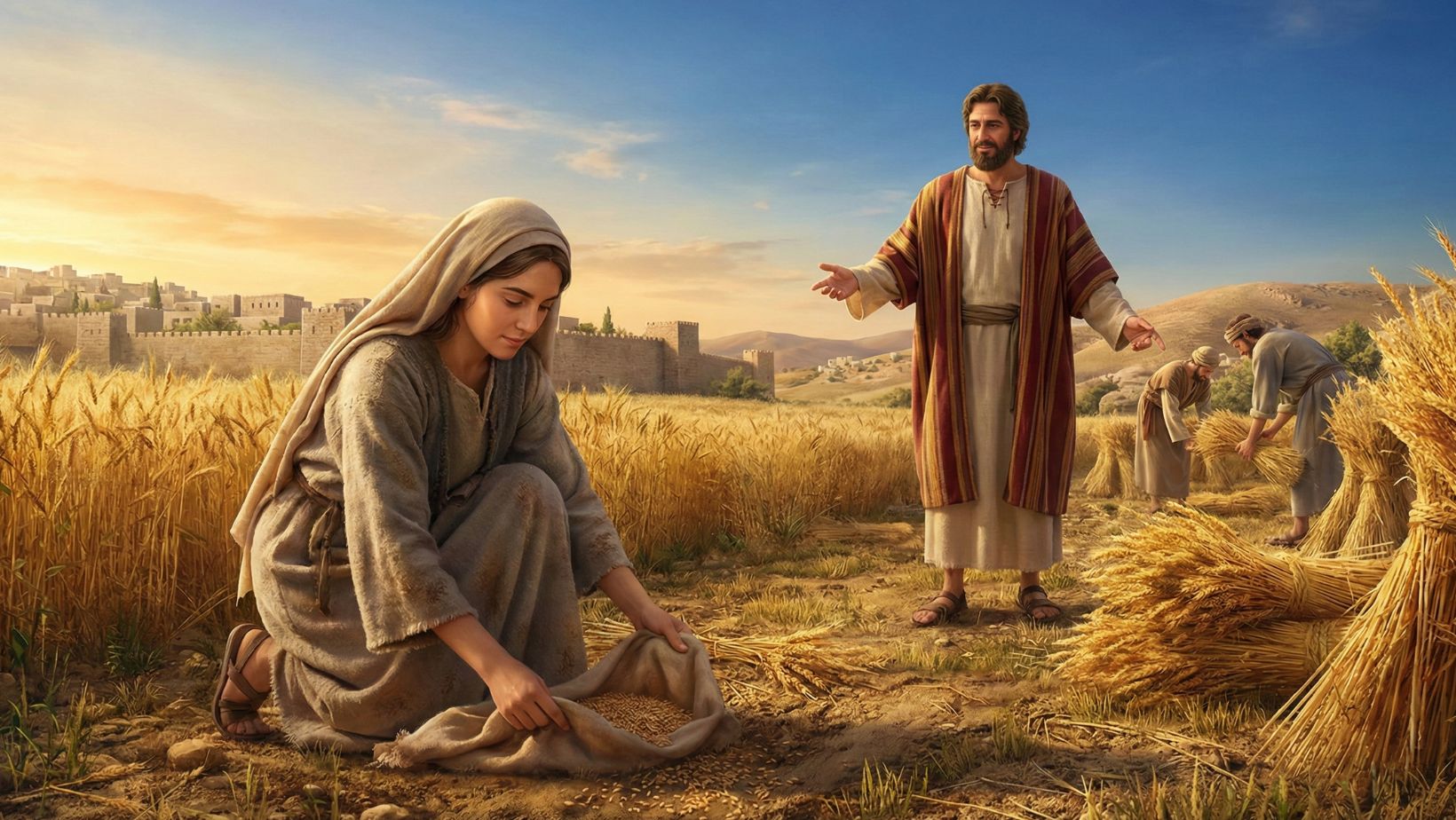
Ruth 2 marks a dramatic shift from the famine and funeral atmosphere of Chapter 1 to the fields of harvest in Chapter 2. The narrative zooms in on the practical survival of the two widows. Ruth takes the initiative to glean in the barley fields to support Naomi. Through apparent coincidence—which the narrator identifies as divine providence—she enters the field of Boaz, a wealthy relative of Elimelech. Boaz notices Ruth, protects her, and extends extraordinary generosity toward her because of her reputation for loyalty to Naomi. The chapter concludes with Naomi realizing that God has not forsaken them, identifying Boaz as a “family redeemer,” sparking a glimmer of hope for their future restoration.
1. Providence in the Fields (Ruth 2:1–3 NLT)
1 Now there was a wealthy and influential man in Bethlehem named Boaz, who was a relative of Naomi’s husband, Elimelech. 2 One day Ruth the Moabite said to Naomi, “Let me go out into the harvest fields to pick up the stalks of grain left behind by anyone who is kind enough to let me do it.” Naomi replied, “All right, my daughter, go ahead.” 3 So Ruth went out to gather grain behind the harvesters. And as it happened, she found herself working in a field that belonged to Boaz, the relative of her father-in-law, Elimelech.
Commentary:
- Introduction of Boaz (v. 1): The narrator introduces Boaz before Ruth meets him to build anticipation. He is described as a man of gibbor chayil (wealth/influence/standing). This parallels the description of Ruth later as a woman of noble character (eshet chayil). He is a kinsman, which is the key legal detail for the rest of the book.
- Ruth’s Initiative (v. 2): Ruth does not sit in passivity or wallow in victimization. She takes the initiative to work. She relies on the Mosaic Law of gleaning (Leviticus 19:9–10; Deuteronomy 24:19), which functioned as a welfare system where landowners were commanded to leave the corners of their fields and dropped grain for the poor and foreigners.
- The “Hap” of God (v. 3): The phrase “as it happened” (KJV: “her hap was to light on”) is a crucial literary device. In Hebrew (miqreh), it suggests a chance occurrence. However, the theology of the book implies that this “accident” was actually the invisible hand of God guiding her steps.
- The Risk: Gleaning was dangerous for a lone, foreign woman. She was vulnerable to abuse by the male harvesters, making her venture an act of courage.
2. Boaz Notices Ruth (Ruth 2:4–7 NLT)
4 While she was there, Boaz arrived from Bethlehem and greeted the harvesters. “The Lord be with you!” he said. “The Lord bless you!” the harvesters replied. 5 Then Boaz asked his foreman, “Who is that young woman over there? Who does she belong to?” 6 And the foreman replied, “She is the young woman from Moab who came back with Naomi. 7 She asked me this morning if she could gather grain behind the harvesters. She has been hard at work ever since she arrived, except for a few minutes’ rest in the shelter.”
Commentary:
- The Character of Boaz (v. 4): The exchange of blessings between Boaz and his employees indicates that he is a man of faith who treats his workers with dignity. This establishes him as a safe figure in a time when the Judges ruled and safety was scarce.
- The Question of Identity (v. 5): Boaz asks, “Who does she belong to?” In the patriarchal society of the time, a woman was usually identified by the man she was attached to (father or husband). Ruth, as a widow, had no male protection.
- The Foreman’s Report (v. 6-7): The foreman identifies her by her ethnicity (“from Moab”) and her association with Naomi. He highlights her extraordinary work ethic. She asked permission (showing humility, though she had a legal right) and worked tirelessly from morning until now.
- The Outsider: The repetition of “Moabite” underscores her status as a foreigner. She is racially and culturally distinct from the Israelites in the field.
3. Grace and Protection (Ruth 2:8–13 NLT)
8 Boaz went over to say to Ruth, “Listen, my daughter. Stay right here with us when you gather grain; don’t go to any other fields. Stay right behind the young women working in my field. 9 See which part of the field they are harvesting, and then follow them. I have warned the young men not to treat you roughly. And when you are thirsty, help yourself to the water they have drawn from the water jars.” 10 Ruth fell at his feet and thanked him warmly. “What have I done to deserve such kindness?” she asked. “I am only a foreigner.” 11 “Yes, I know,” Boaz replied. “But I also know about everything you have done for your mother-in-law since the death of your husband. I have heard how you left your father and mother and your own land to live here among complete strangers. 12 May the Lord, the God of Israel, under whose wings you have come to take refuge, reward you fully for what you have done.” 13 “I hope I continue to please you, sir,” she replied. “You have comforted me by speaking so kindly to me, even though I am not one of your workers.”
Commentary:
- Protective Measures (v. 8-9): Boaz goes beyond the legal requirement. The law said she could glean; it did not require the landowner to ensure her safety.
- He invites her to stay with his female servants (social integration).
- He commands the men not to touch her (physical protection).
- He offers her water drawn by the men. Historically, women drew water for men. For a man to offer a foreign woman water from his distinct jars was a sign of immense favor and elevation of status.
- Ruth’s Humility (v. 10): Ruth is overwhelmed by chen (favor/grace). She identifies herself as a “foreigner,” acknowledging she has no claim to this kindness.
- The Motive (v. 11): Boaz is not motivated by attraction, but by character. He has heard of her hesed (loyalty) to Naomi.
- Divine Wings (v. 12): This is the theological center of the chapter. Boaz invokes Yahweh, visualizing God as a bird protecting its young under its wings.
- Speaking to the Heart (v. 13): Ruth notes that Boaz has “spoken kindly” (literally: spoken to the heart). This is the first time in the narrative someone has spoken life into her situation.
4. Extraordinary Generosity (Ruth 2:14–16 NLT)
14 At mealtime Boaz called to her, “Come over here, and help yourself to some food. You can dip your bread in the sour wine.” So she sat with his harvesters, and Boaz gave her some roasted grain to eat. She ate all she wanted and still had some left over. 15 When she went back to work again, Boaz ordered his young men, “Let her gather grain right among the sheaves without stopping her. 16 And pull out some heads of barley from the bundles and drop them on purpose for her. Let her pick them up, and don’t give her a hard time!”
Commentary:
- Table Fellowship (v. 14): Sharing a meal was a significant act of acceptance. The “sour wine” (vinegar) was a refreshment for laborers. Boaz serving her roasted grain personally is an act of service that breaks social hierarchy (landowner serving a beggar).
- Satiety (v. 14): “She ate all she wanted and still had some left over.” This contrasts sharply with the famine in Chapter 1.
- Grace upon Grace (v. 15-16): Boaz instructs his workers to allow her to glean “among the sheaves”—areas usually reserved for the hired reapers, not gleaners.
- Intentional “Loss” (v. 16): Boaz commands the reapers to pull grain out of the bundles and drop it “on purpose.” This is a profound picture of dignity. He doesn’t just give her a handout; he allows her to continue working, but he ensures her work is wildly successful.
5. The Report to Naomi (Ruth 2:17–23 NLT)
17 So Ruth gathered barley there all day, and when she beat out the grain that evening, it filled an entire basket. 18 She carried it back into town and showed it to her mother-in-law. Ruth also gave her the roasted grain that was left over from her meal. 19 “So where did you gather all this grain today?” Naomi asked. “Where did you work? May the Lord bless the one who helped you!” So Ruth told her mother-in-law about the man in whose field she had worked. She said, “The man I worked with today is named Boaz.” 20 “May the Lord bless him!” Naomi told her daughter-in-law. “He is showing his kindness to us as well as to your dead husband. That man is one of our closest relatives, one of our family redeemers.” 21 Then Ruth the Moabite said, “What’s more, he told me to stay with his workers until they have finished harvesting all his grain.” 22 “This is wonderful!” Naomi said to her daughter-in-law Ruth. “You must do as he says. Stay with his young women, for in another field you might be harassed.” 23 So Ruth worked alongside the women in Boaz’s fields and gathered grain with them until the end of the barley harvest. Then she continued working with them through the wheat harvest, too. But all the while she lived with her mother-in-law.
Commentary:
- The Results (v. 17):
- The Ephah: The NLT translates this as a “basket,” but the Hebrew is an ephah.
- Concrete Statistic: An ephah of barley is approximately 30 to 50 pounds (14-23 kg) or roughly 22 liters. This would have been enough food to sustain two women for several weeks. This was an astonishing amount for one day of gleaning.
- Naomi’s Awakening (v. 19-20): The sight of the food and the name “Boaz” wakes Naomi from her spiritual depression. She realizes God has not stopped showing kindness (hesed).
- The Family Redeemer (v. 20): Naomi identifies Boaz as a Goel (Kinsman-Redeemer).
- Legal Concept: Based on Leviticus 25, a Goel had the responsibility to redeem enslaved relatives, buy back lost property, and (in some interpretations linked to Levirate marriage) ensure the continuation of the family line.
- Duration of Stay (v. 23): Ruth stays in Boaz’s field for the duration of the barley (spring) and wheat (early summer) harvests. This implies a period of roughly 7 weeks (approx. late April to early June).
Theological Significance of Ruth 2
- God’s Invisible Providence: God is never quoted speaking in this chapter, yet His activity is everywhere. He guides Ruth to the specific field, He softens Boaz’s heart, and He provides the harvest.
- The Theology of Work and Welfare: The chapter provides a biblical model for aiding the poor. Ruth is not passive; she works hard. However, the system (Boaz) is structured to be generous and protective, ensuring that her work yields a living wage.
- Christological Foreshadowing: Boaz acts as a type of Christ. He takes notice of the foreigner, invites her to his table, provides protection, and acts as the Redeemer who pays the price to restore the destitute.
Practical Applications
- Initiative in Difficulty: When facing hardship, prayer should be accompanied by practical action. Ruth prayed with her feet by going to the field.
- The Role of the Influential: Those with “standing” (like Boaz) are called to use their privilege to protect the vulnerable and provide for those who cannot repay them.
- Character over Appearance: Boaz valued Ruth for her loyalty and reputation, not her ethnicity or social standing. We should assess people by their character rather than their background.
Final Insight
Ruth 2 bridges the gap between despair and redemption. It demonstrates that while God’s people may face “famine” seasons, God often has a “Boaz” prepared—a source of grace found in the fields of our obedience.







Leave a Reply