
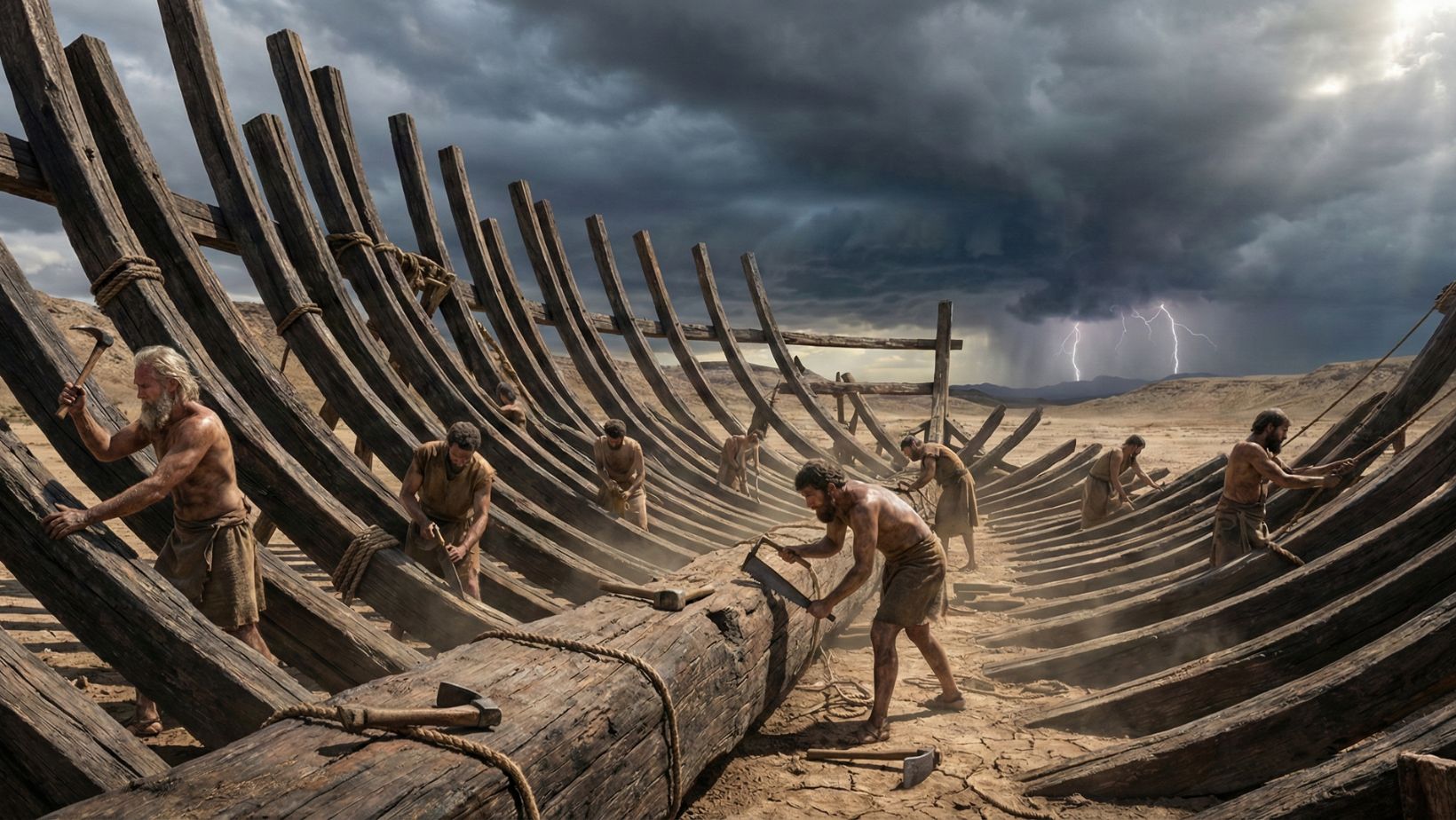
Genesis 6 marks a pivotal and tragic shift in the biblical narrative, moving from the growth of humanity to the necessity of “de-creation.” The chapter describes a rapid escalation of moral depravity, violence, and spiritual corruption that grieves God to His core. As the boundaries between the divine and the human are transgressed and the earth is filled with violence, God resolves to wipe out the human race. However, amidst universal corruption, one man—Noah—finds favor with the Lord. The chapter details God’s instructions to Noah to build an Ark, establishing the framework for judgment and the first explicit covenant in Scripture to preserve life.
1. The Corruption of the Cosmic Order (Genesis 6:1–4)
1 Then the people began to multiply on the earth, and daughters were born to them. 2 The sons of God saw the beautiful women and took any they wanted as their wives. 3 Then the Lord said, “My Spirit will not put up with humans for long, for they are only mortal flesh. In the future, their normal lifespan will be no more than 120 years.” 4 In those days, and for some time after, giant Nephilites lived on the earth, for whenever the sons of God had intercourse with women, they gave birth to children who became the heroes and famous warriors of ancient times.
Commentary:
- “Sons of God” (Bene Elohim): This phrase has generated three primary historical interpretations regarding the identity of these beings:
- The Sethite View: They were the righteous descendants of Seth who intermarried with the “daughters of men” (the ungodly line of Cain), leading to spiritual compromise.
- The Angelic View: Supported by ancient Jewish texts (like 1 Enoch) and implied in the New Testament (Jude 6, 2 Peter 2:4), this view suggests fallen angels took human form to cohabit with women, attempting to corrupt the human genome or cosmic order.
- The Royal/Despotic View: “Sons of God” refers to power-hungry kings or distinct rulers who practiced polygamy, treating women as property (“took any they wanted”).
- The Limit of 120 Years (v. 3): This likely refers to a countdown or a period of grace before the Flood occurs, rather than a hard biological cap on individual human lifespans immediately (as post-flood patriarchs lived longer than 120 years for several generations). It demonstrates God’s patience even in judgment.
- The Nephilim (v. 4): The Hebrew word Nephilim comes from the root naphal (“to fall”). They are described as “giants” or “fallen ones.”
- Physical description: They were known for physical superiority and military might (“heroes,” “warriors”).
- Chronology: The text notes they were on the earth “in those days, and for some time after,” suggesting their presence or the rise of similar “giant” warriors was not limited to this single moment (later seen in Numbers 13:33).
Insight: The core issue in these verses is the transgression of boundaries. Whether angelic, lineage-based, or political, the “sons of God” seized what they desired without divine restraint. It illustrates that when the authority structure of heaven is ignored, chaos reigns on earth.
2. Divine Grief and the Depravity of Man (Genesis 6:5–8)
5 The Lord observed the extent of human wickedness on the earth, and he saw that everything they thought or imagined was consistently and totally evil. 6 So the Lord was sorry he had ever made them and put them on the earth. It broke his heart. 7 And the Lord said, “I will wipe this human race I have created from the face of the earth. Yes, and I will destroy every living thing—all the people, the large animals, the small animals that scurry along the ground, and the birds of the sky. I am sorry I ever made them.” 8 But Noah found favor in the Lord’s eyes.
Commentary:
- Total Depravity (v. 5): The description of sin here is absolute. The text uses comprehensive language: “everything,” “thought,” “imagined,” “consistently,” “totally.” It indicates that sin was not just an external action but an internal condition of the heart.
- Divine Sorrow (v. 6):
- Anthropopathism: The text attributes human emotions to God to help us understand His nature. God is not fickle or admitting a mistake; rather, He is expressing deep relational pain.
- “Broke his heart”: In Hebrew, this implies distinct emotional pain and grief. God’s judgment is not an act of cold fury but of a grieving Father.
- The Scope of Judgment (v. 7): The creation mandate gave man dominion over animals. Consequently, when man falls and must be judged, the creation under his stewardship suffers with him (Romans 8:20–22).
- Noah’s Favor (v. 8): The Hebrew word for “favor” is chen, often translated as “grace.” Noah is not saved because he earned it through perfection, but because he received God’s grace. This is the first usage of the word “grace” in the Bible.
Insight: This passage dismantles the idea of an emotionless “Watchmaker” God. God is deeply emotionally invested in His creation. His justice (judgment) and His love (grief) are not contradictory; they are two sides of His holiness. He destroys because He cherishes the purity of what He made.
3. The Character of Noah (Genesis 6:9–12)
9 This is the account of Noah and his family. Noah was a righteous man, the only blameless person living on earth at the time, and he walked in close fellowship with God. 10 Noah was the father of three sons: Shem, Ham, and Japheth. 11 Now God saw that the earth had become corrupt and was filled with violence. 12 God observed all this corruption in the world, for everyone on earth was corrupt.
Commentary:
- Righteous and Blameless (v. 9):
- Righteous (tsaddiq): Refers to his standing in accordance with God’s standard (moral conformity).
- Blameless (tamiym): Means “whole,” “complete,” or “sound.” It does not imply sinlessness, but rather integrity and a lack of glaring moral blemish compared to his contemporaries.
- “Walked… with God” (v. 9): This recalls Enoch (Genesis 5:24). It implies a daily, intimate communion with the Creator.
- Violence (v. 11): The Hebrew word used here is hamas, meaning wrong, violence, or cruelty. The breakdown of relationship with God inevitably led to the breakdown of relationships between humans, resulting in a society ruled by brute force.
Insight: Noah’s righteousness is highlighted by the contrast of his environment. Being “blameless” is relatively easy in a monastery; being blameless when “everyone on earth was corrupt” requires supernatural fortitude and faith.
4. The Commission to Build the Ark (Genesis 6:13–22)
13 So God said to Noah, “I have decided to destroy all living creatures, for they have filled the earth with violence. Yes, I will wipe them all out along with the earth! 14 “Build a large boat from cypress wood and waterproof it with tar, inside and out. Then construct decks and stalls throughout its interior. 15 Make the boat 450 feet long, 75 feet wide, and 45 feet high. 16 Leave an 18-inch opening below the roof all the way around the boat. Put the door on the side, and build three decks inside the boat—lower, middle, and upper. 17 “Look! I am about to cover the earth with a flood that will destroy every living thing that breathes. Everything on earth will die. 18 But I will confirm my covenant with you. So enter the boat—you and your wife and your sons and their wives. 19 Bring a pair of every kind of animal—a male and a female—into the boat with you to keep them alive during the flood. 20 Pairs of every kind of bird, and every kind of animal, and every kind of small animal that scurries along the ground will come to you to be kept alive. 21 And be sure to take on board enough food for your family and for all the animals.” 22 So Noah did everything exactly as God had commanded him.
Commentary:
- The Material (v. 14): “Cypress wood” (NLT) translates the obscure Hebrew gopher wood. It was likely a resinous wood resistant to rot. The “tar” (pitch) provided necessary waterproofing.
- The Dimensions (v. 15): The text gives dimensions in cubits (approx. 18 inches). The NLT converts this to modern measurements.
- Length: 450 feet (approx. 137 meters).
- Width: 75 feet (approx. 23 meters).
- Height: 45 feet (approx. 14 meters).
- Ratio: The 6:1 ratio of length to width is recognized by naval architects as providing immense stability in rough seas, rather than speed.
- Capacity Statistics:
- Total Volume: Approximately 1.5 million cubic feet.
- Equivalent Capacity: This volume is roughly equivalent to 522 standard railroad stock cars.
- Floor Space: With three decks, the total deck area would be approximately 101,250 square feet.
- The Covenant (v. 18): This is the first explicit mention of a berith (covenant) in the Bible. God binds Himself to preserve Noah.
- Passive Gathering (v. 20): Note that God says the animals “will come to you.” Noah did not have to hunt or trap them; divine instinct guided the animals.
- Obedience (v. 22): The chapter concludes with a statement of total compliance. Noah built a massive structure on dry land, likely amidst mockery, based solely on the word of God.
Insight: The specific engineering details provided by God emphasize that salvation is a specific, designed process. God did not tell Noah to “find a way to survive”; He gave a blueprint. Salvation requires adherence to God’s specific plan, not human innovation.
Theological Significance of Genesis 6
- The Severity of Sin: Sin is not merely a mistake; it is a destructive force that ruins the “good” creation God made, necessitating judgment to purge the earth.
- Grace Precedes Obedience: Noah found favor (grace) before he built the Ark. His obedience in building the Ark was a response to God’s grace, not the cause of it.
- God as Judge and Savior: Genesis 6 holds these two attributes in tension. God judges the wicked world but provides a means of salvation for the righteous. This foreshadows the gospel, where judgment for sin and salvation for the sinner meet at the Cross.
- The Ark as a Type of Christ: Just as the Ark was the only means of safety from divine judgment, the New Testament presents Jesus Christ as the only vessel of salvation (1 Peter 3:20–21). Those “in” the Ark were saved; those “in” Christ are saved.
Practical Applications
- Walking with God in a Corrupt Culture: Noah demonstrates that it is possible to remain faithful even when the entire surrounding culture is hostile to God. We are called to be distinct.
- Taking God at His Word: Noah spent decades building a boat for rain that had never fallen (Hebrews 11:7). Faith often requires obeying God’s instructions even when they contradict current experiences or logic.
- The Grief of God: Understanding that our sin “breaks God’s heart” should motivate us toward holiness more than the fear of punishment does.
- Preparation for Judgment: Just as God provided a warning and a window of time (120 years) before the flood, the Bible teaches that there is a future judgment coming. We are currently in a period of grace, and like Noah, we should use this time to prepare and warn others.
Final Insight
Genesis 6 presents the dark reality that human progress does not equate to moral improvement; in fact, society became more advanced and simultaneously more wicked. Yet, in the face of global catastrophe, God focuses on the individual. He notices the one man who walks with Him. The chapter serves as a solemn reminder that God is attentive to both the sins of the masses and the faithfulness of the few.







Leave a Reply