
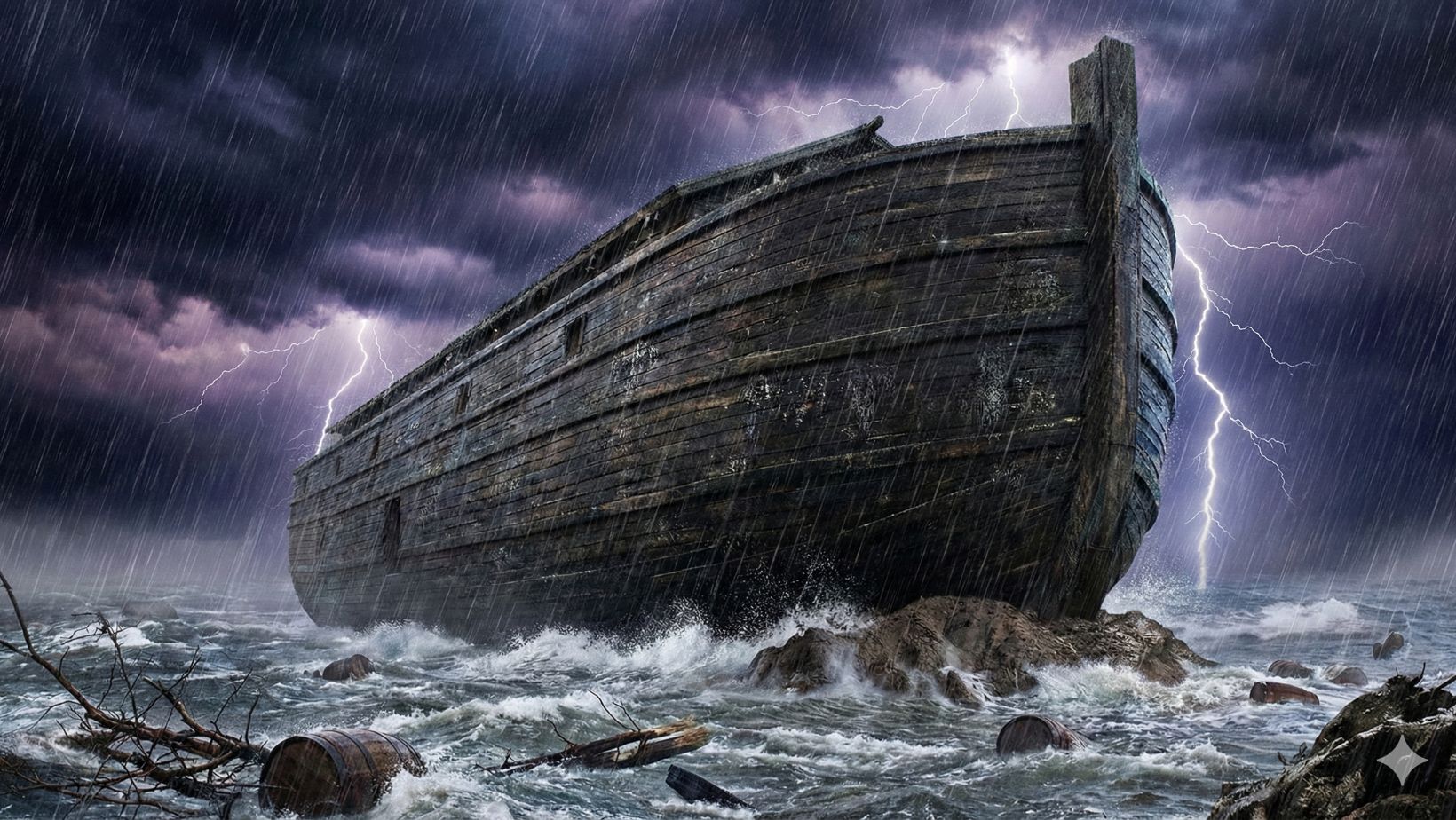
Genesis 7 chronicles the execution of the divine judgment pronounced in the previous chapter. The waiting period ends, and the “de-creation” of the world begins. God commands Noah to enter the Ark, distinguishing for the first time between clean and unclean animals. The floodwaters are unleashed not merely through rain, but through a cataclysmic rupture of the earth’s crust and the opening of the atmospheric heavens. As the waters rise to cover the highest mountains, the Ark floats safely on the surface. The chapter concludes with the total annihilation of all land-based life outside the Ark, contrasting the severity of God’s wrath with the security of His covenant protection.
1. The Call to Enter and the Preservation of Species (Genesis 7:1–5)
1 When everything was ready, the Lord said to Noah, “Go into the boat with all your family, for among all the people of the earth, I can see that you are the only righteous one. 2 Take with you seven pairs—male and female—of each animal I have approved for eating and for sacrifice. Take only one pair of each of the others. 3 Also take seven pairs of every kind of bird. There must be a male and a female in each pair to ensure that all life will survive on the earth after the flood. 4 Seven days from now I will make the rains pour down on the earth. And it will rain for forty days and forty nights, until I have wiped from the earth all the living things I have created.” 5 So Noah did everything as the Lord commanded him.
Commentary:
- The Invitation (v. 1): The command “Go into” (literally “Come into” in some translations) implies that God is already within the Ark or that the Ark is the place of God’s presence and safety. It is an invitation to fellowship and safety, not just an order of evacuation.
- Righteousness Reaffirmed (v. 1): God reiterates the basis of Noah’s selection. In a world of universal corruption, Noah remains distinct.
- Clean vs. Unclean (v. 2):
- The Seven-Day Warning (v. 4): God gives a final one-week countdown. This period likely allowed for the final loading of animals and served as a last, silent testimony to the watching world—a final week of grace before judgment.
- The Number Forty (v. 4): This is the first prominent use of “forty” in Scripture, a number often associated with testing, trial, and probation (e.g., Israel in the wilderness, Jesus in the desert).
Insight: God’s provision is abundant. He does not just provide enough animals for survival (one pair), but enough for worship (seven pairs). Worship is factored into the logistics of survival.
2. The Onset of the Deluge (Genesis 7:6–16)
6 Noah was 600 years old when the flood covered the earth. 7 He went on board the boat to escape the flood—he and his wife and his sons and their wives. 8 With them were all the various kinds of animals—those approved for eating and for sacrifice and those that were not—along with all the birds and the small animals that scurry along the ground. 9 They entered the boat in pairs, male and female, just as God had commanded Noah. 10 After seven days, the waters of the flood came and covered the earth. 11 When Noah was 600 years old, on the seventeenth day of the second month, all the underground waters erupted from the earth, and the rain fell in mighty torrents from the sky. 12 The rain continued to fall for forty days and forty nights. 13 That very day Noah had gone into the boat with his wife and his sons—Shem, Ham, and Japheth—and their wives. 14 With them in the boat were pairs of every kind of animal—domestic and wild, large and small—along with birds of every kind. 15 Two by two they came into the boat, representing every living thing that breathes. 16 A male and female of each kind entered, just as God had commanded Noah. Then the Lord shut him in.
Commentary:
- Precise Dating (v. 11): The flood is dated to the 600th year of Noah, 2nd month, 17th day. This specificity counters the idea of the flood being a myth or fable (“once upon a time”); it is presented as a concrete historical event.
- Mechanism of the Flood (v. 11): The flood was not caused by rain alone. The text describes a cosmic upheaval involving two sources:
- “Underground waters erupted” (Fountains of the Great Deep): This suggests a geological cataclysm—oceanic ridges breaking open, tectonic shifts, or subterranean aquifers bursting.
- “Rain fell in mighty torrents” (Windows of Heaven): The collapse of the atmospheric waters (possibly the “canopy” implied in Genesis 1:7).
- De-Creation: In Genesis 1, God separated the waters below from the waters above to create dry land. Here, those barriers are removed. The waters crash back together, returning the earth to a state of watery chaos (tohu wa-bohu).
- “The Lord Shut Him In” (v. 16):
Insight: There is a profound theological tension in verse 16: “God commanded Noah” (human obedience) followed by “The Lord shut him in” (divine sovereignty). We build the “ark” of our lives through obedience, but ultimately, it is God who secures us.
3. The Rising Waters and Total Destruction (Genesis 7:17–24)
17 For forty days the floodwaters grew deeper, covering the ground and lifting the boat high above the earth. 18 As the waters rose higher and higher above the ground, the boat floated safely on the surface. 19 Finally, the water covered even the highest mountains on the earth, 20 rising more than twenty-two feet above the highest peaks. 21 All the living things on earth died—birds, domestic animals, wild animals, small animals that scurry along the ground, and all the people. 22 Everything that breathed and lived on dry land died. 23 God wiped out every living thing on the earth—people, livestock, small animals that scurry along the ground, and the birds of the sky. All were destroyed. The only people who survived were Noah and those with him in the boat. 24 And the floodwaters covered the earth for 150 days.
Commentary:
- The Buoyancy of the Ark (v. 17-18): As the waters—the instrument of judgment—rose, they simultaneously lifted the Ark. The very thing that destroyed the wicked elevated the righteous.
- The Depth of the Water (v. 20):
- The text states the water rose 15 cubits (approx. 22 feet) above the highest peaks.
- Significance: Since the Ark was 30 cubits high, its draft (how deep it sat in the water) would likely be about half its height (15 cubits) when fully loaded. The water level ensured the Ark would not crash into submerged mountain peaks.
- Universality of Judgment (v. 21-23): The text is repetitive to emphasize total annihilation. It lists birds, cattle, beasts, creeping things, and mankind. The repetition serves as a funeral dirge for the pre-flood world.
- “Only Noah” (v. 23): This phrase underscores the concept of the Remnant. The majority is not always right; here, the entire human race is wrong, and a tiny minority is saved.
- Duration (v. 24): The waters “prevailed” or maintained their peak level for 150 days (approx. 5 months) before beginning to recede.
Insight: The flood is the ultimate reminder that God is not obligated to preserve life that rebels against Him. The default state of a sinful world is death; life is a gift of grace sustained only by His mercy.
Theological Significance of Genesis 7
- De-Creation and Re-Creation: The flood is a reversal of creation. God allows the chaotic waters to overwhelm the ordered world, washing it clean to begin again with Noah (a new Adam).
- The Ark as Salvation: The Ark is the primary type of salvation in the Old Testament. It was:
- Divine Patience and Justice: God waited 120 years (Gen 6:3) and then 7 more days (Gen 7:4), but eventually, judgment came. This teaches that God’s patience should not be mistaken for apathy.
Practical Applications
- Responding to Urgent Warnings: Just as there was a final “7 days” before the rain, we often have windows of opportunity to respond to God. We must not procrastinate in matters of spiritual importance.
- Trusting God in the “Shut In”: Sometimes we feel trapped or isolated, “shut in” by circumstances. We can trust that if God has shut the door, it is for our protection, even if it feels restrictive.
- The Safety of Obedience: Noah survived the storm not because he was a master sailor, but because he was inside the shelter God provided. Our safety lies in being “in Christ,” not in our ability to navigate life’s storms.
- Living as a Minority: Noah’s family was a microscopic minority (8 people vs. millions). We must be prepared to stand alone in our convictions, knowing that truth is not determined by consensus.
Final Insight
Genesis 7 creates a claustrophobic yet comforting dichotomy: outside, the roaring chaos of judgment and death; inside, the quiet, smelly, crowded, yet safe preservation of life. The defining difference was the Door. Once the Lord shut the door, the distinction between the saved and the lost was eternal. It serves as a sober reminder that God’s open door does not stay open forever.







Leave a Reply