
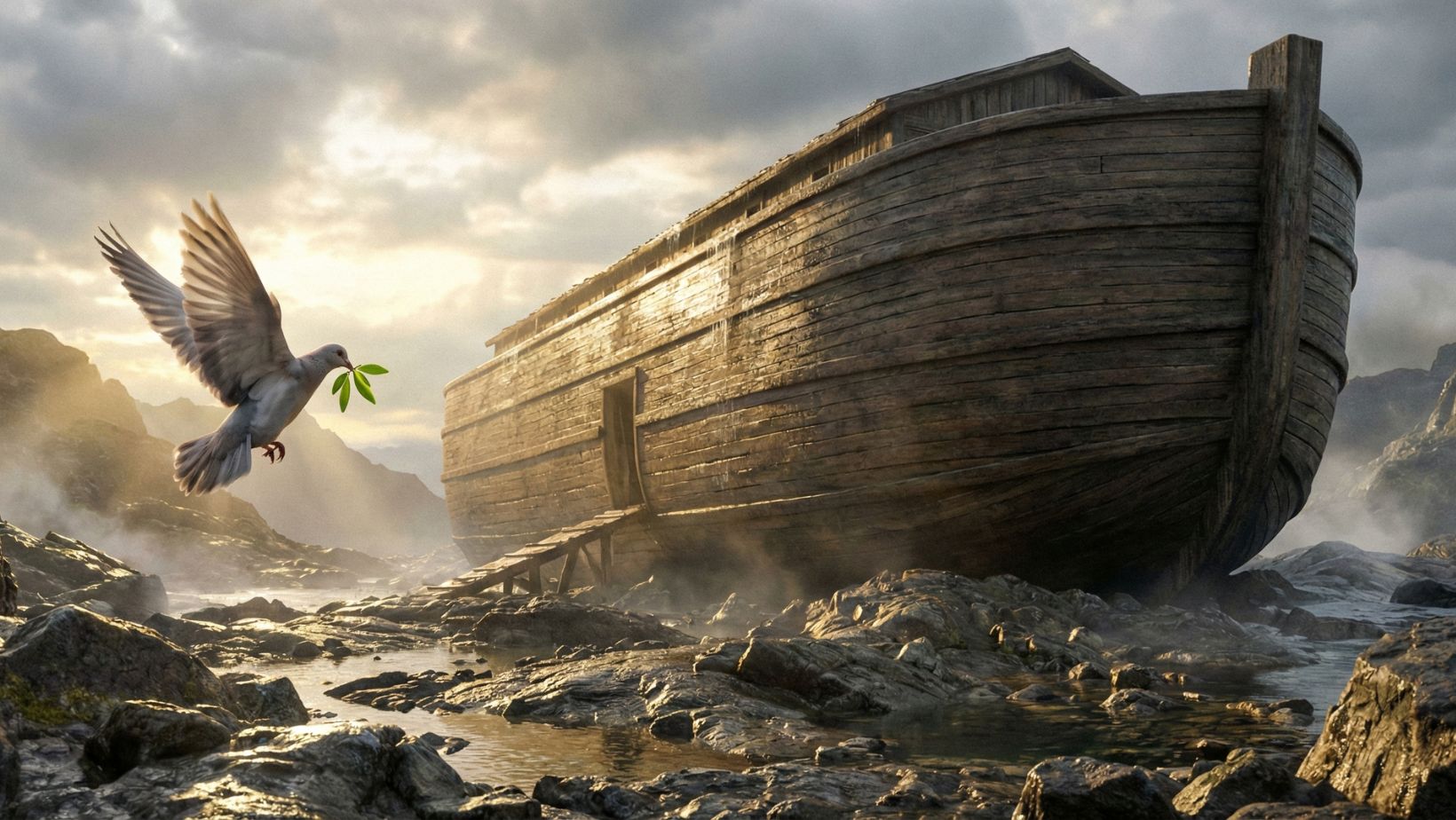
Genesis 8 marks the turning point of the Flood narrative. The waters of judgment begin to recede as God “remembers” Noah, signaling a shift from de-creation back to re-creation. The chapter chronicles the slow drying of the earth, the resting of the Ark on the mountains of Ararat, and Noah’s patient testing of the environment using birds. After over a year inside the vessel, God commands Noah to disembark. The narrative concludes with Noah’s first act of freedom—worship—and God’s response: a divine promise to preserve the natural order of seasons and never again destroy the earth with water, despite the inherent sinfulness of humanity.
1. God Remembers and the Waters Recede (Genesis 8:1–5)
1 But God remembered Noah and all the wild animals and livestock with him in the boat. He sent a wind to blow across the earth, and the floodwaters began to recede. 2 The underground waters stopped flowing, and the torrential rains from the sky were stopped. 3 So the floodwaters gradually receded from the earth. After 150 days, 4 exactly five months from the time the flood began, the boat came to rest on the mountains of Ararat. 5 Two and a half months later, as the waters continued to go down, other mountain peaks became visible.
Commentary:
- “God Remembered” (v. 1):
- This is the theological pivot of the Flood account. In Hebrew scripture, when God “remembers” (zakar), it does not imply He previously forgot. Rather, it signifies a movement toward action based on a covenant or promise (e.g., God remembered Rachel, God remembered His covenant with Abraham).
- God’s focus shifts from the destruction of the wicked to the preservation of the righteous.
- The Wind (v. 1): The Hebrew word for “wind” is ruach, the same word for “Spirit.” Just as the Spirit of God hovered over the waters in Genesis 1:2 to bring order from chaos, a wind from God now blows to restore order to the flooded earth.
- The Mountains of Ararat (v. 4):
- The Ark rests not on a specific peak, but on the “mountains” (plural) of the Ararat region.
- Location: Historically, this refers to the Urartu region (modern-day eastern Turkey, Armenia, and western Iran). This high ground allowed the Ark to land safely while the valleys were still submerged.
- Timeline of Recession (v. 3-5): The text emphasizes a gradual process. The waters “receded” (literally: going and returning), suggesting tidal movement or a steady draining.
Insight: God’s deliverance is often a process, not an instant event. The Ark rested on the mountain months before Noah could leave. Being “safe” does not always mean the trial is immediately over; sometimes, it means waiting for the waters to clear.
2. The Test of the Birds (Genesis 8:6–12)
6 After another forty days, Noah opened the window he had made in the boat 7 and released a raven. The bird flew back and forth until the floodwaters on the earth had dried up. 8 He also released a dove to see if the water had receded and it could find dry ground. 9 But the dove could find no place to land because the water still covered the ground. So it returned to the boat, and Noah held out his hand and drew the dove back inside. 10 After waiting another seven days, Noah released the dove again. 11 This time the dove returned to him in the evening with a fresh olive leaf in its beak. Then Noah knew that the floodwaters were almost gone. 12 He waited another seven days and then released the dove again. This time it did not come back.
Commentary:
- The Raven (v. 7):
- The raven is an unclean animal (Leviticus 11:15) and a scavenger.
- It “flew back and forth,” likely feeding on the floating carcasses of the dead. It did not need dry land to survive, only food, so it did not return to Noah for shelter.
- The Dove (v. 8-9):
- The dove is a clean animal that feeds on seeds and vegetation. It requires a dry, clean place to land.
- Its return indicated that while the mountaintops were visible, the valleys (where vegetation grows) were likely still submerged or muddy.
- The Olive Leaf (v. 11):
- Ecological Sign: Olive trees are hardy and grow at lower altitudes than the peaks. A “fresh” (plucked) leaf meant vegetation had survived and was sprouting again.
- Symbolism: This image of the dove and olive branch has become a universal symbol of peace—specifically, peace between God and man.
- Noah’s Initiative: Unlike the start of the flood where God spoke frequently, here Noah uses wisdom and observation. God expects us to use our minds to discern the times.
Insight: The contrast between the birds is telling. The raven (unclean) was content with the death and decay floating on the water. The dove (clean) could not rest until it found life (the olive branch) or a home. A righteous spirit finds no rest in a world of corruption.
3. The Command to Disembark (Genesis 8:13–19)
13 Noah was now 601 years old. On the first day of the new year, ten and a half months after the flood began, the floodwaters had dried up from the earth. Noah lifted back the covering of the boat and saw that the surface of the ground was drying. 14 Two more months went by, and at last the earth was dry! 15 Then God said to Noah, 16 “Leave the boat, all of you—you and your wife, and your sons and their wives. 17 Release all the animals—the birds, the livestock, and the small animals that scurry along the ground—so they can be fruitful and multiply throughout the earth.” 18 So Noah, his wife, and his sons and their wives left the boat. 19 And all of the large and small animals and birds came out of the boat, pair by pair.
Commentary:
- The Dried Earth (v. 13-14):
- Verse 13 says the ground was “drying” (surface level), but verse 14 confirms the earth was “dry” (solid and stable).
- Total Duration: Comparing Gen 7:11 (600th year, 2nd month, 17th day) to Gen 8:14 (601st year, 2nd month, 27th day), Noah and his family were in the Ark for exactly one lunar year and 10 days (approx. 370-375 days).
- Patient Obedience (v. 15-16):
- Renewal of the Mandate (v. 17): God repeats the creation mandate from Genesis 1: “Be fruitful and multiply.” The earth is to be repopulated. The animals leave “by families” (or kinds), showing that order has been maintained even in the exit.
Insight: Noah’s discipline is remarkable. After a year of confinement, the urge to rush out would have been overwhelming. Yet, he waited for God’s timing. Faith often looks like waiting when we feel ready to move.
4. Worship and the Covenant of Preservation (Genesis 8:20–22)
20 Then Noah built an altar to the Lord, and there he sacrificed as burnt offerings some of all the animals and birds that were approved for sacrifice. 21 And the Lord was pleased with the aroma of the sacrifice and said to himself, “I will never again curse the ground because of the human race, even though everything they think or imagine is bent toward evil from childhood. I will never again destroy all living things. 22 As long as the earth remains, there will be planting and harvest, cold and heat, summer and winter, day and night.”
Commentary:
- Noah’s First Act (v. 20):
- Noah does not build a house, a field, or a monument to his survival. He builds an altar.
- Costly Worship: He sacrifices one of every “clean” bird and animal. Considering these species were limited, this was a massive act of faith. He sacrificed his food source and his “capital” for the future, trusting God to provide.
- The “Pleasing Aroma” (v. 21):
- The Human Condition (v. 21):
- God acknowledges that the Flood did not wash away original sin. The human heart is still “bent toward evil from childhood.”
- Paradoxically, this becomes the reason for God’s mercy, not His judgment. Since man cannot save himself or stop sinning, God decides to sustain the world by grace rather than judgment.
- The Covenant of Preservation (v. 22):
- This is known as the “Noahic Covenant” (specifically the preservation aspect).
- God guarantees the stability of nature (seasons, day/night) essential for agriculture and life. This is “Common Grace”—blessings given to all humanity, regardless of their faith.
Insight: The flood changed the earth, but it did not change the human heart. Therefore, the survival of humanity depends not on human goodness, but on God’s decision to withhold judgment. The altar bridges the gap between a holy God and a sinful survivor.
Theological Significance of Genesis 8
- Resurrection Motif: The Ark resting on the mountains and the emergence of life to a “new world” serves as a type of resurrection. Early Church Fathers often associated the “eighth day” (or chapter 8) with new beginnings.
- The Persistence of Sin: The chapter ends with a sober reality check. The problem of sin is internal, not environmental. A new world didn’t make new men; only God’s grace can sustain them.
- Propitiation: Noah’s sacrifice foreshadows the Levitical system and ultimately Christ. Access to God and the removal of the curse require the shedding of blood.
Practical Applications
- Patience in the “Middle” Time: Like Noah waiting for the waters to recede, we often find ourselves in a transition period where the crisis has passed but the “new normal” hasn’t started. We must remain faithful in the waiting.
- Prioritizing Worship: When entering a new season of life (new job, marriage, moving), our first priority should be establishing our relationship with God, just as Noah built an altar before a home.
- Creation Care: God values the earth and its cycles (v. 22). He is committed to the physical creation, and as His representatives, we should respect the stability and order He sustains.
- Trusting God’s “Memory”: When we feel forgotten in our struggles, we can rest in the truth that God “remembers” us—He is actively working out His covenant promises, even if we can’t see the wind blowing yet.
Final Insight
Genesis 8 bridges the gap between the death of the old world and the birth of the new. It begins with God remembering Noah and ends with Noah remembering God. This reciprocal relationship—God’s grace and man’s worship—forms the foundation for the post-flood existence of humanity.







Leave a Reply