
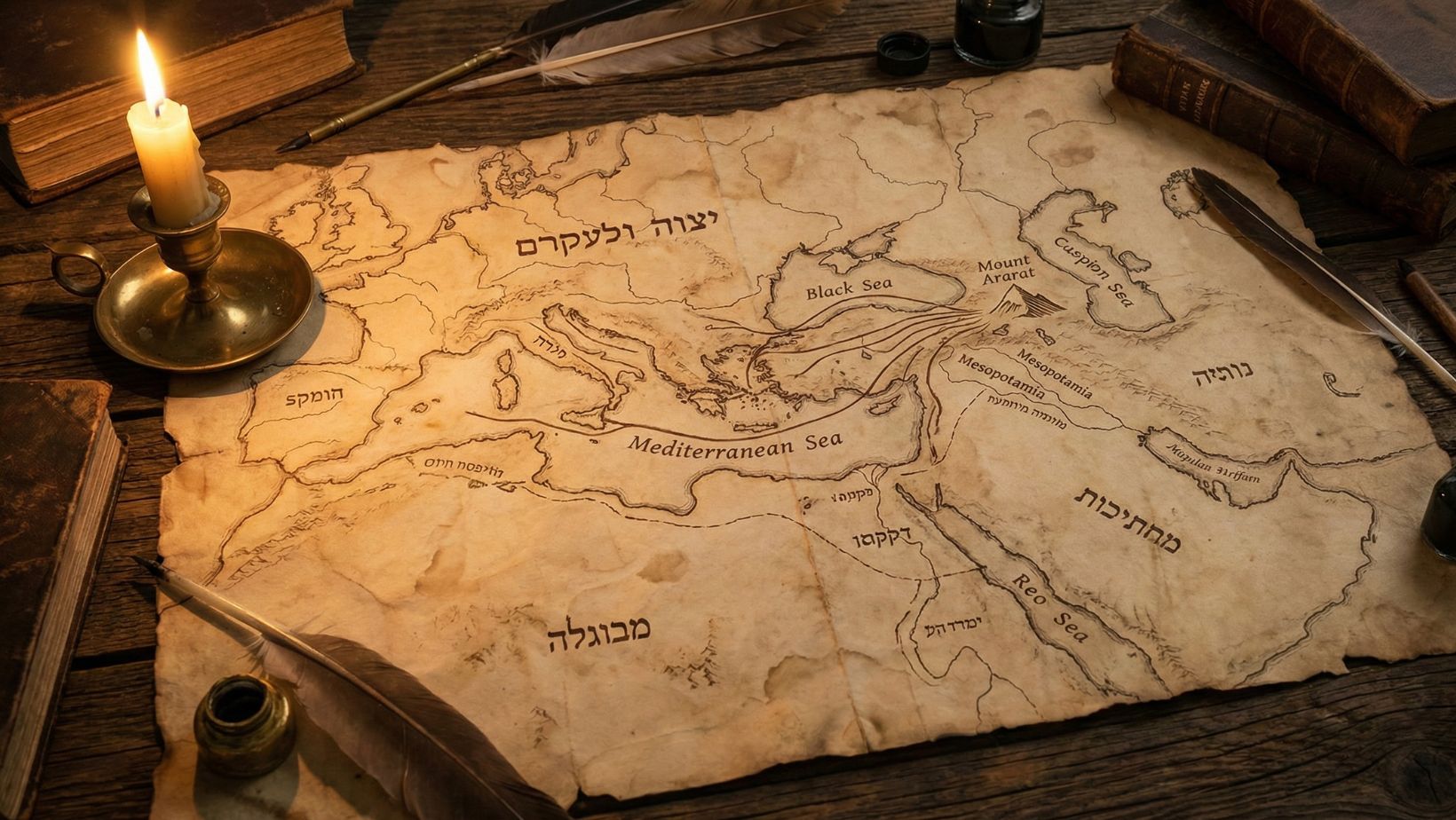
Genesis 10, often referred to as the “Table of Nations,” serves as a bridge between the catastrophic events of the Flood and the dispersion of humanity at the Tower of Babel. It catalogues the descendants of Noah’s three sons—Shem, Ham, and Japheth—tracing the origins of the ancient nations known to Israel. Unlike a modern genealogy that focuses strictly on biology, this chapter is an ethnological document, mapping families to geography, languages, and political entities. It demonstrates the fulfillment of God’s command to “be fruitful and multiply and fill the earth” (Genesis 9:1), listing a total of 70 nations that represent the totality of humanity from a Hebraic perspective.
1. The Japhethites: The Coastal and Northern Peoples (Genesis 10:1–5)
1 This is the account of the families of Shem, Ham, and Japheth, the three sons of Noah. Many children were born to them after the great flood. 2 The descendants of Japheth were Gomer, Magog, Madai, Javan, Tubal, Meshech, and Tiras. 3 The descendants of Gomer were Ashkenaz, Riphath, and Togarmah. 4 The descendants of Javan were Elishah, Tarshish, Kittim, and Rodanim. 5 Their descendants became the seafaring peoples that spread out to various lands, each identified by its own language, clan, and national identity.
Commentary:
- Geographical Scope: The descendants of Japheth generally migrated northward and westward from the Middle East. They are associated with the Indo-European peoples inhabiting Europe and parts of Central Asia.
- Statistical Breakdown: The text lists 14 distinct nations or tribes emerging from Japheth.
- 7 Sons.
- 7 Grandsons.
- Identifications:
- Gomer: Associated with the Cimmerians (southern Russia/Ukraine).
- Magog, Tubal, Meshech: Often associated with regions in modern-day Turkey and the Black Sea area.
- Madai: The Medes (modern-day Iran).
- Javan: The Ionians (Greeks).
- Tarshish: Often identified with Tartessos in Spain, representing the westernmost limit of the ancient world.
- “Seafaring Peoples” (v. 5): This phrase indicates that the Japhethites occupied the coastlands and islands of the Mediterranean.
- Cultural Differentiation (v. 5): This verse proleptically anticipates the confusion of languages at Babel (Genesis 11), noting that these groups were divided by language and geography.
2. The Hamites: Empire Builders and Enemies (Genesis 10:6–20)
6 The descendants of Ham were Cush, Mizraim, Put, and Canaan. 7 The descendants of Cush were Seba, Havilah, Sabtah, Raamah, and Sabteca. The descendants of Raamah were Sheba and Dedan. 8 Cush was also the ancestor of Nimrod, who was the first heroic warrior on earth. 9 Since he was the greatest hunter in the world, his name became proverbial. People would say, “This man is like Nimrod, the greatest hunter in the world.” 10 He built his kingdom in the land of Babylonia, with the cities of Babylon, Erech, Akkad, and Calneh. 11 From there he expanded his territory to Assyria, building the cities of Nineveh, Rehoboth-ir, Calah, 12 and Resen (the great city located between Nineveh and Calah). 13 Mizraim was the ancestor of the Ludites, Anamites, Lehabites, Naphtuhites, 14 Pathrusites, Casluhites, and the Caphtorites. (The Philistines came from these peoples.) 15 Canaan’s oldest son was Sidon, the ancestor of the Sidonians. Canaan was also the ancestor of the Hittites, 16 Jebusites, Amorites, Girgashites, 17 Hivites, Arkites, Sinites, 18 Arvadites, Zemarites, and Hamathites. The Canaanite clans eventually spread out, 19 and the territory of Canaan extended from Sidon in the north to Gerar and Gaza on the south, and east as far as Sodom, Gomorrah, Admah, and Zeboiim, near Lasha. 20 These were the descendants of Ham, identified by clan, language, territory, and national identity.
Commentary:
- Geographical Scope: The Hamites migrated southward to Africa (Egypt, Ethiopia, Libya) and populated the Levant (Canaan) and parts of Arabia/Mesopotamia.
- Statistical Breakdown: This is the most extensive section, listing 30 nations.
- The Problem of “Race” and Ham: Historically, this text was misused to justify slavery via the “Curse of Ham.” However, a textual analysis shows:
- Nimrod (v. 8-12):
- Archetype of Rebellion: Nimrod represents the first imperialist. His name comes from a root meaning “to rebel.”
- Mighty Hunter: This likely implies a warrior-king who hunted men and established dominance, rather than a mere sportsman.
- Urbanization: He is credited with founding the great cities of Mesopotamia (Babylon and Nineveh), which would later become the arch-enemies of Israel. This establishes a Hamitic presence in a region usually associated with Shem.
- Mizraim (v. 13-14):
- Mizraim is the Hebrew name for Egypt.
- The Philistines: Verse 14 notes the Philistines descended from the Casluhites/Caphtorites (Crete), linking Egypt and the Aegean.
- Canaan (v. 15-19):
- This section is detailed because these were the specific tribes Israel would later displace.
- Sidon: The primary Phoenician city.
- Hittites, Jebusites, Amorites: These represent the occupants of the Promised Land.
- Boundaries: Verse 19 delineates the precise borders of the land God would later promise to Abraham.
3. The Semites: The Line of Promise (Genesis 10:21–31)
21 Sons were also born to Shem, the older brother of Japheth. Shem was the ancestor of all the descendants of Eber. 22 The descendants of Shem were Elam, Asshur, Arphaxad, Lud, and Aram. 23 The descendants of Aram were Uz, Hul, Gether, and Mash. 24 Arphaxad was the father of Shelah, and Shelah was the father of Eber. 25 Eber had two sons. The first was named Peleg (which means “division”), for during his lifetime the people of the world were divided into different language groups. His brother’s name was Joktan. 26 Joktan was the ancestor of Almodad, Sheleph, Hazarmaveth, Jerah, 27 Hadoram, Uzal, Diklah, 28 Obal, Abimael, Sheba, 29 Ophir, Havilah, and Jobab. All these were descendants of Joktan. 30 The territory they occupied extended from Mesha all the way to Sephar in the eastern mountains. 31 These were the descendants of Shem, identified by clan, language, territory, and national identity.
Commentary:
- Geographical Scope: The Semites generally stayed in the Middle East, occupying the Arabian Peninsula, Mesopotamia, and the Levant.
- Statistical Breakdown: The text lists 26 nations/descendants.
- 5 Sons.
- 21 Grandsons/Great-grandsons.
- Identifications:
- Elam: Peoples east of Tigris (Susiana/Iran).
- Asshur: The Assyrians (distinct from Nimrod’s kingdom, though geographically overlapping).
- Aram: The Arameans (Syria).
- Lud: Generally associated with the Lydians (Western Turkey), though debated.
- The Significance of Eber (v. 21, 24): Shem is specifically highlighted as “the ancestor of all the descendants of Eber.” The word “Hebrew” (Ivri) is derived from Eber. This narrows the focus toward the chosen line of Abraham.
- Peleg and the Division (v. 25):
- Peleg: Means “Division” or “Watercourse.”
- Timeline: The note that “the people of the world were divided” connects this genealogy chronologically to the Tower of Babel incident in Genesis 11. It suggests Peleg lived during the dispersion.
- Joktan (v. 26-29): Joktan is the progenitor of many Arabian tribes. Names like Sheba, Ophir, and Havilah are associated with wealth, gold, and the spice trade in the southern Arabian Peninsula (Yemen).
4. Conclusion (Genesis 10:32)
32 These are the clans that descended from Noah’s sons, arranged by nation according to their lines of descent. All the nations of the earth descended from these clans after the great flood.
Commentary:
- The Number 70:
- Adding the descendants together: 14 (Japheth) + 30 (Ham) + 26 (Shem) = 70 Nations.
- Symbolism: In Hebraic numerology, 70 represents totality and completion. This table claims to represent the entire human family.
- New Testament Connection: In Luke 10, Jesus sends out 70 (or 72 in some manuscripts) disciples. This is often viewed as a symbolic reversal of Genesis 10—sending the Gospel to every nation listed in the Table.
- Unity of Humanity: The primary theological point is that all humanity shares a common ancestor. Divisions of race, language, and geography are secondary to the biological unity of the human race descending from Noah.
Theological Significance of Genesis 10
- The God of All Nations: By listing nations that were often enemies of Israel (Egypt, Babylon, Assyria, Canaan), the text acknowledges them as part of God’s creation and history. Yahweh is not a tribal deity but the sovereign over all distinct people groups.
- Preparation for Redemption: The genealogy narrows from Adam to Noah, and then focuses on Shem. This “telescoping” technique prepares the reader for Genesis 11 and 12, where the focus narrows further to one man, Abraham, through whom all these 70 nations will eventually be blessed.
- Missiology: Genesis 10 provides the “target audience” for the Great Commission. The diversity established here is not eradicated in the end times; Revelation 7:9 describes a multitude from “every nation, tribe, people and language” standing before the throne.
Practical Applications
- Rejection of Racism: Genesis 10 undermines racism by establishing a singular biological origin for all humanity. We are all “cousins” separated only by geography and language.
- Understanding Geopolitics: The chapter reminds us that nations rise, migrate, and fall under God’s sovereignty. The boundaries and identities of nations are part of His providential orchestration (Acts 17:26).
- Cultural Dignity: Every culture listed, regardless of its relationship to Israel, is given a name and a place in the biblical record, validating human culture and civilization.







Leave a Reply