
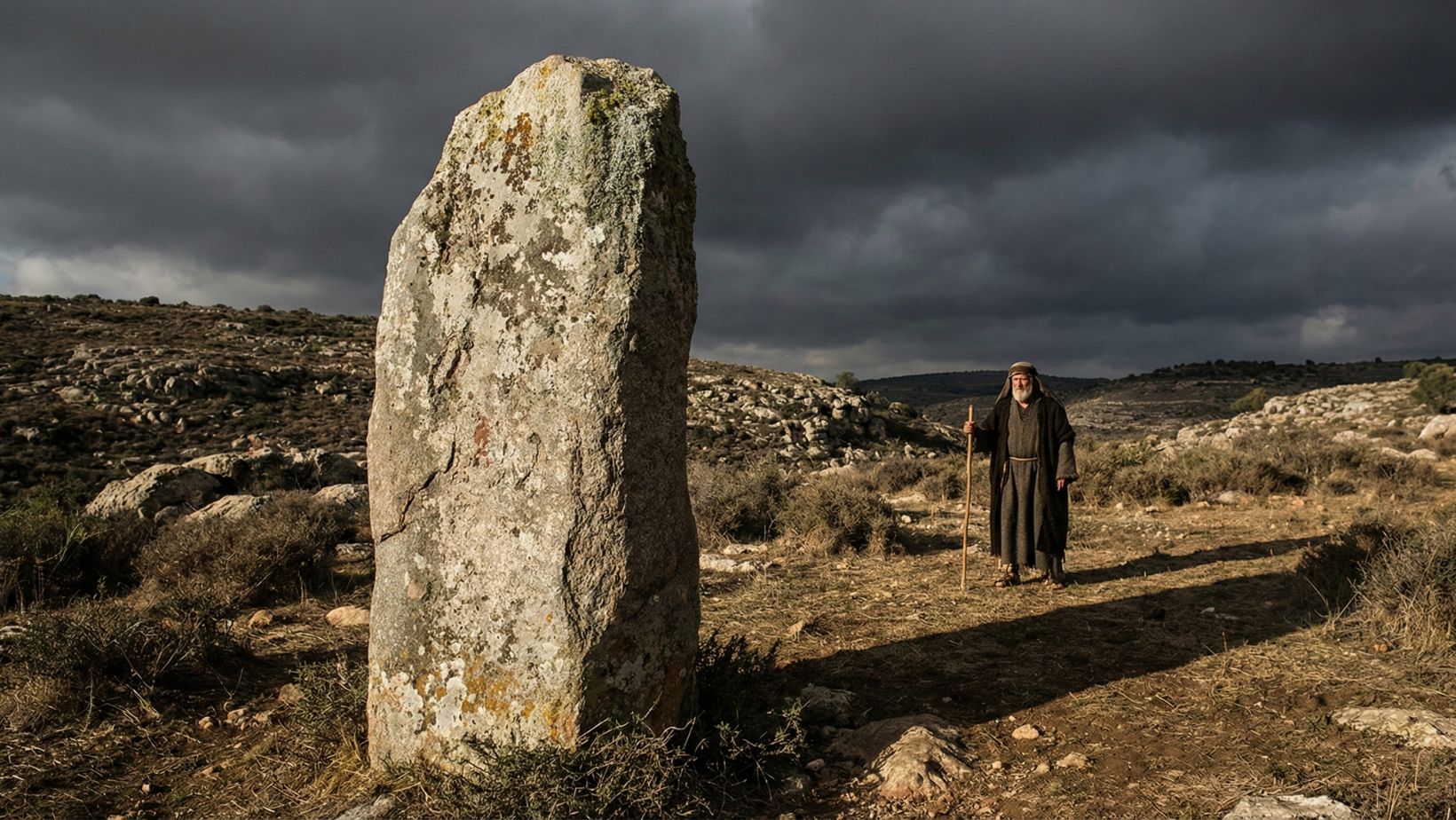
1 Samuel 7 marks the spiritual turning point of the book. After the chaotic “Ark narrative” (Chapters 4–6), the focus shifts back to Samuel, who is now a grown man and established leader. The chapter covers a span of twenty years where Israel mourns and eventually repents. Samuel leads a national revival at Mizpah, calling for the removal of foreign idols. When the Philistines attack this prayer gathering, Israel does not trust in their own strength or a religious object (like the Ark in Ch 4) but in Samuel’s intercession. God responds with thunder, confusing the enemy and granting Israel a decisive victory. Samuel commemorates this with the famous “Ebenezer” stone. The chapter concludes with a summary of Samuel’s successful circuit ministry as Judge over Israel.
1. The Ark in Storage and the Long Wait (1 Samuel 7:1–2 NLT)
1 So the men of Kiriath-jearim came to get the Ark of the Lord. They took it to the hillside home of Abinadab and ordained Eleazar, his son, to be in charge of it. 2 The Ark remained in Kiriath-jearim for a long time—twenty years in all. During that time all Israel mourned because it seemed the Lord had abandoned them.
Commentary:
- Kiriath-jearim (v. 1): Unlike Shiloh (a major center), Kiriath-jearim was a border town. The Ark is treated with respect but is effectively “parked” here rather than restored to a central sanctuary. It remains here until David moves it to Jerusalem (2 Samuel 6).
- Abinadab and Eleazar (v. 1): They “ordained” (consecrated) Eleazar to guard it. This was likely a necessary irregularity; while they were Levites, they weren’t the High Priestly line. The priesthood is still in disarray after Eli’s death.
- Twenty Years of Mourning (v. 2): The text notes a 20-year period of sorrow. The NLT says, “it seemed the Lord had abandoned them,” but the Hebrew literally means the people “lamented after the Lord.” They were sorrowful but had not yet taken the step of active repentance (removing idols). They wanted God’s comfort without God’s holiness.
2. The Call to Repentance at Mizpah (1 Samuel 7:3–6 NLT)
3 Then Samuel said to all the people of Israel, “If you are really serious about wanting to return to the Lord, get rid of your foreign gods and your images of Ashtoreth. Determine to obey only the Lord; then he will rescue you from the Philistines.” 4 So the Israelites got rid of their images of Baal and Ashtoreth and worshiped only the Lord. 5 Then Samuel told them, “Gather all of Israel to Mizpah, and I will pray to the Lord for you.” 6 So they gathered at Mizpah and, in a great ceremony, drew water from a well and poured it out before the Lord. They also went without food all day and confessed that they had sinned against the Lord. (It was at Mizpah that Samuel became Israel’s judge.)
Commentary:
- The Condition (v. 3): Samuel challenges their mourning. “If you are really serious…” True repentance is not just feeling bad (emotion); it is changing behavior (action).
- The Idols (v. 3-4):
- The Water Ritual (v. 6): They “poured it out before the Lord.”
- This is a rare ritual in the OT. It symbolizes the pouring out of the heart in grief (Lamentations 2:19) or the pouring away of sin—an irrevocable act of humility. Like water spilled on the ground, they were completely emptying themselves before God.
- Samuel as Judge (v. 6): This gathering at Mizpah acts as Samuel’s inauguration. He is not just a prophet (mouthpiece) but a Judge (governor/deliverer).
3. Thunder and Victory (1 Samuel 7:7–11 NLT)
7 When the Philistine rulers heard that Israel had gathered at Mizpah, they mobilized their army and advanced. The Israelites were terrified when they learned that the Philistines were coming. 8 “Don’t stop pleading with the Lord our God to save us from the Philistines!” they begged Samuel. 9 So Samuel took a young lamb and offered it to the Lord as a whole burnt offering. He pleaded with the Lord to help Israel, and the Lord answered him. 10 Just as Samuel was sacrificing the burnt offering, the Philistines arrived to attack Israel. But the Lord spoke with a mighty voice of thunder from heaven that day, and the Philistines were thrown into such confusion that the Israelites defeated them. 11 The men of Israel chased them from Mizpah to a place below Beth-car, slaughtering them all along the way.
Commentary:
- The Enemy’s Perspective (v. 7): The Philistines see the large gathering at Mizpah not as a prayer meeting, but as a military revolt. They attack to crush it early.
- A Changed People (v. 8): Contrast this with Chapter 4.
- Chapter 4: “Let’s get the Ark! It will save us!” (Presumption/Magic).
- Chapter 7: “Don’t stop pleading with the Lord!” (Dependency/Prayer).
- They now understand that the power is not in the object, but in the relationship with God.
- The Suckling Lamb (v. 9): Samuel offers a nursing lamb. This represents innocence and total helplessness. It signifies that Israel is helpless without God.
- God Thunders (v. 10): This fulfills Hannah’s prophecy in 1 Samuel 2:10 (“The Lord will shatter his accusers; he will thunder against them”).
- Baal was the “god of the storm” and thunder. By defeating the Philistines with thunder, Yahweh proved He was the true Master of the storm, mocking the Philistine religion.
4. Ebenezer: The Stone of Help (1 Samuel 7:12–14 NLT)
12 Samuel then took a large stone and placed it between the towns of Mizpah and Jeshanah. He named it Ebenezer (which means “the stone of help”), for he said, “Up to this point the Lord has helped us!” 13 So the Philistines were subdued and didn’t invade Israel again for some time. And throughout Samuel’s lifetime, the Lord’s powerful hand was raised against the Philistines. 14 The Israelite villages near Ekron and Gath that the Philistines had captured were restored to Israel, along with the rest of the territory that the Philistines had taken. And there was peace between Israel and the Amorites in those days.
Commentary:
- Ebenezer (v. 12):Eben (Stone) + Ezer (Help).
- Restoration (v. 14): The victory had lasting geopolitical effects. Cities were returned, and there was a period of peace, even with the Amorites (local Canaanite tribes), likely because Israel’s strength deterred attacks.
5. Samuel’s Circuit Ministry (1 Samuel 7:15–17 NLT)
15 Samuel continued as Israel’s judge for the rest of his life. 16 Each year he traveled around, setting up his court first at Bethel, then at Gilgal, and then at Mizpah. He judged the people of Israel at each of these places. 17 Then he would return to his home at Ramah, and he would hear cases there, too. And Samuel built an altar to the Lord at Ramah.
Commentary:
- Itinerant Leadership (v. 16): Unlike Eli, who sat by the gate at Shiloh waiting for news, Samuel is active. He travels a circuit of about 50 miles annually to bring justice to the people.
- Ramah (v. 17): This was his birthplace and headquarters.
- The Altar (v. 17): With Shiloh destroyed and the Ark hidden away in Kiriath-jearim, the central sanctuary was non-functional. Samuel builds a personal altar to maintain worship. This shows that while institutional religion (Shiloh) had collapsed, personal devotion (Samuel’s altar) kept the faith alive.
Theological Significance of 1 Samuel 7
- Repentance Precedes Revival: Deliverance did not come because enough time had passed (20 years) or because they complained enough. It came only when they removed the idols. God does not deliver a divided heart.
- The Power of Intercession: The people were too afraid to fight, so they asked Samuel to pray. This chapter establishes the paradigm that spiritual battle (prayer) wins physical battles.
- God of the Storm: The thunder against the Philistines asserts Yahweh’s supremacy over Baal. It serves as a reminder that the weapons of the enemy (intimidation/fear) are easily silenced by the voice of God.
Practical Applications
- Raising an “Ebenezer”: It is vital to mark milestones in our spiritual life. When God helps us through a crisis, we should create a mental or physical marker (a journal entry, a date, a tangible reminder) to say, “God helped me here.” This builds faith for the future.
- “If you are serious”: We often want God’s help without God’s Lordship. We want the Philistines gone, but we want to keep our Baals (secret sins). Samuel reminds us we must choose one or the other.
- Active Leadership: Samuel didn’t wait for the people to come to him; he went to them (the circuit). Good spiritual influence requires proximity and effort.
Final Insight
1 Samuel 7 offers the positive counter-narrative to Chapter 4. In Chapter 4, Israel had the Ark but no repentance, and they lost. In Chapter 7, they have no Ark but deep repentance, and they win. It proves that the presence of God is not found in religious boxes, but in humble, contrite hearts.







Leave a Reply