
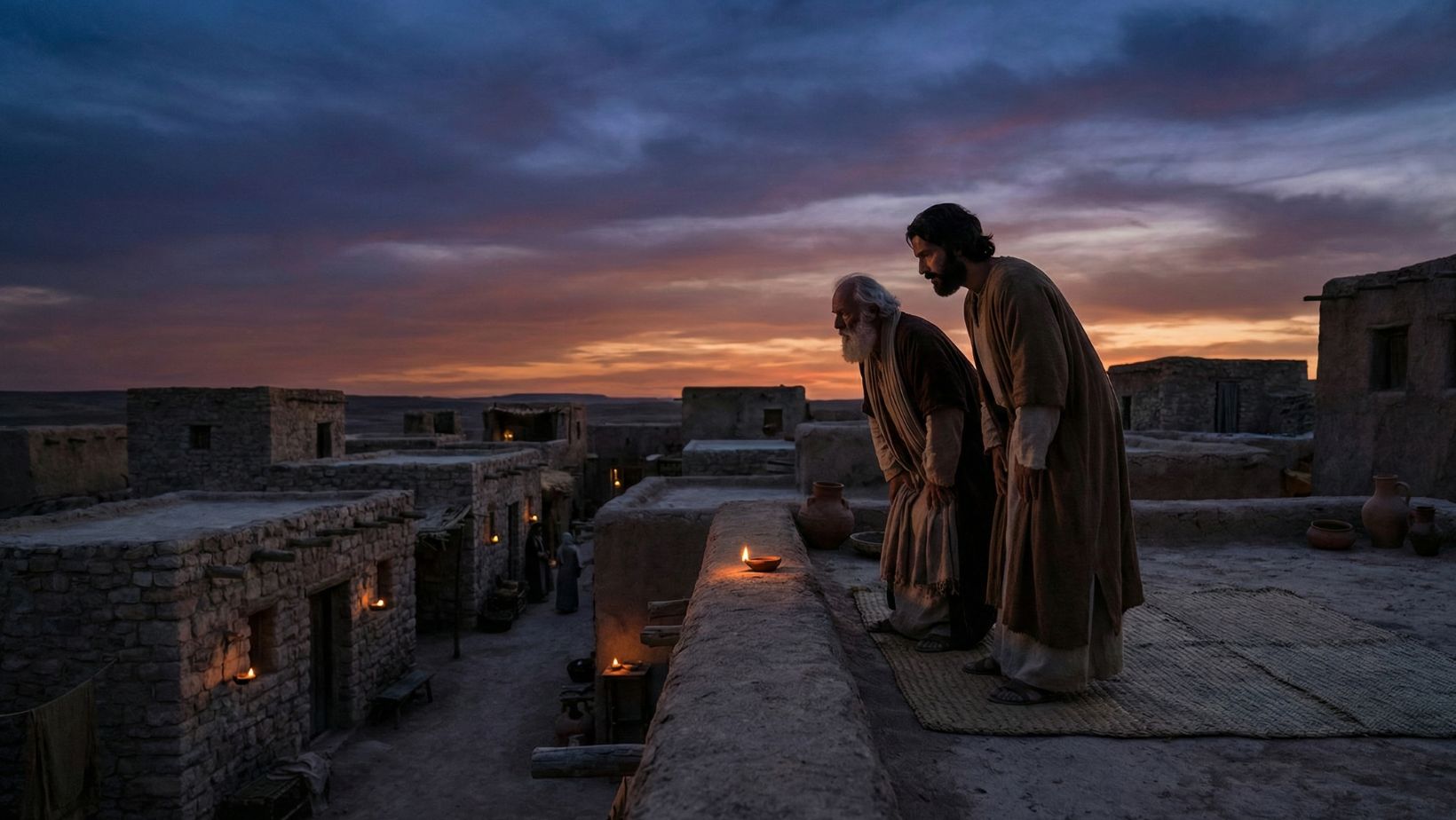
1 Samuel 9 initiates the transition to monarchy with a narrative that is both mundane and miraculous. It introduces Saul, a man who physically embodies the people’s ideal of a king—tall, handsome, and wealthy. The story revolves around a “wild goose chase” for lost donkeys, which God uses as a providential mechanism to bring Saul to Samuel. While Saul thinks he is merely looking for livestock, God is coordinating a meeting to anoint the first king of Israel. The chapter highlights God’s sovereign control over minute details (lost animals, travel routes, timing) to fulfill His national purposes. It concludes with Samuel treating Saul with royal honor before the official anointing, leaving Saul bewildered by his sudden elevation.
1. The Candidate: Saul’s Background (1 Samuel 9:1–2 NLT)
1 There was a wealthy, influential man from the tribe of Benjamin named Kish son of Abiel, son of Zeror, son of Becorath, son of Aphiah, of the tribe of Benjamin. 2 His son Saul was the most handsome man in Israel—head and shoulders taller than anyone else in the land.
Commentary:
- The Lineage (v. 1): Saul comes from the tribe of Benjamin.
- The Visual King (v. 2): The text focuses entirely on Saul’s physical attributes.
- “Most handsome”: He looked the part.
- “Head and shoulders taller”: In ancient warfare, physical stature was often equated with leadership capability. The people wanted a king “like the nations,” and Saul fit the profile of a warrior-king perfectly.
- Missing Attribute: Notably absent is any mention of Saul’s piety, wisdom, or relationship with God (contrast with David in 1 Sam 13:14).
2. The Providence of Lost Donkeys (1 Samuel 9:3–10 NLT)
3 One day Kish’s donkeys strayed away, so he said to his son Saul, “Take one of the servants and go look for the donkeys.” 4 So Saul traveled through the hill country of Ephraim, through the land of Shalisha, and through the Shaalim area, and then through the entire land of Benjamin, but they couldn’t find the donkeys anywhere. 5 Finally, they entered the region of Zuph, and Saul said to his servant, “Let’s go home. By now my father will be worrying about us instead of the donkeys.” 6 But the servant said to him, “Just a minute! There is a man of God in this town. He is highly respected, and everything he says comes true. Let’s go find him. Perhaps he can tell us which way to go.” 7 “But we don’t have anything to offer him,” Saul replied. “Even our food is gone, and we have no gift for the man of God. What do we have?” 8 “Well,” the servant said, “I have one small silver coin. We can give it to the man of God to tell us what to do.” 9 (In those days if people wanted a message from God, they would say, “Let’s go and ask the seer,” for prophets used to be called seers.) 10 “All right,” Saul agreed, “let’s go.” So they started into the town where the man of God lived.
Read: The Divine Detour: Your current frustration is not a sign of God’s absence, but the very transportation He is using to bring you to your destiny.
Commentary:
- Divine Choreography (v. 3-4): The donkeys wandering off was not an accident; it was a divine appointment. God often uses the frustrations of daily life (lost items, delays, detours) to position us for His purposes.
- The Route (v. 4): They cover a significant distance (likely 20-30 miles of rugged terrain) through Ephraim and Benjamin. The failure to find the donkeys is necessary to push them toward Samuel.
- The Servant’s Role (v. 6): Saul is ready to quit. It is the unnamed servant who has the spiritual insight to seek the “man of God.” This servant saves the mission and, ultimately, the monarchy.
- The Gift (v. 7-8): Saul adheres to the custom that one does not approach a dignitary or prophet empty-handed. The “small silver coin” (quarter shekel) was likely a humble amount, but sufficient as a token of respect.
- Seer vs. Prophet (v. 9): The narrator inserts a historical note.
3. The Encounter at the Gate (1 Samuel 9:11–17 NLT)
11 As they were climbing a steep hill toward the town, they met some young women coming out to draw water. So they asked, “Is the seer here?” 12 “Yes,” they replied. “Stay right on this road. He is just ahead of you. He has just come into town to sacrifice with the people at the place of worship. 13 Hurry, and you will catch him before he goes up there to eat. The guests won’t begin eating until he arrives to bless the food. Hurry, and you can catch him now.” 14 So they went into the town, and as they passed through the gates, Samuel was coming out toward them to go up to the place of worship. 15 Now the Lord had told Samuel the previous day, 16 “About this time tomorrow I will send you a man from the land of Benjamin. Anoint him to be the leader of my people Israel. He will rescue them from the Philistines, for I have looked down on my people in mercy and have heard their cry.” 17 When Samuel saw Saul, the Lord said, “That’s the man I told you about! He will rule my people.”
Commentary:
- The High Place (v. 12): Worship was conducted at “high places” (elevated altars) prior to the construction of the Temple in Jerusalem.
- Detailed Timing (v. 13): The women urge them to “Hurry.” If they had arrived five minutes later, they would have missed Samuel. The timing is precise.
- Divine Revelation (v. 15-16): This is the theological core of the chapter.
- God “uncovered Samuel’s ear” (literal Hebrew idiom for “told”): God prepared Samuel so he wouldn’t be surprised.
- “I will send you”: Saul thought he was wandering; God says he was “sent.”
- God’s Mercy: Despite the people’s sinful motivation for wanting a king (Ch 8), God frames this as an act of mercy: “I have heard their cry.” God uses even our flawed desires to bring about deliverance.
4. Saul’s Surprise and Humility (1 Samuel 9:18–21 NLT)
18 Just then Saul approached Samuel at the gateway and asked, “Can you please tell me where the seer’s house is?” 19 “I am the seer!” Samuel replied. “Go up to the place of worship ahead of me. We will eat there together, and in the morning I will tell you what you want to know and send you on your way. 20 And don’t worry about those donkeys that were lost three days ago, for they have been found. And who is all Israel looking to nowadays? Is it not to you and your father’s family?” 21 Saul replied, “But I’m only from the tribe of Benjamin, the smallest tribe in Israel, and my family is the least important of all the families of that tribe! Why are you talking like this to me?”
Commentary:
- The Meeting (v. 18-19): Saul does not recognize Samuel, indicating Saul was not very religious or politically aware, as Samuel was the most famous man in Israel.
- The Prophetic Word (v. 20): Samuel proves his authenticity immediately:
- Clairvoyance: He knows about the donkeys without being told.
- The Greater Destiny: He pivots from donkeys to the throne: “Who is all Israel looking to?”
- Saul’s Modesty (v. 21): Saul’s response seems genuine here.
5. The Feast of Honor (1 Samuel 9:22–27 NLT)
22 Then Samuel brought Saul and his servant into the hall and placed them at the head of the table, honoring them above the thirty special guests. 23 Samuel said to the cook, “Bring me the cut of meat I gave you and told you to set aside.” 24 So the cook brought in the leg of meat and placed it before Saul. “Go ahead and eat it,” Samuel said. “I was saving it for you for this specific time, for I said, ‘I’ll have some guests today.’” So Saul ate with Samuel that day. 25 When they came down from the place of worship and returned to town, Samuel talked with Saul on the roof of his house. 26 At daybreak the next morning, Samuel called to Saul, “Get up! It’s time you were on your way.” So Saul got ready, and he and Samuel left the house together. 27 When they reached the edge of town, Samuel told Saul to send his servant on ahead. After the servant was gone, Samuel said, “Stay here, for I have received a special message for you from God.”
Commentary:
- The Head of the Table (v. 22): Samuel seats Saul above the elders/dignitaries. This is a public signal of his new status, though the guests likely don’t understand the full implication yet.
- The Reserved Portion (v. 23-24): The “leg” (likely the thigh or shoulder) was the choice cut, often reserved for the priests (Leviticus 7:32).
- The Rooftop Conversation (v. 25): In the cool of the evening, Samuel mentors Saul. This private communion was essential to prepare Saul’s heart for the shock of what was coming next.
- The Secret Revelation (v. 27): Samuel sends the servant away. The message of kingship is initially a secret between the prophet and the king.
Theological Significance of 1 Samuel 9
- The Doctrine of Providence: This is the clearest example in Scripture of how God weaves “chance” events (lost animals) into His sovereign plan. As the proverb says, “The lot is cast into the lap, but its every decision is from the Lord” (Prov 16:33).
- God’s Accommodation: Even though the request for a king was sinful (Ch 8), God works within the people’s bad choices to bring about His will. He chooses a king who fits their fleshly criteria (tall/handsome) but establishes His own authority over him through the prophet.
- The Humble Beginning: God often calls people when they are “little in their own eyes” (1 Sam 15:17). Saul’s initial humility serves as a baseline to measure his later fall into pride.
Practical Applications
- Trusting the “Detours”: When our plans are frustrated (like searching for donkeys and finding none), we should remain open to the possibility that God is redirecting us toward a “Samuel.”
- Valuing Wise Counsel: Saul would have quit and gone home if not for his servant. We need people in our lives who encourage us to seek God when we have hit a dead end.
- God’s Preparation: Just as the meal was cooked and reserved for Saul before he arrived, God has prepared good works for us to walk in (Ephesians 2:10). We do not need to manipulate our destiny; we need to walk faithfully until we arrive at it.
Final Insight
1 Samuel 9 is a masterclass in divine subtlety. There are no thunderclaps or parting seas here—just a farm boy looking for livestock. Yet, in this quiet chapter, the history of the world shifts. It teaches us that God is as active in the mundane Tuesday afternoons as He is in the miraculous Sunday mornings.







Leave a Reply