
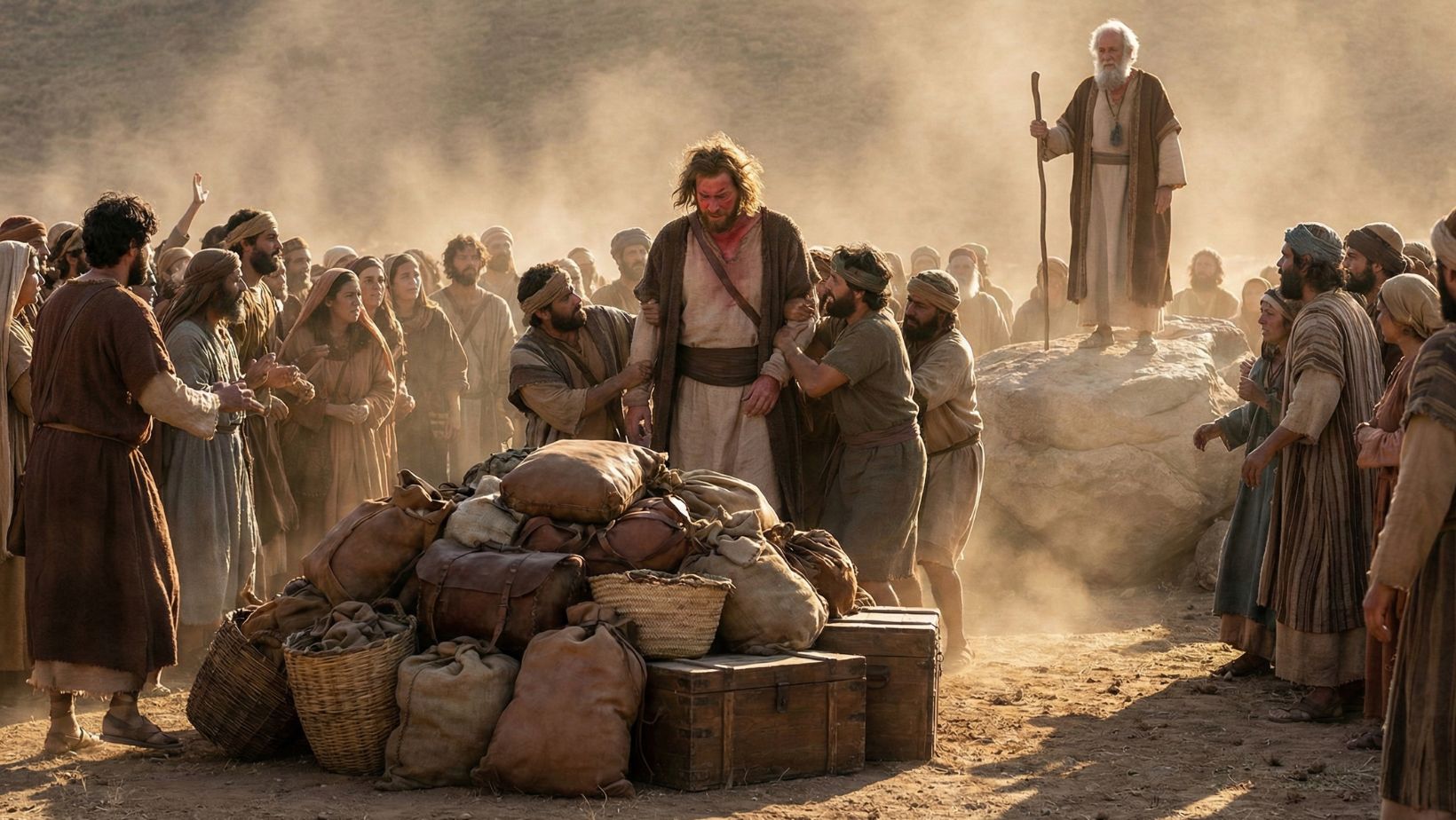
1 Samuel 10 marks the official transition of Israel from a theocracy to a monarchy. It begins in private with the secret anointing of Saul by Samuel and progresses to the public selection of the king at Mizpah. To confirm Saul’s calling, Samuel gives him three specific signs, all of which come true, culminating in Saul prophesying with a band of prophets—a sign that God’s Spirit is equipping him. Despite this divine validation, Saul displays a troubling trait: hiding among the baggage when his name is called. The chapter ends with a divided reaction: some follow him, while others despise him, foreshadowing the conflict that will mark his reign.
1. The Secret Anointing and the Three Signs (1 Samuel 10:1–8 NLT)
1 Then Samuel took a flask of olive oil and poured it over Saul’s head. He kissed Saul and said, “I am doing this because the Lord has appointed you to be the ruler over Israel, his special possession. 2 When you leave me today, you will see two men beside Rachel’s tomb at Zelzah, on the border of Benjamin. They will tell you that the donkeys you set out to look for have been found. Your father has stopped worrying about them and is now worried about you. He is asking, ‘What should I do about my son?’ 3 “When you get to the oak of Tabor, you will see three men coming toward you who are on their way to worship God at Bethel. One will be bringing three young goats, another will have three loaves of bread, and the third will be carrying a wineskin full of wine. 4 They will greet you and offer you two of the loaves, which you are to accept. 5 “When you arrive at Gibeah of God, where the garrison of the Philistines is located, you will meet a band of prophets coming down from the place of worship. They will be playing a harp, a tambourine, a flute, and a lyre, and they will be prophesying. 6 At that time the Spirit of the Lord will come powerfully upon you, and you will prophesy with them. You will be changed into a different person. 7 After these signs take place, do what must be done, for God is with you. 8 Then go down to Gilgal ahead of me. I will join you there to sacrifice burnt offerings and peace offerings. You must wait for seven days until I arrive and give you further instructions.”
Commentary:
- The Anointing (v. 1): The act of pouring oil symbolized the pouring out of the Holy Spirit (see v. 6) and the setting apart of the individual as “holy” to the Lord (Messiah/Christ means “Anointed One”).
- The Three Signs (v. 2-6): Samuel predicts three encounters to prove God is orchestrating Saul’s life:
- The Past Resolved: Two men at Rachel’s tomb confirm the donkeys are found. This frees Saul’s mind from his past duty (farming) to focus on his future duty (ruling).
- Present Provision: Three men at Tabor will give him bread. This signifies that the people will sustain the king. Accepting the bread is his first royal act of receiving tribute.
- Future Power: A band of prophets at Gibeah. This is the most critical sign.
- “Changed into a different person” (v. 6): Saul was a farmer; he needed a spiritual upgrade to be a king. The Spirit equips him for the office, even if his heart wasn’t fully surrendered (as later events show).
- The Command to Wait (v. 8): This instruction is crucial. Samuel sets a test of obedience: “Wait seven days at Gilgal.” Spoiler: Saul’s failure to obey this specific command in Chapter 13 becomes the reason he loses the kingdom.
2. The Signs Fulfilled and the proverb (1 Samuel 10:9–13 NLT)
9 As Saul turned and walked away to leave Samuel, God gave him a new heart, and all Samuel’s signs were fulfilled that day. 10 When Saul and his servant arrived at Gibeah, they saw a group of prophets coming toward them. Then the Spirit of God came powerfully upon Saul, and he, too, began to prophesy. 11 When those who knew Saul heard about it, they asked each other, “What is this? What has happened to the son of Kish? Is Saul also a prophet?” 12 And a man from the area asked, “And who is their father?” So it became a proverb: “Is Saul also a prophet?” 13 When Saul had finished prophesying, he went up to the place of worship.
Commentary:
- A New Heart (v. 9): God empowered Saul. This likely refers to a capacity for leadership and boldness rather than permanent spiritual regeneration, given his later apostasy.
- Ecstatic Prophecy (v. 10): “Prophesying” here likely means praising God in an ecstatic, trancelike state, inspired by music (v. 5). It was visible evidence that God’s hand was on him.
- The Proverb (v. 11-12): “Is Saul also a prophet?” became a saying used when someone acted completely out of character. Saul was known as a secular, wealthy farm boy. Seeing him among the mystics was shocking.
- “Who is their father?” This question implies that prophetic ability comes from spiritual lineage (God), not biological lineage (Kish).
3. Saul’s Silence (1 Samuel 10:14–16 NLT)
14 “Where have you been?” Saul’s uncle asked him and his servant. “We were looking for the donkeys,” Saul replied, “but we couldn’t find them. So we went to Samuel.” 15 “Oh?” the uncle said. “What did Samuel say to you?” 16 “He told us that the donkeys had already been found,” Saul replied. But Saul didn’t tell his uncle what Samuel said about the kingdom.
SERMON: What Are You Not Saying? In 1 Samuel 10:16, Saul speaks of the donkeys but hides the calling. This reminds us that God often works quietly in our lives, giving us purposes that take time to understand and reveal.
Commentary:
- Secrecy (v. 16): Saul omits the most important part—the kingdom. This could be interpreted in two ways:
- Humility/Prudence: Not wanting to brag before the public announcement.
- Fear/Insecurity: Being afraid of the reaction or not truly believing it himself. Given the next scene (hiding in baggage), insecurity seems likely.
4. The Public Selection at Mizpah (1 Samuel 10:17–24 NLT)
17 Later Samuel called all the people of Israel to meet before the Lord at Mizpah. 18 And he said to them, “This is what the Lord, the God of Israel, has declared: I brought Israel out of Egypt and rescued you from the Egyptians and from all the nations that were oppressing you. 19 But though I have rescued you from your misery and distress, you have rejected your God today and have said, ‘No, we want a king!’ Now, therefore, present yourselves before the Lord by tribes and clans.” 20 So Samuel brought all the tribes of Israel before the Lord, and the tribe of Benjamin was chosen by lot. 21 Then he brought each family of the tribe of Benjamin before the Lord, and the family of the Matrites was chosen. And finally Saul son of Kish was chosen from among them. But when they looked for him, he was nowhere to be found! 22 So they asked the Lord, “Where is he?” And the Lord replied, “He is hiding among the baggage.” 23 So they ran and brought him out. And when he stood among the people, he was a head taller than anyone else. 24 Then Samuel said to all the people, “This is the man the Lord has chosen as your king. No one in all Israel is like him!” And all the people shouted, “Long live the king!”
Commentary:
- Reiteration of Rejection (v. 19): Before the coronation, Samuel reminds them again: This is happening because you rejected God. The coronation is a concession, not a celebration of faith.
- Casting Lots (v. 20-21): This was the standard method for determining God’s will (like rolling dice, likely using the Urim and Thummim). It narrowed down from Tribe (Benjamin) -> Clan (Matrites) -> Family (Kish) -> Man (Saul). This public process proved to the people that Saul wasn’t just Samuel’s favorite; he was God’s choice.
- Hiding in the Baggage (v. 22): This is the defining image of Saul. While David ran toward giants, Saul hid among suitcases. It reveals a deep-seated passivity and reluctance to lead. He had to be dragged into his destiny.
- The Visual Confirmation (v. 23): Once revealed, his height pacified the crowd. They wanted a warrior, and he looked like one.
- “Long live the king!” (v. 24): The first time this phrase is used in the Bible.
5. The Constitution and the Opposition (1 Samuel 10:25–27 NLT)
25 Then Samuel told the people what the rights and duties of a king were. He wrote them down on a scroll and placed it before the Lord. Then Samuel sent the people home. 26 When Saul returned to his home at Gibeah, a group of men whose hearts God had touched went with him. 27 But there were some scoundrels who complained, “How can this man save us?” And they scorned him and refused to bring him gifts. But Saul ignored them.
Commentary:
- The Constitution (v. 25): Samuel writes the “rights and duties” (regulations) of the kingship. This was likely based on Deuteronomy 17:14-20, which limits the king’s power. Samuel tries to establish a Constitutional Monarchy where the king is subject to God’s Law, not an absolute despot.
- Gibeah (v. 26): Saul does not build a palace or a capital city yet. He goes back to his farm. The monarchy begins very humbly.
- Divine Support (v. 26): “Men whose hearts God had touched.” Saul cannot succeed alone; God provides a core team of loyalists.
- The Scoundrels (v. 27): “How can this man save us?”
- This skepticism was somewhat valid given Saul’s shyness (hiding) and lack of military track record.
- “Saul ignored them”: (Literally: “He was as one who is deaf”). This is one of Saul’s finest moments. He shows restraint and patience, refusing to start his reign with a civil war or vengeance.
Theological Significance of 1 Samuel 10
- The Enabling of the Spirit: God does not call the qualified; He qualifies the called. Saul was an ordinary man “changed” by the Spirit (v. 6) to do an extraordinary task. Spiritual leadership requires spiritual empowerment.
- God’s Confirmation: God confirms His will through multiple channels: the private word (Samuel), the supernatural signs (prophecy), and the public affirmation (lots).
- The Reluctant Leader: Saul serves as a complex case study. Is his hiding humility or cowardice? The Bible suggests that while modesty is good, refusing to step into the role God has assigned is a form of fear that hinders God’s work.
Practical Applications
- Confirmation of Calling: When we feel God leading us, it is helpful to look for confirmation—inner witness (Spirit), outer circumstances (signs/provision), and the affirmation of the community (public selection).
- Ignoring the Critics: Like Saul in verse 27, when we step into leadership, there will always be “scoundrels” who doubt us. Sometimes the best response is silence and letting our future actions speak for us.
- The “New Heart”: We can have a “new heart” (giftings/empowerment) for a task without having a heart fully surrendered to God in intimacy. We must ensure our character keeps up with our anointing.
Final Insight
1 Samuel 10 presents a king who is outwardly perfect but inwardly hesitant. It is a chapter of “already but not yet.” Saul is the king, but he has no palace, no army, and no universal respect. He has the title, but in the next chapter, he will have to earn the trust through battle.







Leave a Reply