
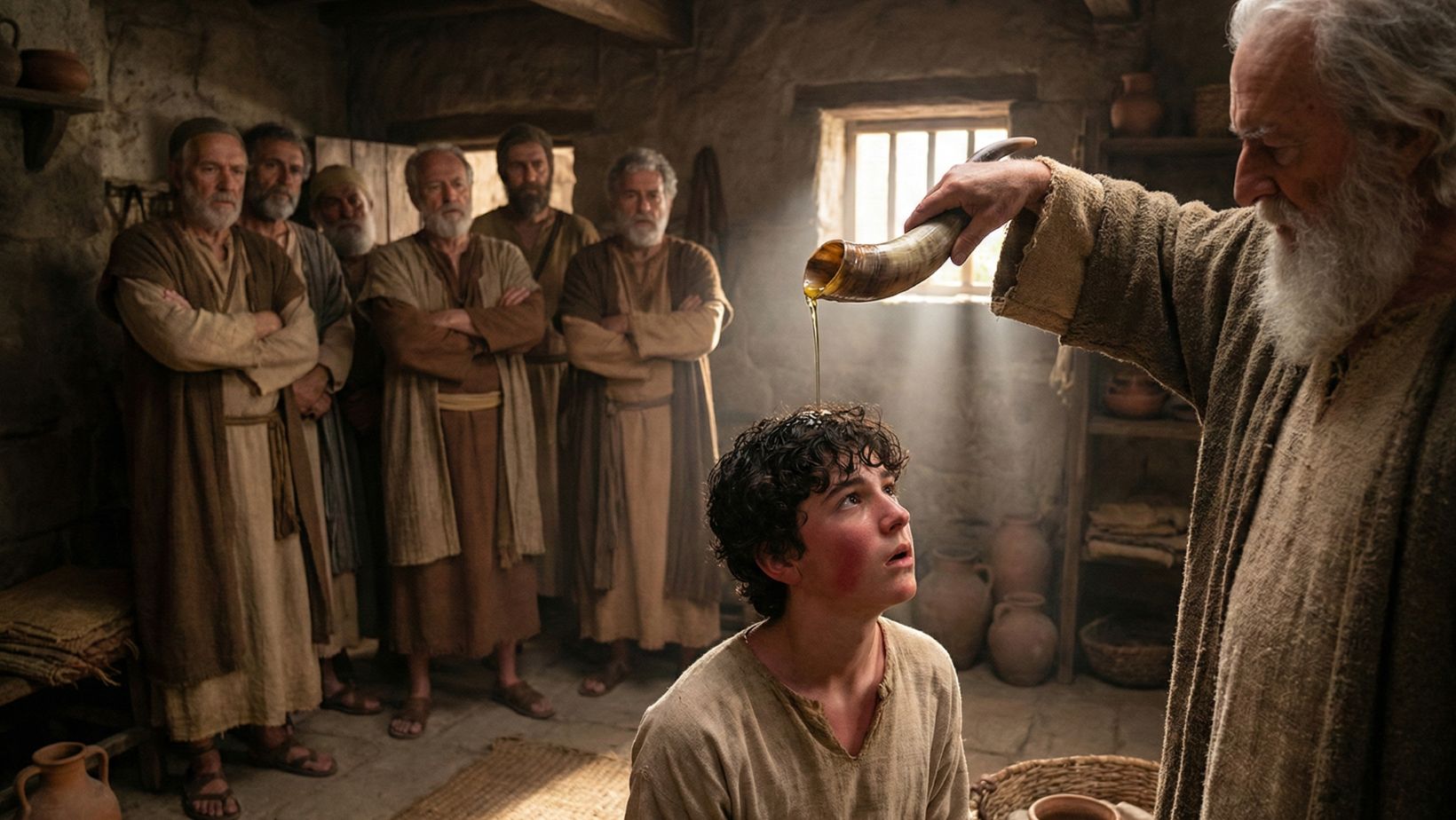
1 Samuel 16 introduces David, the shepherd boy who will become Israel’s greatest king. The narrative shifts from the rejected Saul to the chosen David. Samuel, still grieving over Saul, is sent by God to Bethlehem to anoint one of Jesse’s sons. In a famous selection process, God rejects the impressive older brothers, teaching Samuel that “people look at the outward appearance, but the Lord looks at the heart.” David is anointed in secret, receiving the Holy Spirit. The chapter concludes with a twist of providence: David enters Saul’s court as a musician to soothe the king’s tormented spirit, placing the future king right under the nose of the current one.
1. The Mission to Bethlehem (1 Samuel 16:1–5 NLT)
1 Now the Lord said to Samuel, “You have mourned long enough for Saul. I have rejected him as king of Israel, so fill your flask with olive oil and go to Bethlehem. Find a man named Jesse who lives there, for I have selected one of his sons to be my king.” 2 But Samuel asked, “How can I go? Saul will hear about it and kill me.” “Take a heifer with you,” the Lord replied, “and say that you have come to make a sacrifice to the Lord. 3 Invite Jesse to the sacrifice, and I will show you which of his sons to anoint for me.” 4 So Samuel did as the Lord instructed. When he arrived at Bethlehem, the elders of the town came trembling to meet him. “What is wrong?” they asked. “Do you come in peace?” 5 “Yes,” Samuel replied. “I have come to sacrifice to the Lord. Purify yourselves and come with me to the sacrifice.” Then Samuel performed the purification rite for Jesse and his sons and invited them to the sacrifice, too.
Commentary:
- “Mourned long enough” (v. 1): God commands Samuel to move on. Grief is natural, but prolonged paralysis is not. The work of God continues.
- The Risk (v. 2): Samuel fears for his life. This confirms that Saul has become a dangerous, paranoid tyrant. If he knew Samuel was anointing a rival, he would execute him.
- The Cover Story (v. 2): God tells Samuel to say he is coming to sacrifice. This was true (he did sacrifice), but it concealed his primary purpose. It teaches that secrecy is sometimes necessary for safety in a hostile political environment.
- Fear in Bethlehem (v. 4): The elders “tremble.” Samuel was the man who chopped Agag to pieces (Ch 15). When the Judge shows up unexpectedly, people assume judgment is coming.
2. The Selection Process: Heart vs. Height (1 Samuel 16:6–13 NLT)
6 When they arrived, Samuel took one look at Eliab and thought, “Surely this is the Lord’s anointed!” 7 But the Lord said to Samuel, “Don’t judge by his appearance or height, for I have rejected him. The Lord doesn’t see things the way you see them. People judge by outward appearance, but the Lord looks at the heart.” 8 Then Jesse told his son Abinadab to step forward and walk in front of Samuel. But Samuel said, “This is not the one the Lord has chosen.” … 10 In the same way all seven of Jesse’s sons were presented to Samuel. But Samuel said to Jesse, “The Lord has not chosen any of these.” 11 Then Samuel asked, “Are these all the sons you have?” “There is still the youngest,” Jesse replied. “But he’s out in the fields watching the sheep and goats.” “Send for him at once,” Samuel said. “We will not sit down to eat until he arrives.” 12 So Jesse sent for him. He was dark and handsome, with beautiful eyes. And the Lord said, “This is the one; anoint him.” 13 So as David stood there among his brothers, Samuel took the flask of olive oil and poured it over his head. And the Spirit of the Lord came powerfully upon David from that day on. Then Samuel returned to Ramah.
Commentary:
- Eliab’s Appearance (v. 6): Eliab looked like Saul—tall and impressive. Samuel makes the same mistake Israel made: assuming leadership looks like physical strength.
- The Key Verse (v. 7): “The Lord looks at the heart.”
- This is the thesis statement of David’s life. He is not perfect, but his heart orientation (trust, repentance, worship) aligns with God.
- The Forgotten Son (v. 11): David is not even invited to the feast. He is the “youngest” (Hebrew: ha-qatan, which can mean smallest or insignificant). He is doing the lowest job: shepherding.
- The Anointing (v. 13):
- Public/Private: It was done “among his brothers,” so they saw it, but they likely didn’t understand the full political implication (perhaps thinking he was being anointed as a student-prophet).
- The Spirit: “The Spirit of the Lord came powerfully upon David.” This marks the transfer of power. The anointing was the physical symbol; the Spirit was the actual equipment for kingship.
3. Saul’s Torment and David’s Entry (1 Samuel 16:14–23 NLT)
14 Now the Spirit of the Lord had left Saul, and the Lord sent a tormenting spirit that filled him with depression and fear. 15 Some of Saul’s servants said to him, “A tormenting spirit from God is troubling you. 16 Let us find a good musician to play the harp whenever the tormenting spirit troubles you. He will play soothing music, and you will soon be well again.” … 18 One of the servants said to Saul, “One of Jesse’s sons from Bethlehem is a talented lyre player. Not only that—he is a brave warrior, a man of war, and has good judgment. He is also a fine-looking young man, and the Lord is with him.” 19 So Saul sent messengers to Jesse to say, “Send me your son David, the shepherd.” … 21 So David went to Saul and began to serve him. Saul loved David very much, and David became his armor-bearer. 22 Then Saul sent word to Jesse asking, “Please let David remain in my service, for I am very pleased with him.” 23 And whenever the tormenting spirit from God troubled Saul, David would play the harp. Then Saul would feel better, and the tormenting spirit would go away.
Commentary:
- The Spiritual Vacuum (v. 14): “The Spirit… left Saul.” The Holy Spirit’s role in the OT was often for specific empowerment/office. When Saul lost the office, he lost the empowerment.
- The “Tormenting Spirit” (v. 14):
- The text says the Lord “sent” it. This presents a theological difficulty.
- Interpretation: God is sovereign over all spirits. When God withdrew His protection and presence, He allowed a demonic or psychological affliction to plague Saul as a form of judgment. It manifests as “depression and fear” (terror).
- Music Therapy (v. 16): The ancients understood the power of music to soothe the soul.
- David’s Resume (v. 18): The servant describes David as:
- Musician.
- Brave Warrior (foreshadowing Goliath).
- Man of War (likely meaning capable/trained).
- Good Judgment (wise speech).
- “The Lord is with him” (the most important quality).
- The Irony (v. 21): Saul “loved” David. The man who will eventually kill Saul’s dynasty becomes Saul’s personal therapist and armor-bearer. God places David in the palace to learn the ropes of royalty before he wears the crown.
Theological Significance of 1 Samuel 16
- Inward vs. Outward: God values character over charisma. In a world obsessed with image, this chapter reminds us that God is auditing the heart.
- The Anointing: The Spirit is the essential qualification for leadership. David is nothing without the oil (Spirit); Saul is a disaster without it.
- Providence: God orchestrates events so that the rejected king invites the chosen king into his own house. It shows God’s humor and control over history.
Practical Applications
- Don’t Overlook the “Small” Ones: We often dismiss people because of their age, status, or appearance (like Jesse dismissed David). We must learn to see potential through God’s eyes.
- Faithfulness in Obscurity: David was faithful with the sheep when no one was watching. That faithfulness prepared him for the throne. If you want to lead greatly, serve faithfully in the small things.
- The Power of Worship: David’s music drove back darkness. Worship is not just a prelude to a sermon; it is spiritual warfare that clears the atmosphere of fear and depression.
Final Insight
1 Samuel 16 is a chapter of replacement. The Spirit leaves the palace and goes to the pasture. It teaches us that God’s presence is mobile; He is not tied to buildings or titles. He goes where the humble hearts are.







Leave a Reply