
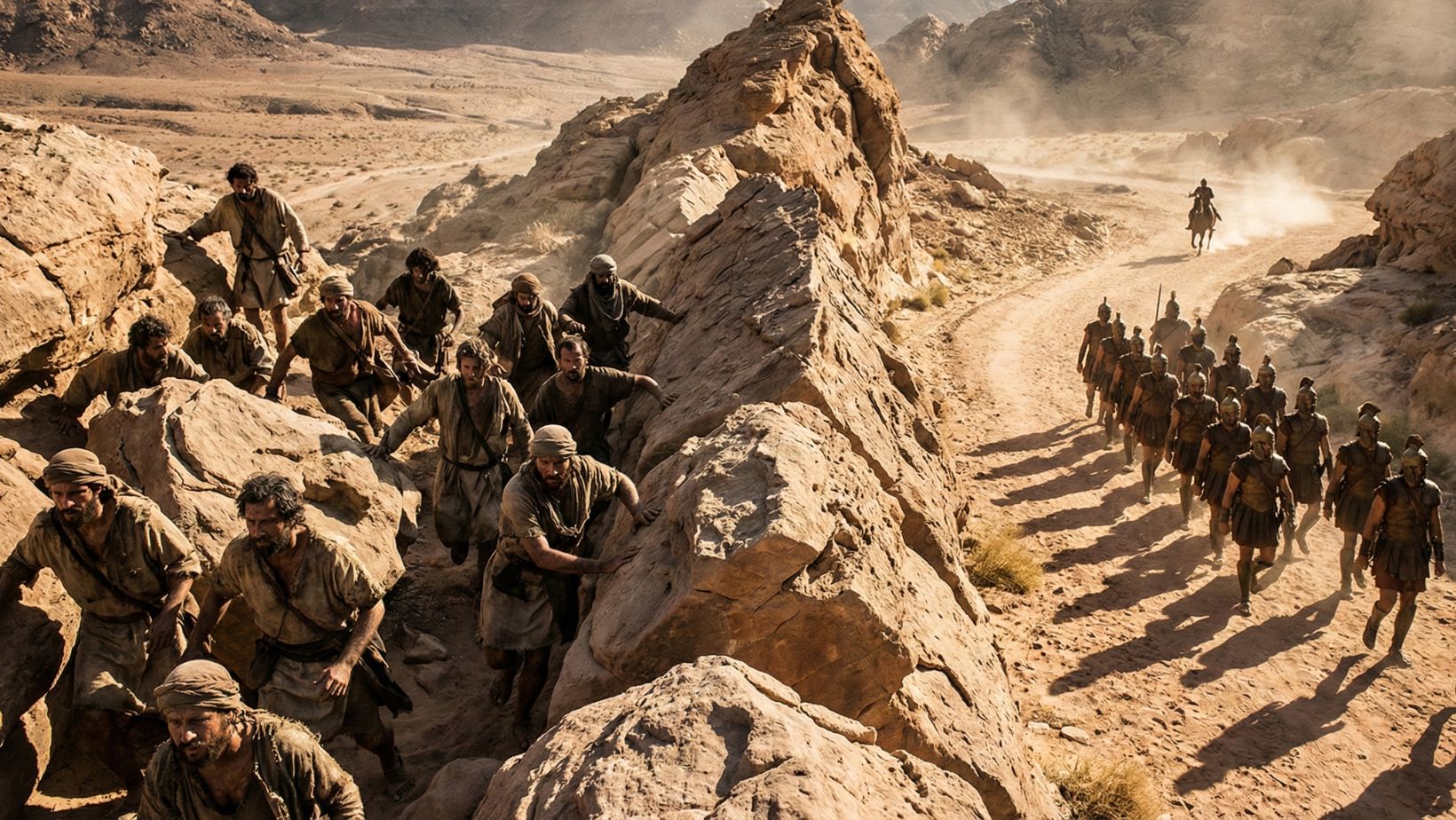
1 Samuel 23 continues the cat-and-mouse game between Saul and David, but with a theological twist: David constantly inquires of the Lord for guidance, while Saul relies on spies and force. The chapter details David’s rescue of the city of Keilah from the Philistines, only to face betrayal by the very people he saved. It features the final, emotional meeting between Jonathan and David, where Jonathan encourages his friend in the wilderness. The narrative concludes with a dramatic near-capture in the Desert of Maon, where David is saved at the last second by a providential Philistine raid that forces Saul to withdraw.
1. The Rescue of Keilah (1 Samuel 23:1–5 NLT)
1 One day news came to David that the Philistines were attacking Keilah and robbing the threshing floors. 2 David asked the Lord, “Should I go and attack them?” “Yes, go and save Keilah,” the Lord told him. 3 But David’s men said, “We’re afraid even here in Judah. We certainly don’t want to go to Keilah to fight the whole Philistine army!” 4 So David asked the Lord again, and again the Lord replied, “Go down to Keilah, for I will help you conquer the Philistines.” 5 So David and his men went to Keilah. They slaughtered the Philistines and took all their livestock and rescued the people of Keilah.
Commentary:
- The Dilemma (v. 1): Keilah was a city in Judah (David’s own tribe). The Philistines were stealing the “threshing floors” (the harvest food supply). Saul, the actual king, is too busy hunting David to protect his own borders.
- The Inquiry (v. 2): David is a fugitive, yet he acts like a king. He cares about the people’s safety. He consults Yahweh (likely through Abiathar and the Ephod/Urim).
- Fear of the Men (v. 3): David’s men are practical. “We are already hunted criminals; why pick a fight with a national army?”
- Double Confirmation (v. 4): David doesn’t rebuke their fear; he respects it by asking God again. God confirms the mission. This shows David’s patience as a leader—he brings his men along spiritually rather than just barking orders.
2. The Betrayal at Keilah (1 Samuel 23:6–13 NLT)
6 Now when Abiathar the priest fled to David at Keilah, he brought the ephod with him. 7 Saul was told that David was at Keilah, and he said, “God has handed him over to me, for he has trapped himself in a walled town with gates and bars.” 8 So Saul mobilized his entire army to march to Keilah and besiege David and his men. 9 …David said to Abiathar the priest, “Bring the ephod!” 10 Then David prayed, “O Lord, God of Israel… 11 Will the men of Keilah surrender me to him? And will Saul actually come, as I have heard? …” And the Lord said, “He will come.” 12 Again David asked, “Will the citizens of Keilah surrender me and my men to Saul?” And the Lord said, “Yes, they will.” 13 So David and his men—about 600 of them now—left Keilah and began roaming the countryside…
Commentary:
- Saul’s Theology (v. 7): Saul interprets circumstances (“walled town”) as divine favor (“God has handed him over”). This is a dangerous delusion—assuming that opportunity equals Providence.
- The Ephod (v. 9): This is the mechanical means of inquiry.
- The Two Questions (v. 11-12): David asks two hypothetical questions:
- Ingratitude: The men of Keilah were ready to hand over their savior to save their own skins. David learns not to trust in human gratitude.
3. The Last Meeting: Jonathan Strengthens David (1 Samuel 23:14–18 NLT)
14 David stayed in the strongholds of the wilderness and in the hill country of Ziph. Saul hunted him day after day, but God didn’t let Saul find him. 15 …David was at Horesh. 16 Jonathan went to find David and encouraged him to stay strong in his faith in God. 17 “Don’t be afraid,” Jonathan assured him. “My father will never find you! You are going to be the king of Israel, and I will be next to you, as my father, Saul, is well aware.” 18 So the two of them renewed their solemn pact before the Lord. Then Jonathan returned home, while David stayed at Horesh.
Commentary:
- God’s Protection (v. 14): “God didn’t let Saul find him.” Despite Saul’s spies and resources, he could not penetrate God’s shield.
- Jonathan’s Encouragement (v. 16): Literally, he “strengthened his hand in God.” This is the ultimate ministry of a friend. He didn’t just give him food or weapons; he reminded him of God’s promises.
- The Future Hierarchy (v. 17): “You are going to be king… and I will be next to you.” Jonathan is content to be Number Two. Tragically, this dream never happens because Jonathan dies in battle, but his heart was right.
- The Final Goodbye: This is the last time they see each other. They part with a renewed covenant, unaware it is the end.
4. The Betrayal of the Ziphites and the Great Escape (1 Samuel 23:19–29 NLT)
19 But now the men of Ziph went to Saul at Gibeah and betrayed David… 24 …David and his men were in the wilderness of Maon… 25 When David heard that Saul was coming, he went down to the rock… 26 Saul and David were now on opposite sides of a mountain. As Saul and his forces were closing in on David and his men to capture them, 27 a messenger arrived and told Saul, “Hurry and come back! The Philistines are raiding the land!” 28 So Saul stopped pursuing David and returned to fight the Philistines. That is why that place is called Sela-hammahlekoth (“The Rock of Escape”). 29 David then left there and stayed in the strongholds of En-gedi.
Commentary:
- The Ziphites (v. 19): Another betrayal. The Ziphites (fellow Judeans) volunteer to spy for Saul, likely to gain political favor.
- The Trap (v. 26): This is the closest call yet. “Opposite sides of a mountain.” Saul is encircling the mountain; David is trapped. It is checkmate.
- Deus Ex Machina (v. 27): “The Philistines are raiding!”
- God uses Israel’s enemy (Philistines) to save Israel’s king (David).
- Saul is forced to choose between his personal vendetta and his national duty. For once, he chooses duty and leaves.
- Sela-hammahlekoth (v. 28): “Rock of Parting” or “Rock of Escape.” A monument to God’s timing. David learns that God is never late.
Theological Significance of 1 Samuel 23
- Guidance: David inquires of the Lord multiple times (v. 2, 4, 10). He does not rely on his own military genius. He moves only when God speaks.
- Divine Sovereignty over “Chance”: The timing of the Philistine raid (v. 27) was not a coincidence; it was a divine interruption. God controls global geopolitics to protect His individual servants.
- Contingency: The Keilah incident teaches that God knows “what if.” He guides us away from negative outcomes if we ask for wisdom.
Practical Applications
- Asking Again: Like David in verse 4, when we (or our team) are afraid, it is okay to go back to God for reassurance.
- Strengthening Hands: We should aspire to be like Jonathan. Who in your life is in a “wilderness”? Go to them and strengthen their hand in God—remind them of their calling and God’s faithfulness.
- Don’t Expect Gratitude: David saved Keilah, and they betrayed him. Do good because it is right, not because you expect people to appreciate it.
Final Insight
1 Samuel 23 shows David squeezed from all sides—Philistines, Saul, treacherous citizens, and spies. Yet, he is sustained by three things: The Word of God (Ephod), the encouragement of a friend (Jonathan), and the sovereign intervention of Providence (the raid).







Leave a Reply