
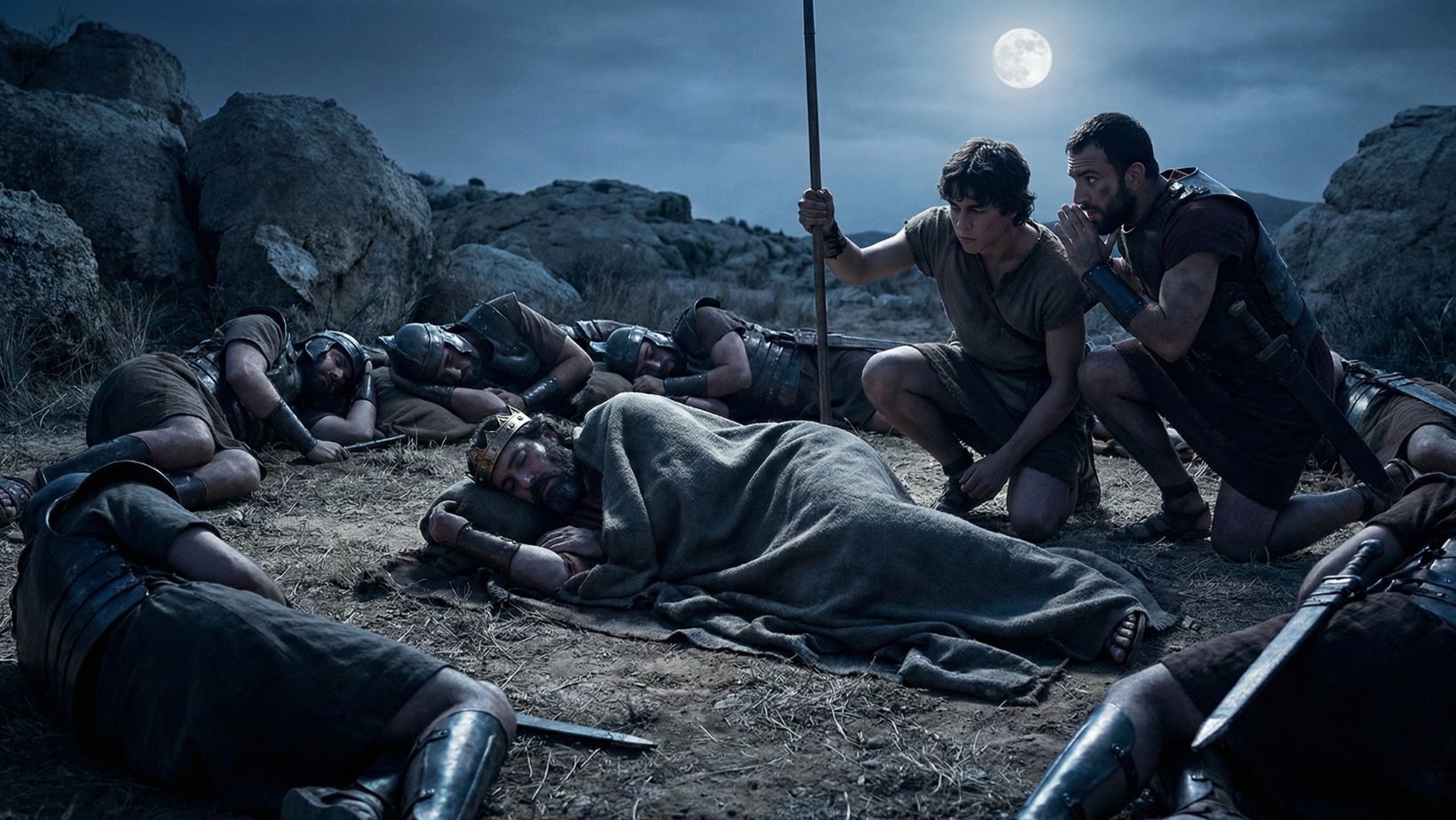
1 Samuel 26 is often called “the second chance” or a “mirror” of Chapter 24. Once again, Saul is hunting David in the wilderness of Ziph, and once again, David infiltrates Saul’s camp at night while a supernatural deep sleep from the Lord falls upon the army. Finding Saul asleep with his spear stuck in the ground beside his head, David’s nephew Abishai begs for permission to kill the king with a single strike. David refuses, maintaining his conviction not to “touch the Lord’s anointed.” Instead, he steals the spear and water jug as proof. The chapter concludes with David mocking Saul’s commander, Abner, for failing to protect the king, and a final, weary conversation with Saul where the king admits his foolishness but David realizes he can never return.
1. The Second Betrayal and the Night Raid (1 Samuel 26:1–5 NLT)
1 Now some men from Ziph came to Saul at Gibeah to tell him, “David is hiding on the hill of Hachilah, which overlooks Jeshimon.” 2 So Saul took 3,000 of Israel’s elite troops and went to hunt him down in the wilderness of Ziph. 3 Saul camped along the road beside the hill of Hachilah… But David was staying in the wilderness. When David heard that Saul was following him, 4 he sent out spies and verified that Saul had indeed arrived. 5 David slipped over to Saul’s camp one night to see where Saul and Abner son of Ner, the commander of his army, were sleeping. They were sleeping inside a ring of their men.
Commentary:
- The Ziphites (v. 1): The men of Ziph betray David a second time (see Ch 23:19). This persistence in treachery underscores David’s isolation.
- Saul’s Relapse (v. 2): Despite his weeping repentance in Chapter 24 (“You are more righteous than I”), Saul returns to his old pattern. Repentance without a change in behavior is just regret.
- David’s Boldness (v. 5): Unlike Chapter 24 where Saul accidentally came to David, here David goes to Saul. He infiltrates the camp. This is a special ops mission.
- The Camp Layout (v. 5): Saul is in the center (“trench” or perimeter), surrounded by Abner and the army. He should have been untouchable.
2. The Spear and the Water Jug (1 Samuel 26:6–12 NLT)
6 “Who will volunteer to go in there with me?” David asked… “I’ll go with you,” Abishai replied. 7 So David and Abishai went right into Saul’s camp in the dead of night. There was Saul, sleeping soundly inside the circle. His spear was stuck in the ground near his head, and Abner and the soldiers were sleeping around him. 8 “God has surely handed your enemy over to you this time!” Abishai whispered to David. “Let me pin him to the ground with one thrust of the spear; I won’t need to strike twice!” 9 “No!” David said. “Don’t kill him. For who can remain innocent after attacking the Lord’s anointed one? 10 …The Lord will surely strike him down some day, or he will die of old age or in battle. 11 The Lord forbid that I should kill the one he has anointed! But take his spear and that jug of water beside his head, and then let’s get out of here.” 12 So David took the spear and jug of water that were near Saul’s head… No one saw them or heard them, for the Lord had put them into a deep sleep.
Commentary:
- Abishai (v. 6): David’s nephew (son of his sister Zeruiah) and brother to Joab. He is loyal but violent. He represents the “pragmatic” voice that tempts David to sin.
- The Temptation (v. 8): Abishai uses theological language: “God has handed him over.”
- The Logic: It looks perfect. Saul is asleep. The weapon is his own spear. Abishai offers to do the dirty work (“I won’t need to strike twice”), keeping David’s hands technically clean.
- David’s Refusal (v. 9-10): David rejects the shortcut.
- The Deep Sleep (v. 12): Tardemah (deep sleep) from Yahweh. This confirms that God was orchestrating the test, not the opportunity for murder.
- The Spear (v. 12): The symbol of Saul’s violence (which he threw at David twice) is now in David’s hand. By taking it, David disarms the king.
3. Taunting Abner (1 Samuel 26:13–16 NLT)
13 Then David climbed the hill opposite the camp until he was at a safe distance. 14 He shouted down to the soldiers and to Abner son of Ner, “Wake up, Abner!” “Who is it?” Abner demanded. “Who is calling out to the king?” 15 “Well, Abner, you’re a great man, aren’t you?” David taunted. “Where in all Israel is there anyone as mighty? So why haven’t you guarded your master the king when someone came to kill him? 16 This isn’t good at all! I swear by the Lord that you and your men deserve to die, because you failed to protect your master, the Lord’s anointed! Look around! Where are the king’s spear and the water jug that were beside his head?”
Commentary:
- Public Humiliation (v. 15): David mocks Abner’s professional competence. As the bodyguard, Abner failed.
- “Deserve to die” (v. 16): Under military law, sleeping on guard duty was a capital offense. David is proving that he cares more for Saul’s life than Saul’s own general does.
- The Evidence (v. 16): Showing the spear and water jug proves the infiltration was real.
4. The Final Conversation (1 Samuel 26:17–25 NLT)
17 Saul recognized David’s voice and called out, “Is that you, my son David?” And David replied, “Yes, my lord the king. 18 Why are you chasing me? What have I done? What is my crime? 19 …If the Lord has stirred you up against me, then let him accept my offering. But if this is simply a human scheme, then may those who are involved be cursed by the Lord. For they have driven me from my home, so I can no longer live among the Lord’s people… 20 Must I die on foreign soil, far from the presence of the Lord? Why has the king of Israel come out to search for a single flea? Why does he hunt me down like a partridge on the mountains?” 21 Then Saul confessed, “I have sinned. Come back home, my son David, and I will no longer try to harm you, for you valued my life today. I have been a fool and very, very wrong.” 22 “Here is your spear, O king,” David replied. “Let one of your young men come over and get it. 23 The Lord gives his own reward for doing good and for being loyal, and I refused to kill you even when the Lord placed you in my power… 24 Now may the Lord value my life, even as I have valued yours today. May he rescue me from all my troubles.” 25 And Saul said to David, “Blessings on you, my son David. You will do many heroic deeds, and you will surely succeed.” Then David went away, and Saul returned home.
Commentary:
- David’s Theology of Exile (v. 19):
- “Driven me from my home”: To be driven from the land of Israel was to be driven from the inheritance of Yahweh. David feels the spiritual weight of exile.
- “Go worship other gods”: Not that David intended to commit idolatry, but living in a pagan land (Philistia) meant being cut off from the sanctuary and the community of faith.
- “I have been a fool” (v. 21): Saul uses the word sakal (acted foolishly). It connects him to Nabal (the fool) from Chapter 25. He admits his entire pursuit is idiocy.
- The Transaction (v. 22): David returns the spear. He refuses to keep the symbol of Saul’s power. He doesn’t want the throne by theft.
- The Appeal to God (v. 23-24): David stops appealing to Saul for justice and appeals only to God. “The Lord gives his own reward.”
- The Final Parting (v. 25): “David went away.” Despite Saul’s invitation to “Come back home” (v. 21), David knows better. This is the last recorded time they see each other.
Theological Significance of 1 Samuel 26
- Perseverance in Righteousness: It is one thing to spare an enemy once (Ch 24); it is another to do it again when they return evil for good. David proves his character is consistent, not situational.
- The Sanctity of Life/Office: David reinforces that God appoints leaders, and God removes them. While we can resist evil policies or flee abuse, taking the life of a leader (assassination) is not God’s method for kingdom advancement.
- The Futility of the Flesh: Saul admits he “played the fool.” His life is a warning that fighting against God’s will is not only wicked, it is stupid. It consumes resources (3,000 elite troops) to chase a “flea” and ends in shame.
Practical Applications
- Resisting the “Abishais”: We often have friends who give us bad, pragmatic advice (“Just do it, God opened the door!”). We must filter their advice through God’s Word. Opportunity does not equal permission.
- Waiting on God’s Timing: David trusted that God would deal with Saul (v. 10). Waiting is the hardest part of faith, but taking matters into our own hands (like Abraham with Hagar) always creates an Ishmael.
- Forgiveness with Boundaries: David forgave Saul but did not trust him. We can forgive abusers without allowing them back into a position to hurt us.
Final Insight
1 Samuel 26 is the graduation exam of David’s wilderness years. He passes the test of power (refusing to kill) and the test of patience (waiting for God). He walks away from Saul’s camp with a clean conscience, ready for the throne, while Saul walks back to his palace with nothing but the knowledge that the man he hates is better than he is.







Leave a Reply