
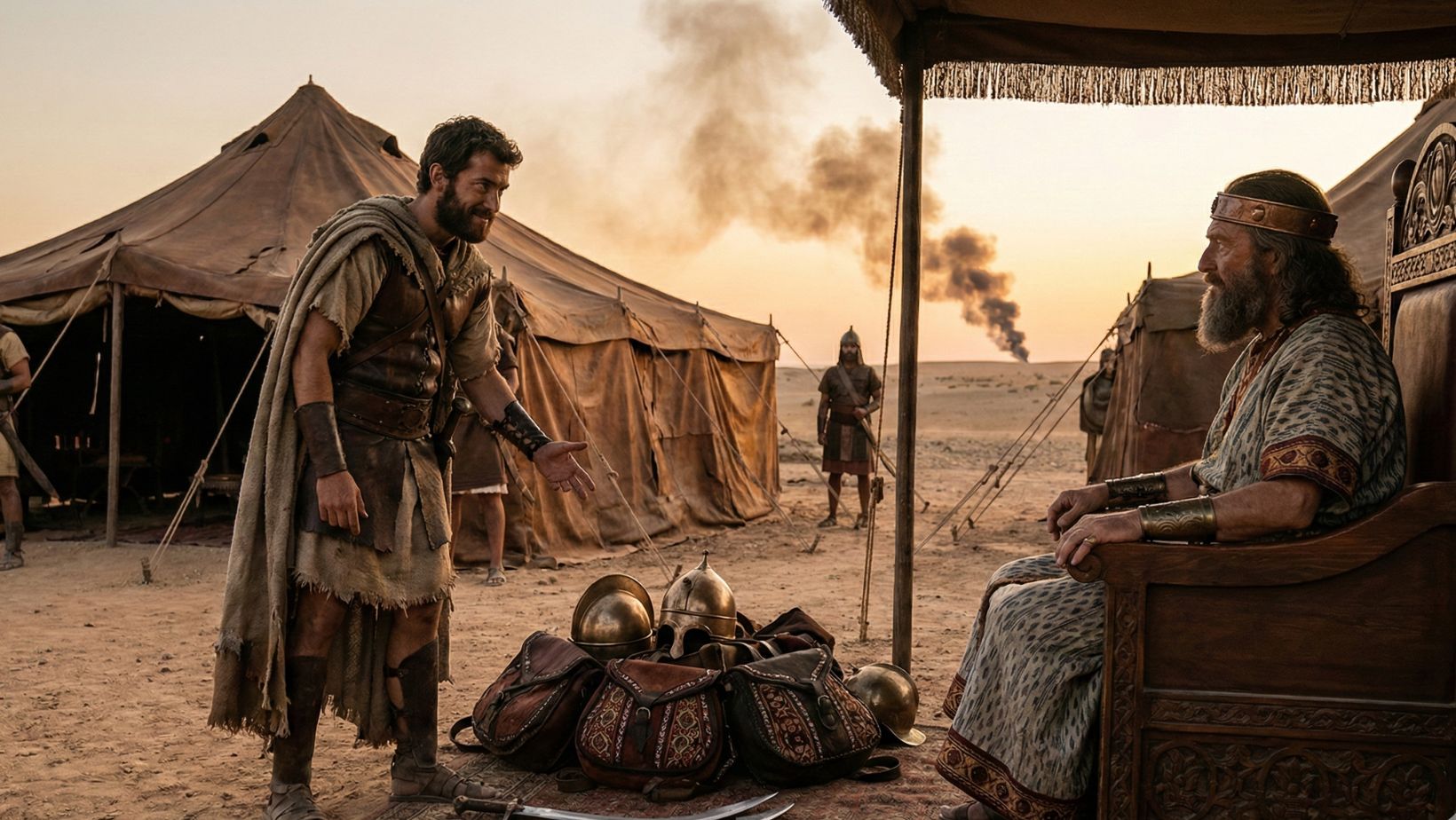
1 Samuel 27 marks a controversial turning point in David’s wilderness years. Exhausted by the constant stress of evading Saul, David makes the pragmatic decision to leave Israel and seek asylum in Philistia—the land of his enemies. He allies himself with Achish, the King of Gath, who gives him the town of Ziklag. For 16 months, David lives a double life: pretending to serve the Philistines by raiding Israel, while actually raiding Israel’s ancient enemies (Geshurites, Girzites, Amalekites) and lying to Achish about it. While the chapter shows David’s cleverness in survival, it also highlights a period where he stops inquiring of the Lord and relies on his own wits.
1. The Decision to Defect (1 Samuel 27:1–4 NLT)
1 But David kept thinking to himself, “Someday Saul is going to get me. The best thing I can do is escape to the Philistines. Then Saul will stop hunting for me in Israelite territory, and I will finally be safe.” 2 So David took his 600 men and went over and joined Achish son of Maoch, the king of Gath. 3 David and his men stayed with Achish in Gath. Each man had his family with him, and David had his two wives: Ahinoam from Jezreel and Abigail of Carmel, the widow of Nabal. 4 Word soon reached Saul that David had fled to Gath, so he stopped hunting for him.
Commentary:
- David’s Internal Monologue (v. 1): “David kept thinking to himself” (literally: “David said in his heart”). Notice he does not inquire of the Lord here (contrast with Ch 23).
- The Logic: It is fear-based logic (“Saul is going to get me”). Despite God’s repeated protection, fatigue has set in. He chooses the “best thing” from a human perspective, not necessarily a divine one.
- The Move to Gath (v. 2): This is the same city David fled to in Chapter 21, where he had to act like a madman. Now, he returns as a powerful warlord with 600 soldiers. Achish welcomes him this time because a mercenary army of 600 men is a valuable asset against Saul.
- Saul Stops (v. 4): The plan works pragmatically. Saul cannot invade Philistine territory without starting a major international war. David finds safety, but at the cost of living among pagans.
2. The Gift of Ziklag (1 Samuel 27:5–7 NLT)
5 One day David said to Achish, “If it is acceptable to you, please give me a town in the country where I can live. Why should your servant live here with you in the royal city?” 6 So Achish gave him the town of Ziklag that day. (That is why Ziklag still belongs to the kings of Judah to this day.) 7 David lived in the Philistine territory for a year and four months.
Commentary:
- David’s Proposal (v. 5): David wants to leave the capital city (Gath).
- Stated Reason: Modesty (“Why should I live in the royal city?”).
- Real Reason: Autonomy. He wants to operate without Achish watching his every move.
- Ziklag (v. 6): A town on the border of the Negev desert. It becomes David’s private fiefdom.
- Duration (v. 7): “A year and four months.” This is a significant period of spiritual silence. There are no recorded Psalms or prayers from this period.
3. The Double Life: Raids and Lies (1 Samuel 27:8–12 NLT)
8 David and his men spent their time raiding the Geshurites, the Girzites, and the Amalekites—people who had lived near Shur, along the road to Egypt, since ancient times. 9 David did not leave one person alive in the villages he attacked. He took the sheep, goats, cattle, donkeys, and camels, and then returned to report to Achish. 10 “Where did you make your raid today?” Achish would ask. And David would reply, “Against the south of Judah, the Jerahmeelites, and the Kenites.” 11 No one was left alive to come to Gath and tell where he had really been. This happened again and again while he was living among the Philistines. 12 Achish believed David and thought to himself, “By now the people of Israel must hate him bitterly. Now he will have to stay here and serve me forever!”
Commentary:
- The Targets (v. 8): David raids the Geshurites, Girzites, and Amalekites. These were nomadic, Bedouin-like tribes that were historic enemies of Israel.
- Total Extermination (v. 9): “Did not leave one person alive.”
- The Motive: This wasn’t just brutality; it was counter-intelligence. He couldn’t risk a prisoner escaping and telling Achish, “David is actually attacking your allies, not Israel.” Dead men tell no tales.
- The Deception (v. 10):
Theological Significance of 1 Samuel 27
- The Silence of God: This chapter is unique because God is not mentioned as speaking or acting. It portrays a season where the believer operates on “autopilot.” While David is clever, he is dangerously close to compromising his identity.
- Providence in the Shadows: Even when David stops inquiring, God protects him. God allows the deception to work so that David survives and even enriches his army (taking sheep/camels) in preparation for his kingship.
- The Complexity of Leadership: David is forced to walk a moral tightrope—lying to a king who gave him asylum to protect the people of God. It shows the messy, gray areas of political survival in a fallen world.
Practical Applications
- Fatigue and Faith: David’s decision in verse 1 (“I shall perish one day”) was driven by exhaustion, not reality (God had saved him for 10 years!). We must be careful not to make major life decisions when we are tired, burned out, or discouraged.
- Living in “Ziklag”: Sometimes we find ourselves in a season of “Ziklag”—a place that isn’t where we belong (Israel), but a place of refuge provided by the world. While there, we must maintain our true allegiance (to God) even if we have to navigate the world’s systems wisely.
- The Trap of Deception: One lie (to Achish) required a thousand deaths (v. 11) to cover it up. Sin often demands more sin to sustain it.
Final Insight
1 Samuel 27 sets up a massive crisis. David’s deception is too successful. Achish trusts him so much that in the next chapter, he will demand David march with the Philistines to fight against Saul and Jonathan. David’s cleverness paints him into a corner from which only God can extract him.







Leave a Reply