
Summary of 1 Samuel 28
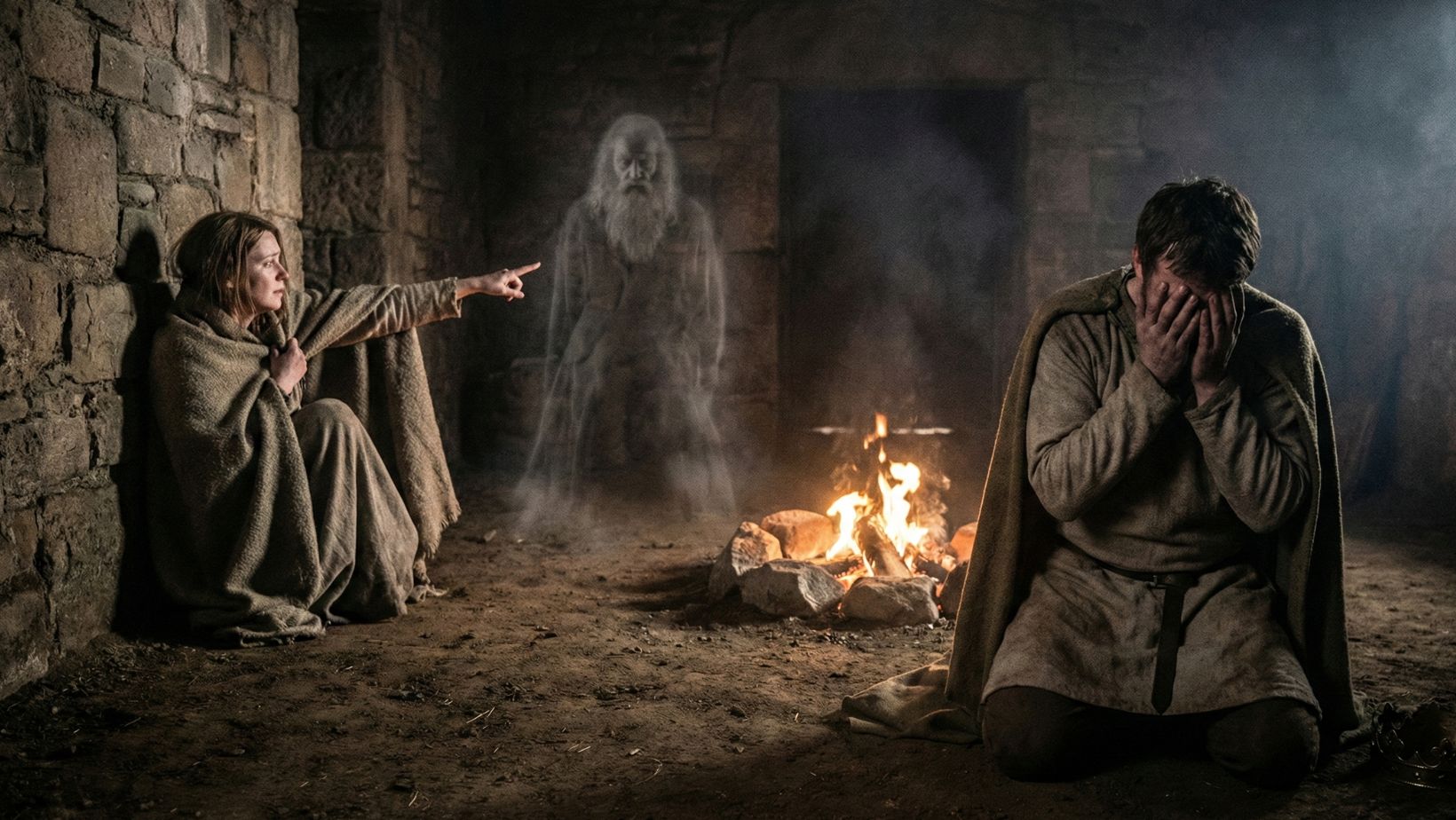
1 Samuel 28 presents one of the most eerie and tragic narratives in the Old Testament, marking the final spiritual collapse of King Saul. The chapter opens with a looming military crisis: the Philistines have gathered for war, and David is precariously positioned among them. Saul, terrified and sensing his impending doom, seeks guidance from the Lord but is met with terrifying silence—God answers him by neither dreams, Urim, nor prophets. In desperation, Saul violates his own royal decree and seeks out a prohibited medium at Endor. This seance results in a terrifying confrontation with the spirit of the deceased prophet Samuel, who rises from the dead not to offer comfort, but to pronounce the final judgment: the kingdom has been torn from Saul and given to David, and by tomorrow, Saul and his sons will join Samuel in death.
1. The Crisis: War and Divine Silence (1 Samuel 28:1–6)
1 About that time the Philistines mustered their armies for another war with Israel. King Achish said to David, “You and your men will be expected to join me in battle.” 2 “Very well!” David agreed. “Now you will see for yourself what we can do.” Then Achish told David, “I am going to make you my personal bodyguard for life.” 3 Meanwhile, Samuel had died, and all Israel had mourned for him. He was buried in Ramah, his hometown. And Saul had banned from the land of Israel all mediums and those who consult the spirits of the dead. 4 The Philistines set up their camp at Shunem, and Saul gathered all the army of Israel and camped at Gilboa. 5 When Saul saw the vast Philistine army, he became frantic with fear. 6 He asked the Lord what he should do, but the Lord refused to answer him, either by dreams or by sacred lots or by the prophets.
Commentary:
- David’s Dilemma (v. 1–2): The narrative briefly shifts to David, who is living in exile among the Philistines. Achish, the Philistine king of Gath, unwittingly places David in an impossible moral bind: fight against his own people (Israel) or betray his host. David’s ambiguous response (“Now you will see…”) preserves his loyalty to God while maintaining his cover.
- The Spiritual Vacuum (v. 3): The narrator re-establishes two critical facts: Samuel is dead (leaving Saul without a spiritual mentor), and Saul has previously purged mediums from the land. This highlights Saul’s hypocrisy in what follows; he publicly upheld the Law (Leviticus 19:31, Deuteronomy 18:10–12) while privately lacking faith.
- Geographical Context (v. 4):
- Shunem: A location in the Valley of Jezreel.
- Gilboa: A mountain range south of Shunem.
- This positioning effectively cut Saul off from the northern tribes and gave the Philistines control of the strategic valley floor, ideal for their chariots.
- Saul’s Terror (v. 5): The Hebrew text emphasizes the physical manifestation of Saul’s fear—his heart “trembled greatly.” He realizes he is outmatched strategically and spiritually.
- The Three Means of Revelation (v. 6): In the Old Testament, God typically communicated through three legitimate channels, all of which are now silent for Saul:
- Dreams: Direct revelation to the individual.
- Urim (Sacred Lots): The priestly tool used to determine binary “yes/no” answers from God. The High Priest (Abiathar) had fled to David with the ephod (1 Samuel 23:6), leaving Saul without this connection.
- Prophets: The spoken word of God. Samuel was dead, and living prophets seemingly had no word for the rejected king.
- Divine Abandonment: The silence is not passive; it is an active judgment. As stated in 1 Chronicles 10:14, Saul died because he was unfaithful and “did not inquire of the Lord”—meaning he did not inquire with a heart of repentance.
2. The Forbidden Seance at Endor (1 Samuel 28:7–14)
7 Then Saul said to his advisers, “Find a woman who is a medium, so I can go and ask her what to do.” His advisers replied, “There is a medium at Endor.” 8 So Saul disguised himself by wearing ordinary clothing instead of his royal robes. He went to the woman’s home at night, accompanied by two of his men. “I have to talk to a man who has died,” he said. “Will you call up his spirit for me?” 9 “Are you trying to get me killed?” the woman demanded. “You know that Saul has outlawed all the mediums and all who consult the spirits of the dead. Why are you setting a trap for me?” 10 But Saul took an oath in the name of the Lord and promised, “As surely as the Lord lives, nothing bad will happen to you for doing this.” 11 Finally, the woman said, “Well, whose spirit do you want me to call up?” “Call up Samuel,” Saul replied. 12 When the woman saw Samuel, she screamed, “You’ve deceived me! You are Saul!” 13 “Don’t be afraid!” the king told her. “What do you see?” “I see a god coming up out of the earth,” she said. 14 “What does he look like?” Saul asked. “It is an old man wrapped in a robe,” she replied. Saul realized it was Samuel, and he fell to the ground before him.
Commentary:
- The Journey to Endor (v. 7): Endor was located on the north side of the hill of Moreh, meaning Saul had to travel perilously close to (or around) the Philistine camp at Shunem to get there. It was a desperate, dangerous night mission behind enemy lines.
- The Irony of the Oath (v. 10): Saul swears “As surely as Yahweh lives” to protect a woman breaking Yahweh’s law. He uses the Lord’s name to sanction an abomination.
- The Appearance of Samuel (v. 12): The medium screams when she sees Samuel.
- Why did she scream? Most commentators argue she was shocked because she was a charlatan used to faking spirits, but this time a real spirit appeared. Alternatively, the spirit’s appearance revealed to her that her client was the King.
- Was it really Samuel? The text plainly says “the woman saw Samuel” and later “Samuel said to Saul.” While some early church fathers and modern skeptics argue this was a demon or a hallucination, the straightforward reading of the narrative, supported by Jewish tradition (Sirach 46:20), is that God allowed Samuel to return one last time to pronounce judgment.
- “I See a God” (v. 13): The woman describes the figure as elohim coming up out of the earth.
- In Hebrew, elohim is usually translated “God,” but it is a plural noun that can generally refer to spiritual beings or celestial residents. Here, it signifies a being from the other realm—terrifying and majestic.
- Wrapped in a Robe (v. 14): The “robe” (me’il) is a key identifier. Samuel wore a specific robe as a child (1 Sam 2:19), and Saul tore Samuel’s robe when the kingdom was torn from him (1 Sam 15:27). The robe symbolizes his prophetic office and authority.
3. The Judgment from Beyond the Grave (1 Samuel 28:15–19)
15 “Why have you disturbed me by bringing me up?” Samuel asked Saul. “I am in deep trouble,” Saul replied. “The Philistines are at war with me, and God has turned away from me. He no longer answers me by prophets or dreams. So I have called for you to tell me what to do.” 16 But Samuel replied, “Why ask me, since the Lord has done exactly what I said he would. He has torn the kingdom from you and given it to your rival, David. 17 The Lord has done just as he said he would. He has torn the kingdom from you and given it to your rival, David. 18 The Lord has done this to you today because you refused to obey his voice and his strict anger against the Amalekites. 19 What’s more, the Lord will hand you and the army of Israel over to the Philistines tomorrow, and you and your sons will be here with me. The Lord will bring down the entire army of Israel.”
Commentary:
- Disturbing the Dead (v. 15): Samuel’s first words are a rebuke: “Why have you disturbed me?” The Hebrew concept of the afterlife (Sheol) was a place of rest. Saul’s intrusion violates the natural order.
- The Logic of Judgment (v. 16): Samuel presents a crushing logical argument: If God has become your enemy, how can a prophet of God help you? Samuel cannot bypass God’s will; he can only confirm it.
- Confirmation of Prophecy (v. 17): Samuel reiterates the prophecy from 1 Samuel 15. The “tearing” of the kingdom is now complete. Notably, Samuel finally names the “neighbor” mentioned in chapter 15—it is David.
- The Reason: Amalek (v. 18): Saul is reminded that his downfall began with partial obedience regarding the Amalekites (1 Samuel 15). He failed to carry out God’s “strict anger” (devotion to destruction), so now God’s judgment falls on him.
- The Prediction of Death (v. 19): This is one of the most precise prophecies in Scripture.
- “Tomorrow”: Immediacy.
- “You and your sons”: Total dynastic collapse (Jonathan, Abinadab, and Malchishua die with him).
- “Will be here with me”: This refers to Sheol (the realm of the dead). It implies that despite Saul’s rebellion, he joins Samuel in the grave, marking the end of the first transition of leadership in the monarchy.
4. Saul’s Collapse and the Meal of the Condemned (1 Samuel 28:20–25)
20 Saul fell full length on the ground, paralyzed with fright because of Samuel’s words. He was also faint with hunger, for he had eaten nothing all day and all night. 21 When the woman saw how distraught he was, she said, “Sir, I obeyed your command at the risk of my life. 22 Now do what I say, and let me give you a little something to eat so you can regain your strength for the trip back.” 23 But Saul refused to eat. “I won’t eat anything,” he said. But his advisers joined the woman in urging him to eat, so he finally yielded and got up from the ground and sat on the couch. 24 The woman had a fattened calf at the house, which she quickly slaughtered. She also took some flour, kneaded it into dough, and baked unleavened bread. 25 She brought the meal to the king and his men, and they ate. That same night they got up and left.
Commentary:
- Total Collapse (v. 20): Saul falls “full length”—a metaphor for his fallen stature. He is physically weak from fasting and spiritually shattered by the news of his death.
- The Medium’s Hospitality (v. 21–24): In a strange twist, the prohibited pagan woman shows more compassion (hesed) than Saul showed to the priests of Nob (whom he slaughtered in 1 Samuel 22). She risks her safety to feed the king who banned her.
- The Fatted Calf (v. 24): The slaughtering of a “fattened calf” and baking of unleavened bread mimics a sacrificial meal or a feast. However, for Saul, it is the “Last Supper” of a condemned man.
- The Departure (v. 25): Saul eats, rises, and walks into the night. There is no repentance, no prayer, only resignation to the fate pronounced by God. He walks toward Gilboa to die.
Theological Significance of 1 Samuel 28
- The Exclusivity of Divine Revelation: The chapter underscores that God cannot be manipulated. Silence from God is a severe form of judgment. When legitimate means (prayer, Scripture/prophets) are ignored or exhausted due to disobedience, turning to illegitimate means (occultism, horoscopes, mediums) only brings greater condemnation.
- The Reality of the Afterlife: This passage provides a rare Old Testament glimpse into the afterlife. It affirms the conscious existence of the soul after death (Samuel is recognizable and speaks) and the separation between the living and the dead.
- Sovereignty Over the Occult: Even in a pagan seance, God remains sovereign. The medium is shocked because her magic did not control the situation—God intervened to allow Samuel to speak. The dark powers are terrified when the true God steps in.
- The Inevitability of God’s Word: Samuel’s words from decades prior (1 Sam 15) had not faded. Time does not erase unrepented sin or annul God’s decrees.
Practical Applications
- The Danger of Desperation: Saul sought a medium not out of curiosity, but panic. When we feel God is silent, the temptation is to look for answers in “forbidden” places (consulting the world’s wisdom, shortcuts, or unethical means). We must learn to wait on God, even in silence.
- Finishing Well: Saul started well but finished tragically. His life serves as a warning that spiritual past successes do not guarantee future faithfulness. We must cultivate a heart that inquires of the Lord daily, not just in crisis.
- Obedience over Sacrifice: Saul lost his kingship because he thought he could negotiate God’s commands (Amalek). True faith requires total obedience, not partial compliance.
- Compassion in Unlikely Places: The medium, though engaged in sinful practices, showed basic human kindness to a broken man. Believers should be challenged that if a pagan medium can show compassion to her enemy, how much more should children of God show love.
Final Insight
1 Samuel 28 depicts the terrifying loneliness of a life lived without God. Saul stands in the dark, surrounded by enemies, rejected by heaven, and comforted only by a medium he sought to destroy. It is a somber reminder that the “silence” of God is often the echo of our own persistent disobedience. Yet, even here, God’s truth is victorious—Samuel speaks, and God’s word stands firm.







Leave a Reply