
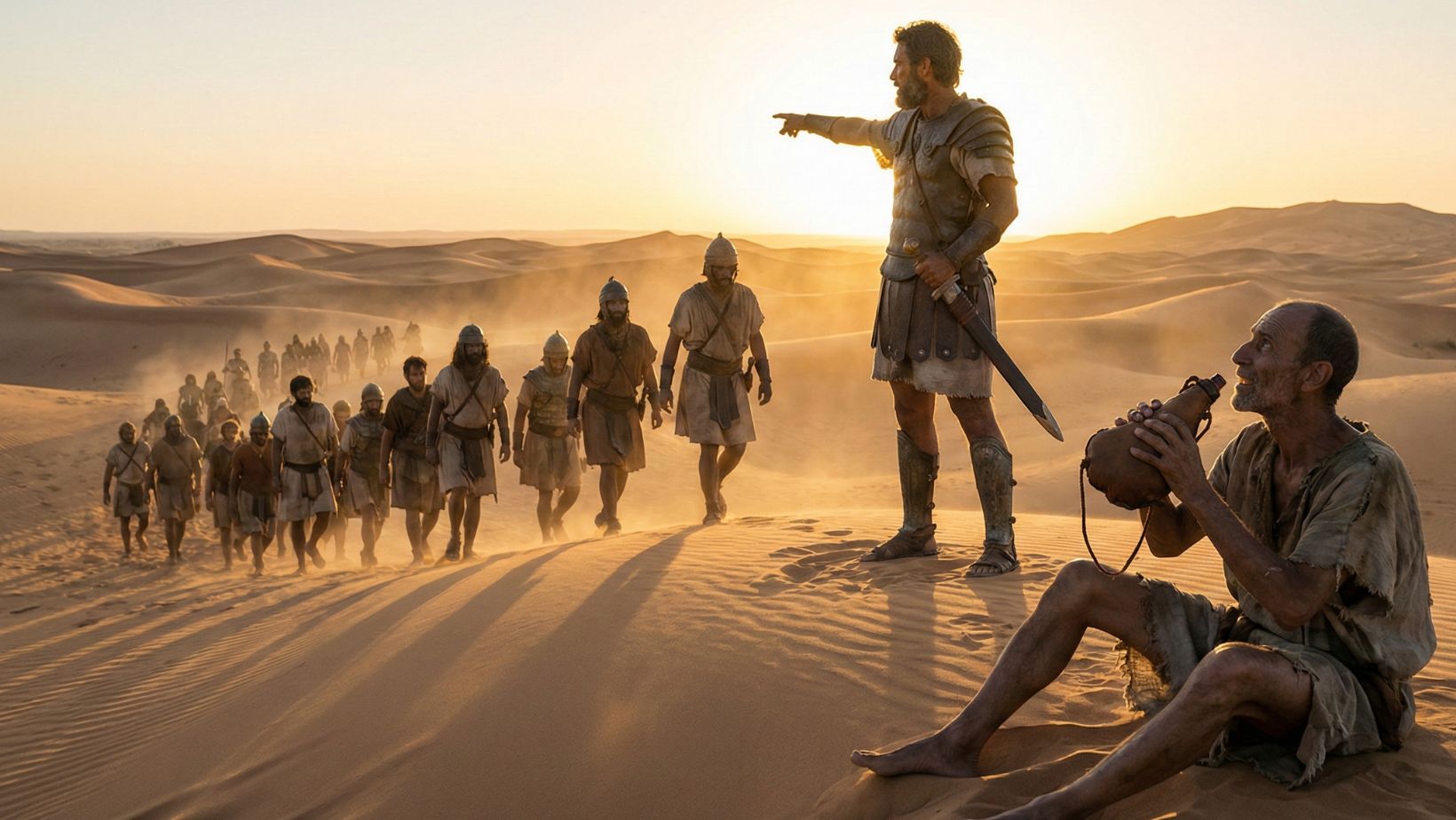
1 Samuel 30 is a narrative of catastrophe, spiritual resilience, and total restoration. After being dismissed by the Philistines, David returns to his base at Ziklag to find it burned to the ground and all the women and children kidnapped by Amalekites. Facing the potential mutiny of his own grief-stricken men, David “strengthens himself in the Lord” and launches a pursuit. Through divine guidance and the help of an abandoned Egyptian slave, David tracks down the raiders, recovers everything that was lost, and distributes the plunder generously, acting more like a king than ever before.
1. The Catastrophe at Ziklag (1 Samuel 30:1–6)
1 Three days later, when David and his men arrived home at their town of Ziklag, they found that the Amalekites had made a raid into the Negev and Ziklag; they had crushed Ziklag and burned it to the ground. 2 They had carried off the women and children and everyone else but without killing anyone. 3 When David and his men saw the ruins and realized what had happened to their families, 4 they wept until they could weep no more. 5 David’s two wives, Ahinoam from Jezreel and Abigail, the widow of Nabal from Carmel, had been captured. 6 David was now in great danger because all his men were very bitter about losing their sons and daughters, and they began to talk of stoning him. But David found strength in the Lord his God.
Commentary:
- The Amalekite Raid (v. 1): While David and his 600 men were north at Aphek (a 3-day march away), the Amalekites took advantage of the unguarded south (Negev). This was likely retaliation for David’s earlier raids (1 Sam 27:8).
- Providential Mercy (v. 2): Remarkably, the Amalekites killed no one. In ancient warfare, it was common to slaughter males and enslave females. The text notes they “carried off… everyone… without killing anyone.” This detail is a subtle hint of God’s restraining hand even in disaster.
- The Crisis of Leadership (v. 4–6):
- Grief: The men wept until they were physically exhausted.
- Mutiny: Grief turned to anger. The men blamed David for leaving Ziklag defenseless to march with the Philistines. They spoke of stoning him—the punishment for a false prophet or a bringer of disaster.
- The Turning Point: Verse 6 is the pivot of the entire chapter (and perhaps David’s life). While Saul turned to a medium in his distress (Ch. 28), David “strengthened himself in the Lord his God.” He remembered God’s covenant promises rather than surrendering to panic.
2. The Pursuit and the Egyptian Guide (1 Samuel 30:7–15)
7 Then he said to Abiathar the priest, “Bring me the ephod!” So Abiathar brought it. 8 Then David asked the Lord, “Should I chase this band of raiders? Will I catch them?” And the Lord told him, “Yes, go after them. You will surely recover everything that was taken from you!” 9 So David and his 600 men set out, and they came to the Brook Besor. 10 But 200 of the men were too exhausted to cross the brook, so David continued the pursuit with 400 men. 11 Along the way they found an Egyptian man in a field and brought him to David. They gave him some bread to eat and water to drink. 12 They also gave him part of a fig cake and two clusters of raisins, for he hadn’t eaten anything or drunk any water for three days and nights. Before long his strength returned. 13 “To whom do you belong, and where do you come from?” David asked him. “I am an Egyptian—the slave of an Amalekite,” he replied. “My master abandoned me three days ago because I fell sick. 14 We were on our way back from raiding the Kerethites in the Negev, the territory of Judah, and the land of Caleb, and we had just burned Ziklag.” 15 “Will you lead me to this band of raiders?” David asked. The young man replied, “If you take an oath in God’s name that you will not kill me or give me back to my master, then I will guide you to them.”
Commentary:
- Inquiring of the Lord (v. 7–8): Unlike Saul, who had no access to the Ephod (since Abiathar had fled to David), David has direct access to God. The Lord gives a two-part promise: “Pursue” and “Recover all.”
- The Brook Besor (v. 9–10): The physical toll of the march from Aphek (3 days) plus the emotional toll of the kidnapping broke 200 men. David does not rebuke them; he allows them to stay and guard the baggage. This demonstrates wisdom—recognizing physical limits without condemning loyalty.
- The Egyptian Slave (v. 11–13):
- Compassion as Strategy: David stops his urgent pursuit to feed a dying outcast. This act of kindness (hesed) becomes the key to his victory. If David had ignored the dying slave to save time, he would have never found the Amalekites.
- The Contrast: The Amalekite master abandoned his slave because he was sick (useless). David restores the slave. This contrasts the cruelty of the world with the character of God’s kingdom.
- Intelligence Gathering (v. 14): The slave confirms the raiders’ identity and location. The raid was extensive, covering Philistine (Kerethites), Judean, and Calebite territories.
3. The Battle and Recovery (1 Samuel 30:16–20)
16 So he led David to them, and they found the Amalekites spread out across the fields, eating and drinking and dancing with joy because of the vast amount of plunder they had taken from the Philistines and the land of Judah. 17 David rushed in and fought them from before dawn until the evening of the next day. None of the Amalekites escaped except 400 young men who fled on camels. 18 David got back everything the Amalekites had taken, and he rescued his two wives. 19 Nothing was missing: small or great, son or daughter, nor anything else that had been taken. David brought everything back. 20 He also recovered all the flocks and herds, and his men drove them ahead of the other livestock. “This plunder belongs to David!” they said.
Commentary:
- The Element of Surprise (v. 16): The Amalekites were celebrating, assuming they were safe. Their guard was down (“spread out,” “dancing”).
- The Slaughter (v. 17): The battle was intense, lasting from twilight (dawn) until the evening of the next day—roughly 24 to 36 hours of fighting. The escape of 400 men on camels indicates the enemy force was likely over a thousand strong, making David’s victory with only 400 men miraculous.
- Total Restoration (v. 18–19): The text emphasizes the completeness of the recovery: “Nothing was missing.” This fulfills God’s promise in verse 8 exactly.
- “David’s Plunder” (v. 20): In addition to recovering their own property, they captured the Amalekites’ flocks (stolen from other raids). The men designated this extra wealth as “David’s plunder,” establishing his ability to provide for his people.
4. The Statute of Equity (1 Samuel 30:21–25)
21 When they arrived at the Brook Besor, the 200 men who had been too exhausted to go with them came out to meet David and the people who were with him. David greeted them joyfully. 22 But some evil troublemakers among David’s men said, “They didn’t go with us, so they can’t have any of the plunder we recovered. Give them their wives and children and tell them to be gone.” 23 But David said, “No, my brothers! Don’t be selfish with what the Lord has given us. He has kept us safe and helped us defeat the band of raiders that attacked us. 24 Who will listen to you when you talk like this? We share and share alike—those who go to battle and those who guard the equipment.” 25 From then on David made this a decree and regulation for Israel, and it is still followed today.
Commentary:
- The Conflict (v. 22): The “evil troublemakers” (literally “men of Belial”—worthless men) operate on a merit-based system: “We fought, we eat. You rested, you starve.”
- David’s Ruling (v. 23–24): David rejects this mindset based on grace:
- Source: The victory was not due to their fighting skill but “what the Lord has given us.” Since it was a gift, it must be shared.
- Unity: The role of support (guarding the baggage) is as vital as the role of combat.
- The Precedent (v. 25): This became a standing law in Israel (and a principle in Numbers 31:27). It demonstrates David’s kingly wisdom—unifying his people and ensuring the weak are not trampled by the strong.
5. Diplomacy Through Generosity (1 Samuel 30:26–31)
26 When he arrived at Ziklag, David sent part of the plunder to the elders of Judah, who were his friends. “Here is a present for you, taken from the Lord’s enemies,” he wrote. 27 The gifts were sent to the people of the following towns where David and his men had visited: Bethel, Ramoth-negev, Jattir, 28 Aroer, Siphmoth, Eshtemoa, 29 Racal, the towns of the Jerahmeelites, the towns of the Kenites, 30 Hormah, Bor-ashan, Athach, 31 Hebron, and all the other places David and his men had visited.
Commentary:
- Strategic Generosity (v. 26): David sends the surplus plunder to the elders of Judah. This is a brilliant political move.
- The Locations (v. 27–31): These towns are in the southern territory of Judah. David is repaying those who likely harbored him during his flight from Saul. He is solidifying his base.
Theological Significance of 1 Samuel 30
- Spiritual Resilience: David shows us what to do when life collapses. He didn’t repress his grief (he wept), but he didn’t stay in it. He turned to God for strength and direction. “Strengthening oneself in the Lord” is the antidote to despair.
- God as the Restorer: The chapter affirms that God is interested in the restoration of what the enemy has stolen. The phrase “Recover all” echoes the redemptive nature of God.
- Grace over Merit: David’s distribution of the plunder teaches that rewards in God’s kingdom are based on grace and corporate unity, not just individual effort. Those who “hold the ropes” are rewarded equally with those who go down into the well.
- The Contrast of Kings:
Practical Applications
- Encourage Yourself: When no one else will encourage you, and even friends turn against you, you must know how to find strength in God alone through prayer and remembering His promises.
- Don’t Ignore the “Small” People: David’s breakthrough came because he stopped for a dying slave. We should never be too busy with our “great mission” to show kindness to the marginalized; often, they hold the key to our next step.
- Value the Support Team: In any ministry or organization, honor those who do the behind-the-scenes work (administrative, prayer, logistics) just as much as those on the “front lines.”
- Generosity paves the future: Use your victories to bless others. David used his success to build bridges, not walls.
Final Insight
1 Samuel 30 transforms David from a fugitive leader into a king-in-waiting. By managing his own grief, unifying his fractured army, showing mercy to a slave, and sharing the spoils with his people, David demonstrates he is finally ready for the throne. The ashes of Ziklag became the foundation of his kingdom.







Leave a Reply