
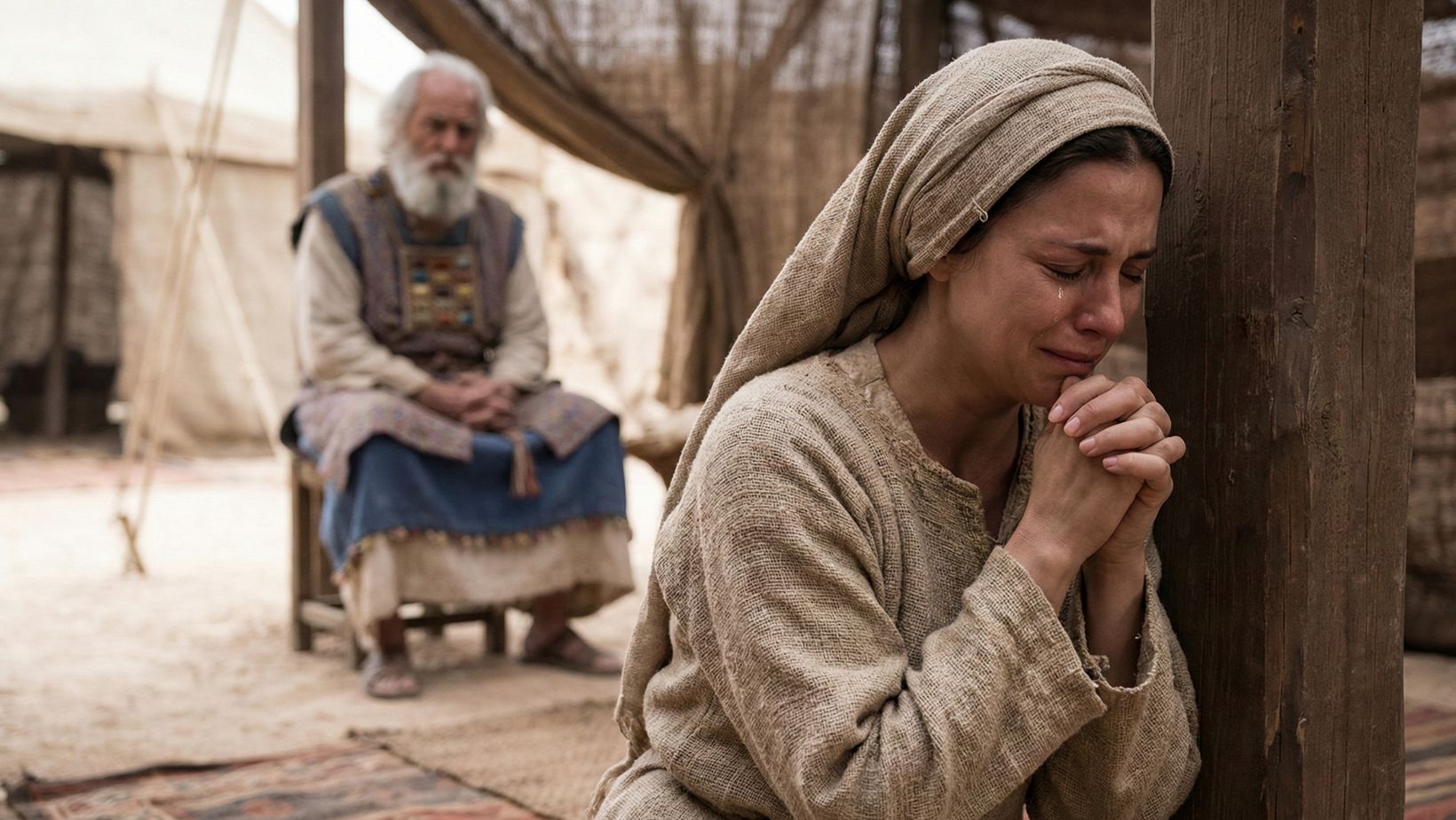
Hannah is one of the most poignant figures in the Old Testament, representing the pain of barrenness and the power of persistent, pouring-out prayer. Her story, found in the opening chapters of 1 Samuel, serves as the catalyst for the transition from the chaotic era of the Judges to the establishment of the Monarchy. While she is defined early on by her deep sorrow and the harassment she endured from her rival, she is ultimately defined by her faithfulness to a vow. She did not just ask God for a child to fill a void in her life; she asked for a son she could dedicate entirely to the Lord’s service. That son, Samuel, became the prophet who anointed King David.
- Name: Hannah (Hebrew: Channah)
- Meaning: “Grace” or “Favor”
- Husband: Elkanah
- Rival: Peninnah (Elkanah’s other wife)
- Home: Ramathaim-zophim (Ramah)
- Key Location: The Tabernacle at Shiloh
- Son: Samuel (plus three other sons and two daughters later)
- Book: 1 Samuel (Chapters 1–2)
- Key Virtues: Persistence, Integrity, Self-Sacrifice
- Legacy: Mother of the prophet Samuel; author of a prophetic song (The Magnificat of the OT)
Name Meaning
Hebrew: Channah, meaning “Grace” or “Favor.” Significance: For years, her name seemed ironic as she felt forgotten by God. However, her life ultimately became a testament to God’s grace, not only in giving her a son but in allowing her to play a role in Israel’s salvation history.
Lineage / Family Background
Husband: Elkanah, a man of the hill country of Ephraim (though 1 Chronicles 6 indicates he was of Levite lineage, which explains why Samuel could serve as a priest).
Domestic Situation: Hannah was the preferred wife but was barren. Peninnah, the second wife, had many children and used this to mock Hannah relentlessly, creating a household of tension and grief.
Biblical Era / Context
Time: The end of the period of Judges (~11th Century BCE).
Religious Context: The spiritual state of Israel was low. The priesthood at Shiloh (led by Eli and his corrupt sons, Hophni and Phinehas) was compromised.
Setting: The family made annual pilgrimages to Shiloh to sacrifice to the Lord of Hosts (Yahweh Sabaoth—the first time this title appears in the Bible is in Hannah’s story).
Major Roles / Identity
The Suffering Intercessor: She represents the pious remnant of Israel, weeping over her barrenness just as the faithful wept over Israel’s spiritual barrenness.
The Vow-Keeper: Unlike many figures who make rash vows (like Jephthah), Hannah made a thoughtful vow and meticulously kept it, even at great personal cost.
The Prophetic Poet: Her prayer of thanksgiving (1 Samuel 2) is a theological masterpiece that predicts the Messiah and the reversal of fortunes (the weak becoming strong).
Key Character Traits
Emotional Authenticity: She did not hide her pain; she wept bitterly and poured out her soul, refusing to eat during her depression.
Humility: When accused of drunkenness by the High Priest Eli, she responded with respect and clarity rather than anger.
Devotion: She realized that the solution to her problem was God, not her husband (who tried to comfort her by saying, “Am I not better to you than ten sons?”).
Sacrifice: The ultimate test of her character was not getting the son, but giving him up to the priesthood as soon as he was weaned (likely around age 3).
Main Life Events
The Provocation: Year after year at Shiloh, Peninnah would provoke Hannah until she wept, emphasizing her empty womb (1 Samuel 1:6-7).
The Prayer at the Doorpost: Hannah stood at the Tabernacle, weeping and praying silently (moving only her lips), vowing that if God gave her a son, she would give him back to the Lord as a Nazirite (1 Samuel 1:11).
The Misunderstanding: Eli the priest watched her mouth and assumed she was drunk, rebuking her. She corrected him, explaining she was a woman “oppressed in spirit” (1 Samuel 1:12-16).
The Birth of Samuel: “The Lord remembered her.” She conceived and bore a son, naming him Samuel (“Heard by God”).
The Dedication: Once Samuel was weaned, she took him to Shiloh with a sacrificial offering and left him there to serve under Eli, fulfilling her vow (1 Samuel 1:24-28).
The Yearly Visit: Every year, she would make a little robe and bring it to Samuel at the Tabernacle, maintaining her bond with him (1 Samuel 2:19).
Major Relationships
Elkanah: A loving but somewhat oblivious husband. He loved Hannah deeply (giving her a double portion of meat) but struggled to understand the depth of her grief over childlessness.
Peninnah: The antagonist who utilized her fertility as a weapon of cruelty against Hannah.
Eli: The aging High Priest who blessed her after initially misjudging her. He later blessed Elkanah and Hannah to have more children.
Samuel: Her firstborn, the child of promise, whom she released into God’s service.
Notable Passages
1 Samuel 1:11: The Vow — “O LORD Almighty, if you will only look on your servant’s misery and remember me… then I will give him to the LORD for all the days of his life.”
1 Samuel 1:15: Her defense — “I am a woman who is deeply troubled… I have been pouring out my soul to the LORD.”
1 Samuel 1:27: The testimony — “I prayed for this child, and the LORD has granted me what I asked of him.”
1 Samuel 2:1-2: The Song — “My heart rejoices in the LORD… There is no one holy like the LORD; there is no one besides you; there is no Rock like our God.”
Legacy & Impact
Theology of Prayer: Hannah teaches that prayer is not just asking for things; it is a “pouring out of the soul.” She introduced silent prayer (praying in the heart) in Scripture.
The Prototype of Mary: Hannah’s Song (1 Samuel 2) is the direct theological ancestor of Mary’s Magnificat (Luke 1). Both women celebrate God raising the humble and bringing down the proud.
The Samuel Transition: By giving up her son, she provided Israel with the leader who would anoint its kings. Her personal sacrifice led to national salvation.
Symbolism / Typology
Barrenness to Life: Hannah represents the spiritual state of Israel—barren and mocked—waiting for God to open the womb of history to bring forth a deliverer.
The Nazirite: By dedicating Samuel as a Nazirite (no razor on his head), she set him apart as holy, similar to Samson and John the Baptist.
Extra-Biblical References
Jewish Tradition: The Talmud lists Hannah as one of the seven prophetesses of Israel. The Rabbis teach that she was the first person to address God as Yahweh Sabaoth (Lord of Hosts), recognizing His sovereignty over the armies of heaven and earth.
Liturgical Use: Hannah’s prayer is read in synagogues on Rosh Hashanah (the Jewish New Year) because tradition holds that she was “remembered” by God on this day.







Leave a Reply