
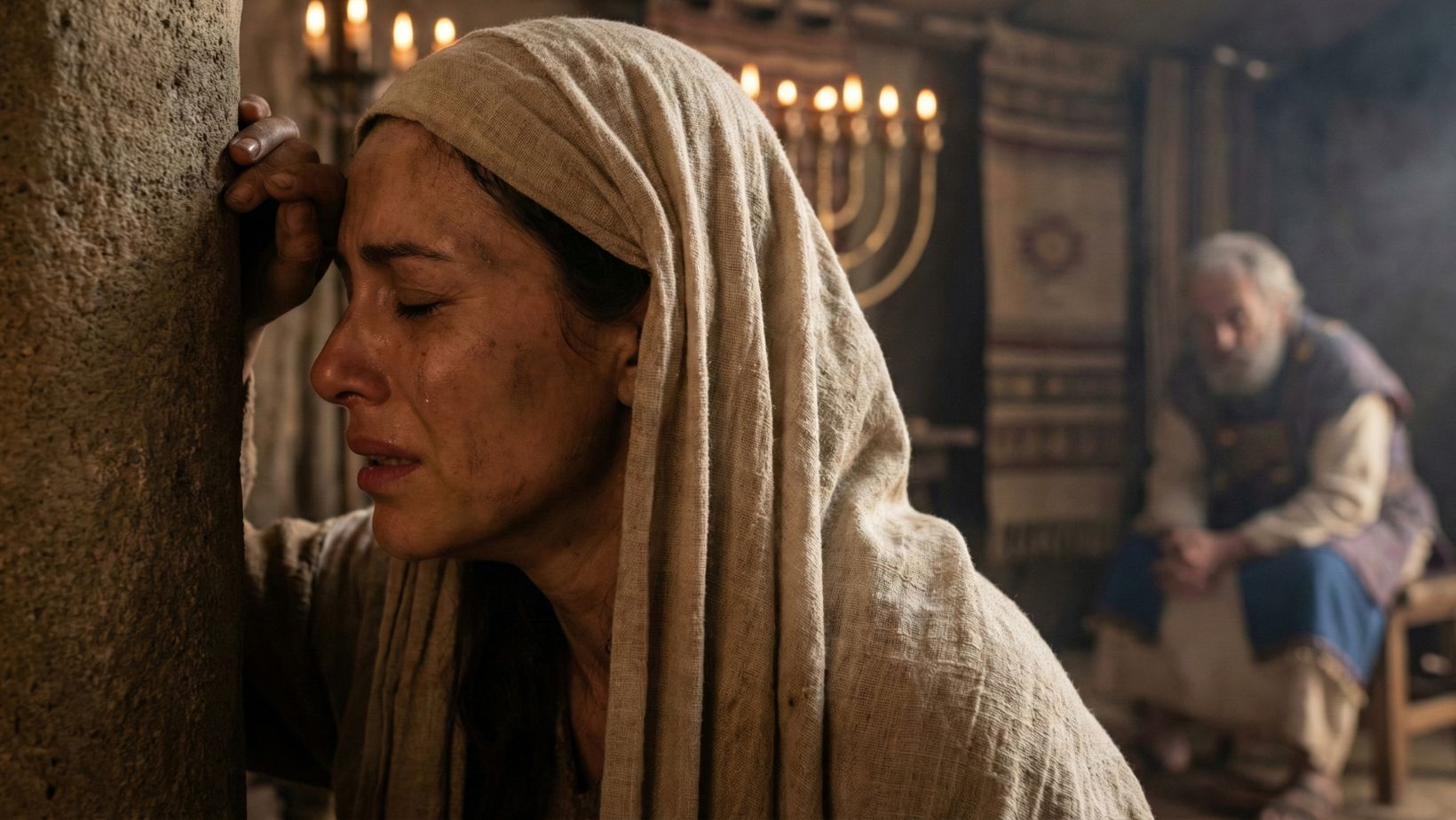
The event of Hannah praying for a son (1 Samuel 1:9–18) is one of the most intimate and transformative moments in the Old Testament. It is the pivot point where the era of the Judges—characterized by chaos and spiritual deafness—begins to turn toward the era of the Prophets and Kings. This event is not merely about a woman wanting a baby; it is about a faithful believer taking her brokenness directly to the throne of Yahweh, bypassing the corrupt human systems of her day, and striking a covenant with God that would save her nation.
- Event: Hannah’s Vow and Prayer for a Son
- Scripture: 1 Samuel 1:9–18
- Location: The Tabernacle at Shiloh (by the doorpost)
- Key Characters: Hannah, High Priest Eli
- The Vow: To dedicate her son as a lifelong Nazirite
- Key Outcome: Hannah’s countenance changes; she eventually conceives Samuel
- Theological First: First recorded instance of silent prayer in Scripture
The Context: A Feast of Tears
The event takes place during the annual sacrificial feast at Shiloh. This should have been a time of celebration, but for Hannah, it was a yearly reminder of her “failure.”
- The Provocation: Elkanah had just distributed the sacrificial meat. He gave Peninnah and her children their portions, but he gave Hannah a “double portion” (or a worthy portion) because he loved her. This act of favor incited Peninnah’s jealousy, causing her to mock Hannah’s barrenness relentlessly.
- The Reaction: Overwhelmed by grief and unable to eat the sacrificial meal, Hannah rises from the table. While the rest of the family is feasting and drinking, she retreats to the sanctuary alone.
Detailed Scene Breakdown
1. The Separation (Verse 9)
Hannah stands up after eating and drinking. She leaves the family gathering. This physical separation symbolizes her spiritual state: she feels cut off from the blessing of fruitfulness that others are enjoying. She moves toward the Tabernacle structure where Eli the priest is sitting by the doorpost.
2. The Pouring Out (Verse 10)
The text describes her as being in “bitterness of soul.” She does not pray a polite, religious prayer. She “wept much” and prayed to the Lord.
- The Title: She addresses God as Yahweh Sabaoth (“Lord of Hosts”). This is the first time in the Bible this title is used. Hannah recognizes that the God who commands the armies of heaven surely has the power to open a womb.
3. The Radical Vow (Verse 11)
Hannah moves beyond simple petition to negotiation. She makes a conditional vow:
- The Request: “Look on your servant’s misery… give your servant a son.”
- The Promise: “Then I will give him to the LORD for all the days of his life, and no razor will ever be used on his head.”
- Analysis: This is a Nazirite Vow (Numbers 6). Usually, this vow was temporary (30 days or so). Hannah is offering a lifelong Nazirite consecration. She is essentially saying, “God, if you give me a son, I will renounce my right to raise him for myself. I will carry him, nurse him, and then give him back to You to fix this broken nation.”
4. The Silent Intercession (Verses 12–13)
Hannah continues praying “a long time.” Crucially, she prays in her heart; her lips move, but her voice is not heard.
- Cultural Note: In the ancient world, prayer was almost always audible/spoken aloud. Silent prayer was highly unusual and suspicious. This intimacy suggests Hannah had a personal relationship with God that transcended ritual.
5. The Accusation (Verses 13–14)
Eli, the High Priest, is watching her. His spiritual perception is so dulled that he mistakes deep spiritual anguish for drunkenness.
- Eli’s assumption: “How long will you keep on getting drunk?”
- Irony: The High Priest (who should have been the most discerning man in Israel) cannot tell the difference between a holy woman and a drunkard. This highlights the corruption of the priesthood at the time.
6. The Defense and Blessing (Verses 15–17)
Hannah responds with immense dignity. She does not get angry; she explains, “I have been pouring out my soul to the Lord.”
- The Turn: Eli realizes his mistake. He shifts from accuser to intercessor: “Go in peace, and may the God of Israel grant you what you have asked of him.”
- The Seal: Hannah accepts this word as a divine confirmation.
7. The Transformation (Verse 18)
This is the climax of the event, even before the pregnancy. Hannah says, “May your servant find favor in your eyes.” Then she goes her way, eats, and “her face was no longer downcast.”
- Significance: The burden lifted before the answer came. The prayer itself, and the assurance from the priest, settled the matter in her heart.
Theological Analysis
1. Prayer as “Pouring Out” The Hebrew word for Hannah’s prayer suggests a liquid being poured out. She held nothing back. This teaches that God desires authentic, raw emotion rather than polished religious language.
2. The First “Lord of Hosts” Hannah introduces the concept of God as the Sovereign Commander. In a time when Israel felt weak and threatened by the Philistines, a barren woman recognized God as the ultimate power broker.
3. The Conditional Vow Was Hannah bargaining with God? Yes, but in a holy way. She aligned her desire with God’s need. God needed a prophet to replace Eli’s corrupt house; Hannah needed a son. She aligned her womb with God’s will.
Character Dynamics in the Event
Hannah vs. Peninnah (The Catalyst): Peninnah’s cruelty was the pressure that pushed Hannah to the prayer altar. Without the harassment, Hannah might have been content to be a childless but loved wife. The pain drove her to the purpose.
Hannah vs. Eli (The Contrast): The scene contrasts the spiritually vibrant layperson (Hannah) with the spiritually dull clergy (Eli). Hannah represents the new thing God is doing; Eli represents the old, fading order.
Hannah vs. Elkanah (The limit of human love): Elkanah tried to fill Hannah’s void with his own love (“Am I not better to you?”). This event proves that some voids in the human soul can only be filled by God, not by even the best spouse.







Leave a Reply