
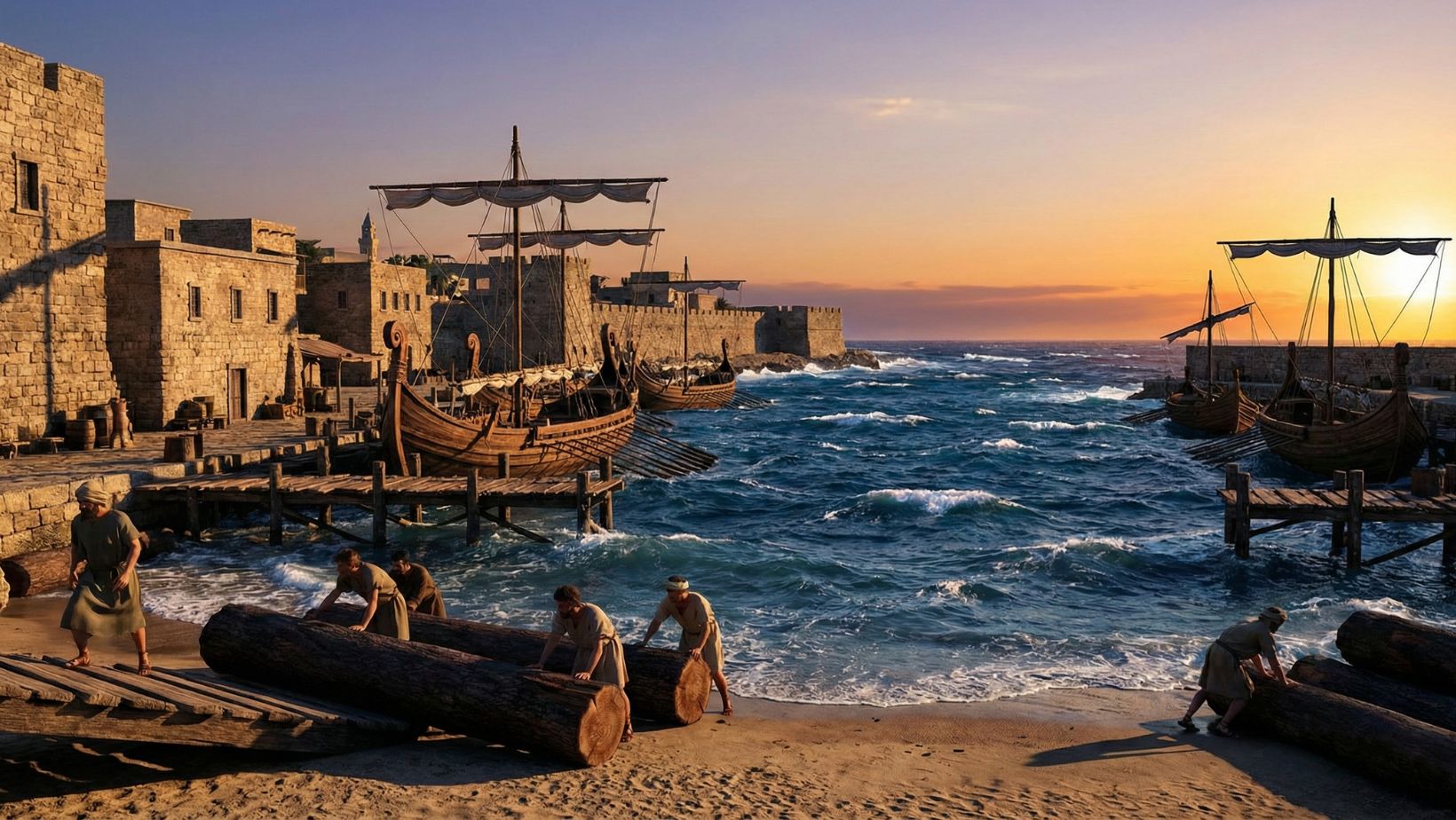
The Mediterranean Sea, known in the Bible primarily as the “Great Sea” or the “Western Sea,” served as the formidable western border of the Promised Land. Unlike the Phoenicians to their north, the Israelites were not historically a seafaring people; thus, the Great Sea often represented a boundary, a source of mystery, and the gateway to the Gentile nations (“the isles”). While it defined the limit of the land inheritance given to Abraham, in the New Testament, it transformed from a barrier into a highway, becoming the primary vessel through which the Apostle Paul and the early church spread the Gospel to the Roman Empire.
- Biblical Names: The Great Sea, The Western Sea, The Sea of the Philistines
- Location: The western border of Israel
- Key Ports: Joppa (Jaffa), Caesarea Maritima, Tyre, Sidon
- Key Characters: Jonah, Paul, King Hiram, Peter
- Role: Trade route, military transport, geographical boundary
- Symbolism: The Gentile nations, the unknown, the abyss/chaos
- Mentioned: Numbers 34:6, Joshua 1:4, Ezekiel 47:10, Acts 9-28
Physical & Geographical Description
The Western Limit: Geographically, the coastline of Israel is relatively straight with few natural deep-water harbors south of Mount Carmel. This lack of natural ports contributed to Israel’s agricultural rather than maritime focus.
The Highway of Antiquity: While Israel focused on the land, the Great Sea was the superhighway of the ancient world, connecting Egypt, Rome, Greece, and Asia Minor. The famous Via Maris (“Way of the Sea”) was an international trade route that ran along the Mediterranean coast, linking Africa with Mesopotamia.
Biblical Names and References
The Great Sea (HaYam HaGadol): Used in Numbers 34:6 to define the borders of the land: “Your western border will be the Great Sea.” It was “Great” in comparison to the inland bodies of water like the Sea of Galilee or the Dead Sea.
The Western Sea (HaYam HaAcharon): Used in Deuteronomy 11:24. Literally “The Hinder Sea” or “The Sea Behind,” based on the orientation of facing East (forward).
The Sea of the Philistines: Referenced in Exodus 23:31, as the Philistines controlled the southern coastal plain (Gaza, Ashkelon, Ashdod).
Key Biblical Events
1. The Timber for the Temple (1 Kings 5, 2 Chronicles 2)
Israel lacked the massive trees required for Solomon’s Temple. King Hiram of Tyre (a Phoenician city on the coast) floated cedar and pine logs from Lebanon down the Mediterranean coastline to Joppa. From there, Solomon’s workers hauled them overland to Jerusalem.
- Significance: The Sea facilitated the construction of God’s house using Gentile resources.
2. Jonah’s Flight (Jonah 1)
When God called Jonah to go east to Nineveh, Jonah went to Joppa and found a ship heading west to Tarshish (likely Spain). He sought to use the vastness of the Great Sea to escape the presence of the Lord.
- Significance: The sea became a place of divine discipline (the storm) and rescue (the great fish), demonstrating God’s sovereignty over the deep.
3. Peter’s Vision at the Coast (Acts 10)
Peter was staying in Joppa (a port city) at the house of Simon the Tanner by the sea when he received the vision of the clean and unclean animals.
- Significance: It is fitting that the vision opening the door to the Gentiles occurred at the edge of the Great Sea, facing the nations.
4. Paul’s Missionary Journeys (Acts 13–28)
The narrative of Acts shifts from land travel to sea travel as the Gospel expands. Paul sailed the Great Sea extensively, visiting Cyprus, Crete, Malta, and eventually Rome.
- The Shipwreck (Acts 27): Paul’s journey to Rome involved a disastrous storm (the “Northeaster”) on the Mediterranean, leading to a shipwreck on Malta.
Theological Analysis & Symbolism
The Abode of the Gentiles: In the Old Testament, the “coastlands” or “isles” across the sea represented the distant Gentile nations (Isaiah 42:4). The sea was the buffer between the Covenant people and the pagan world.
Symbol of Chaos and Mystery: In Ancient Near Eastern thought, the sea (Yam) often represented chaos and death. For a non-seafaring Israelite, the Great Sea was terrifying and untamable. This makes Revelation 21:1’s declaration—”and there was no longer any sea”—a promise of the final removal of separation, chaos, and danger.
From Barrier to Bridge: The theological trajectory of the sea changes from the OT to the NT. In the OT, it is a border defining the land. In the NT, it becomes a bridge. The Roman mastery of the Mediterranean (called Mare Nostrum or “Our Sea” by Romans) allowed the early missionaries to plant churches rapidly across the known world.







Leave a Reply