
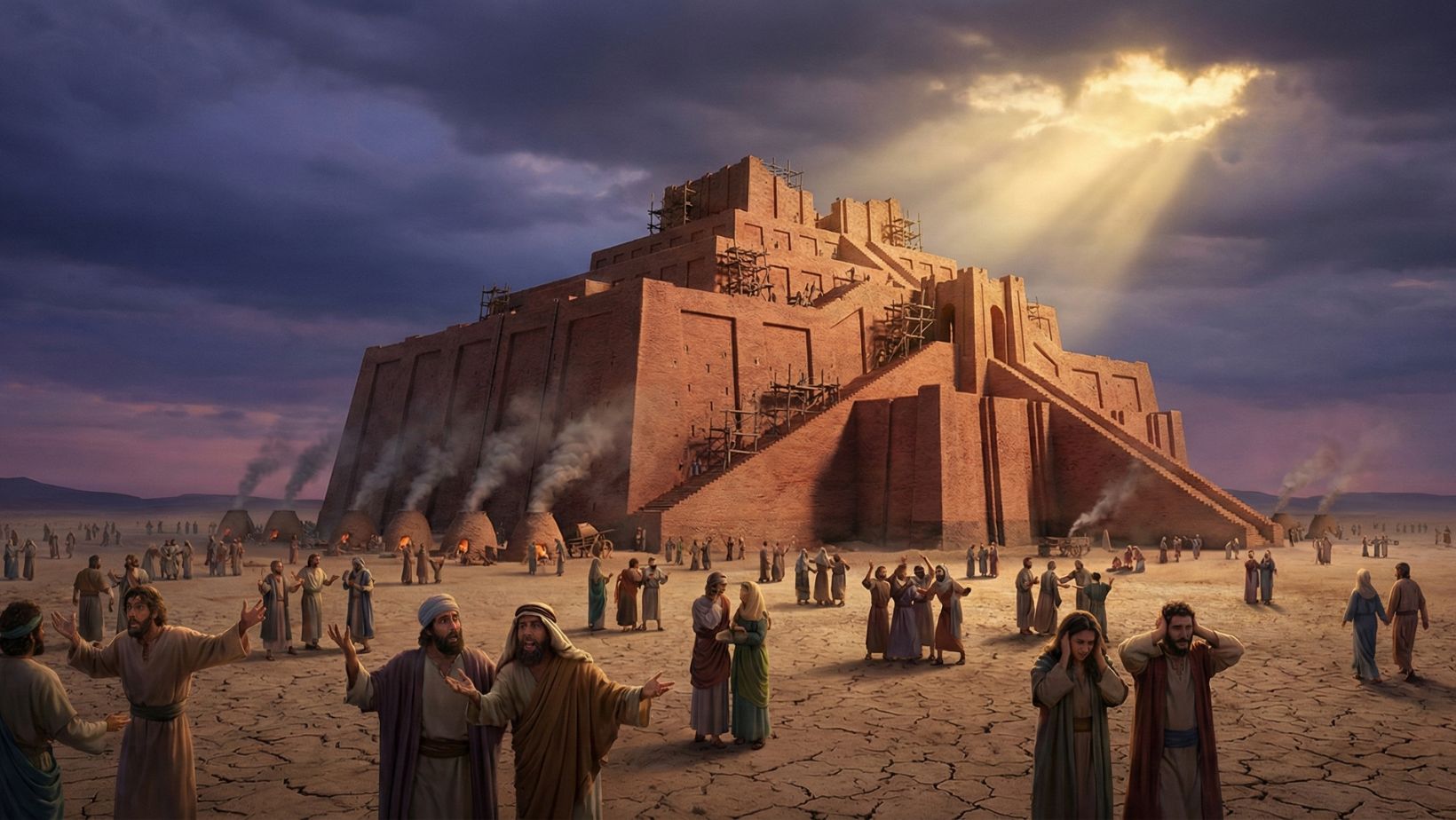
The Tower of Babel is one of the foundational narratives of Genesis, explaining the diversity of human languages and the dispersion of nations. Recorded in Genesis 11, it stands as the final event of “primeval history” before the focus narrows to one man (Abraham) in Genesis 12. The story describes a humanity united in language but also united in rebellion, attempting to build a civilization centered on human glory (“let us make a name for ourselves”) rather than divine obedience. It serves as a timeless critique of urbanization, technological hubris, and the collective attempt to reach God on human terms.
- Event: The Building of the Tower of Babel
- Scripture: Genesis 11:1–9
- Location: The Plain of Shinar (Babylonia/Mesopotamia)
- Key Figure: Traditionally associated with Nimrod (Genesis 10:10)
- Materials: Baked brick and tar (bitumen) for mortar
- Motivation: Pride (“make a name”) and Fear (“lest we be scattered”)
- Outcome: Confusion of languages and global dispersion
- Theological Contrast: The reversal of Babel is Pentecost (Acts 2)
Name Meaning
Hebrew: Bavel, resembling the Hebrew verb balal, meaning “to confuse” or “to mix.” Akkadian: Bab-ilim, meaning “Gate of God.” Significance: This wordplay highlights the irony of the story. What the builders intended to be the “Gate of God” (a stairway to heaven), God turned into a site of “confusion.”
Location / Setting
The Plain of Shinar: This refers to the southern region of Mesopotamia (modern-day Iraq), the cradle of civilization where the Sumerian and Akkadian empires rose. Geographical Context: Unlike Canaan (which has stone), this alluvial plain lacked natural stone. This necessitated the invention of kiln-fired bricks, a major technological leap that allowed for massive, vertical construction.
Detailed Event Description
1. The Unity (Verse 1)
“Now the whole world had one language and a common speech.” Following the Flood, humanity was a singular unit. While unity is generally good, here it was utilized for a rebellious purpose.
2. The Innovation (Verse 3)
“They said to each other, ‘Come, let’s make bricks and bake them thoroughly.’” They replaced stone (God-made material) with brick (man-made uniform material) and used tar for mortar. This represents the first industrial revolution—using technology to overcome environmental limitations.
3. The Rebellion (Verse 4)
The project had two components: a City (political organization) and a Tower (religious structure).
- The Goal: “A tower that reaches to the heavens.” This was likely a Ziggurat—a stepped pyramid designed not for people to live in, but for gods to descend.
- The Motive: “So that we may make a name for ourselves; otherwise we will be scattered over the face of the whole earth.”
- The Sin: God had commanded Noah’s descendants to “be fruitful and increase in number and fill the earth” (Genesis 9:1). By congregating in one spot to avoid being scattered, they were in direct disobedience to the Great Commission of that era.
4. The Descent (Verse 5)
“But the LORD came down to see the city and the tower.”
- Divine Irony: The text employs massive irony here. The builders thought their tower was reaching the heavens, but it was so puny from God’s perspective that He had to “come down” just to see it.
5. The Judgment (Verses 6–8)
God observed that this unity fueled their rebellion: “nothing they plan to do will be impossible for them.”
- The Action: “Come, let us go down and confuse their language.” (Note the plural “us,” hinting at the Trinity or the Divine Council).
- The Result: Communication broke down. The project was abandoned (“they stopped building the city”).
- The Dispersion: The people were scattered, fulfilling God’s original command to fill the earth, but doing so through judgment rather than obedience.
Theological Analysis
Humanism vs. Theism: Babel is the archetype of secular humanism. The repeated phrase “Let us…” (Let us make bricks, let us build, let us make a name) contrasts with the biblical focus on what God does. It was a project designed to glorify human potential (“make a name”) rather than God’s name.
The City of Man vs. The City of God: Babel is the spiritual ancestor of “Babylon,” which appears throughout Scripture (culminating in Revelation 17–18) as the symbol of worldly government and false religion standing in opposition to Jerusalem (Zion).
The Remedy of Pentecost: In Acts 2, the Holy Spirit descended. Instead of confusion, people from every nation heard the Gospel in their own tongues. Babel scattered humanity through language barriers; Pentecost united humanity across language barriers through the Spirit.
Symbolism / Typology
The Ziggurat: Represents the human attempt to climb up to God by works/effort. This contrasts with “Jacob’s Ladder” (Genesis 28), where the ramp is revealed by God, and eventually with Jesus, who is the true link between heaven and earth (John 1:51).
Bricks: In Scripture, stones often represent individuals (unique, God-created, “living stones” in 1 Peter), while bricks represent uniformity and interchangeability—totalitarianism where the individual is suppressed for the sake of the system.







Leave a Reply