
We live in an age of utility. We value things based on their usefulness to us. We use phones to communicate, cars to travel, and medicine to heal. The danger arises when we apply this same mindset to our relationship with the Almighty. We unknowingly attempt to reduce the Creator of the universe to a cosmic vending machine: we insert a prayer, a tithe, or a good deed, and we expect Him to dispense the blessing we desire. We treat Him like a spare tire, forgotten until there is an emergency, or a lucky charm, kept close to ward off misfortune. But God is not a tool. He is the Treasure. He is not a means to an end; He is the End. Today, we look at a sobering moment in the history of Israel where God’s people tried to force His hand. They wanted the power of God without the person of God, and they learned a devastating lesson: You cannot twist the arm of the Omnipotent.
Main Scripture: 1 Samuel 4:3 (NIV)
“When the soldiers returned to camp, the elders of Israel asked, ‘Why did the LORD bring defeat on us today before the Philistines? Let us bring the ark of the LORD’s covenant from Shiloh, so that it may go with us and save us from the hand of our enemies.’”
Quick Insights
- God is a Father to be loved, not a formula to be solved or manipulated.
- Possessing the symbols of religion without a relationship of obedience offers no protection.
- Superstition is the attempt to control God; faith is the surrender to God.
- A shout of enthusiasm in the camp is not the same as a heart of repentance before the throne.
- God would rather see His symbol captured by enemies than His holiness compromised by His people.
- You cannot use God to get what you want; you must trust God to give what you need.
Illustration Consider a man who wears a wedding ring. That ring is a profound symbol of covenant, intimacy, and exclusivity. Now, imagine that man is unfaithful to his wife. He breaks his vows and ignores her wishes. Yet, he refuses to take off the ring. He believes that as long as the gold band is on his finger, his marriage is secure. He trusts the object, but he has destroyed the relationship. We would call that delusion. The ring has no power if the covenant is broken. In 1 Samuel 4, Israel made this exact mistake. They treated the Ark of the Covenant like a magic ring. They believed that carrying the religious furniture of God would force God to protect them, even though their hearts were far from Him. They wanted the symbol, but they rejected the Sovereign.
The Silence of Self-Deception
The narrative begins with a confusing defeat. Israel fights the Philistines, and 4,000 men die. The elders gather, dusty and bloodied, and ask a profound theological question: “Why did the LORD bring defeat on us today?” They correctly understood that God is sovereign. But notice what they did not do. They did not wait for an answer. They did not fall on their faces in repentance. They did not ask Samuel the prophet to seek God’s will. They asked “Why?” but immediately pivoted to their own solution. They assumed the problem was a lack of power, not a lack of purity. When we fail, our first instinct should not be to find a new strategy, but to search our hearts.
The Idol of Utility
The elders hatched a plan that sounded spiritual but was deeply rebellious.
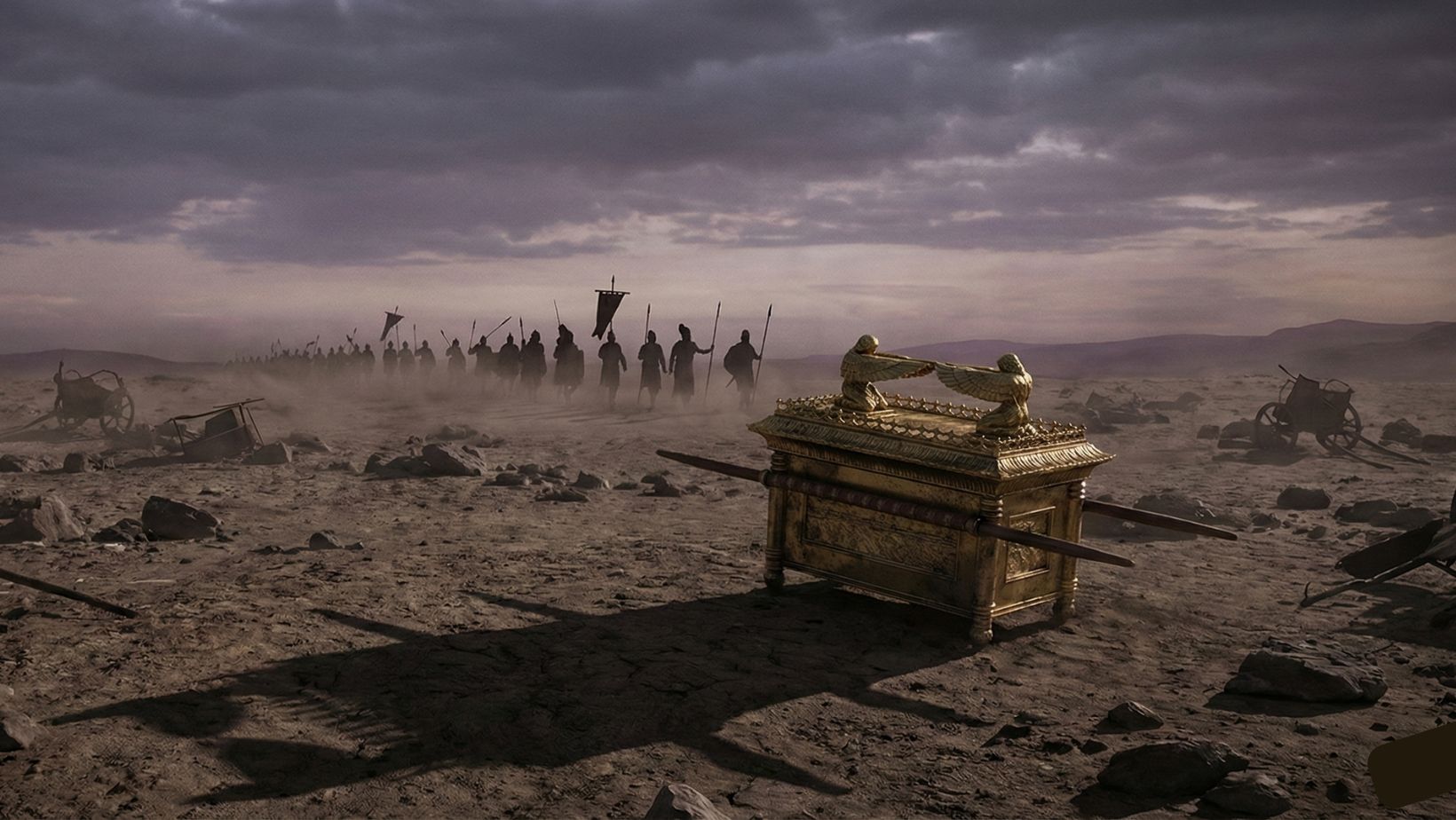
“Let us bring the ark… so that it may go with us and save us.” Look closely at their language. They did not say, “Let us seek the Lord so He may save us.” They said, “Let us bring the ark… so that it may save us.” They placed their trust in the “it”—the object, the box, the relic. They treated the Ark like a talisman. They thought, “God loves this box. If we drag it onto the battlefield, God will be forced to fight for us to protect His property.” We do this too. “If I go to church, God must bless my business.” “If I wear this cross, nothing bad can happen.” This is not faith; it is manipulation. It is an attempt to corner God. But God will not be blackmailed by our religious displays.
The Deception of Enthusiasm
When the Ark arrived in the camp, carried by corrupt priests, the reaction was overwhelming.
“All Israel gave such a great shout that the ground shook.” (1 Samuel 4:5) The morale was sky-high. The adrenaline was pumping. The Philistines were terrified, shouting, “A god has come into the camp!” But here is the terrifying reality: You can have a loud church service, earth-shaking music, and high emotional excitement, yet God can be completely absent. The Israelites mistook their own enthusiasm for God’s presence. They were shouting at a box, while the God of the box was silent. True revival is not measured by the volume of our shout, but by the depth of our repentance.
The Mercy of Defeat
The battle began with the Ark in the front lines. The result was catastrophic. Israel didn’t just lose; they were slaughtered. Thirty thousand men fell. The priests died. And, most shockingly, the Ark of God was captured by the pagan Philistines. It looked like God had failed. But He hadn’t. God simply refused to be used. He was willing to let His reputation take a hit in the eyes of the nations rather than allow His people to continue in their superstition. He allowed the symbol of His presence to be taken to show them that He cannot be domesticated. This was a severe mercy. God destroyed their false confidence to eventually bring them back to true faith. Sometimes, God allows our plans to fail so that our souls can be saved.
- The Anchor in the Pause Quote: “God is not a distinct entity to be used; He is the source of life to be worshiped.”
- Theological Point: The tragedy of the captured Ark teaches us that God is not committed to our religious institutions or symbols; He is committed to His own holiness and glory. He dwells in the contrite heart, not in the man-made box.
- Prayer Guide: Father, forgive me for the times I have treated You like a utility. Forgive me for thinking my religious habits obligate You to bless my agenda. Shatter my superstitions. I do not want to use You; I want to know You. I surrender my demand for control and accept Your Lordship.
- Summary: Religious activity without relational intimacy is a hollow superstition that God will dismantle to bring us back to the heart of true worship.







Leave a Reply