
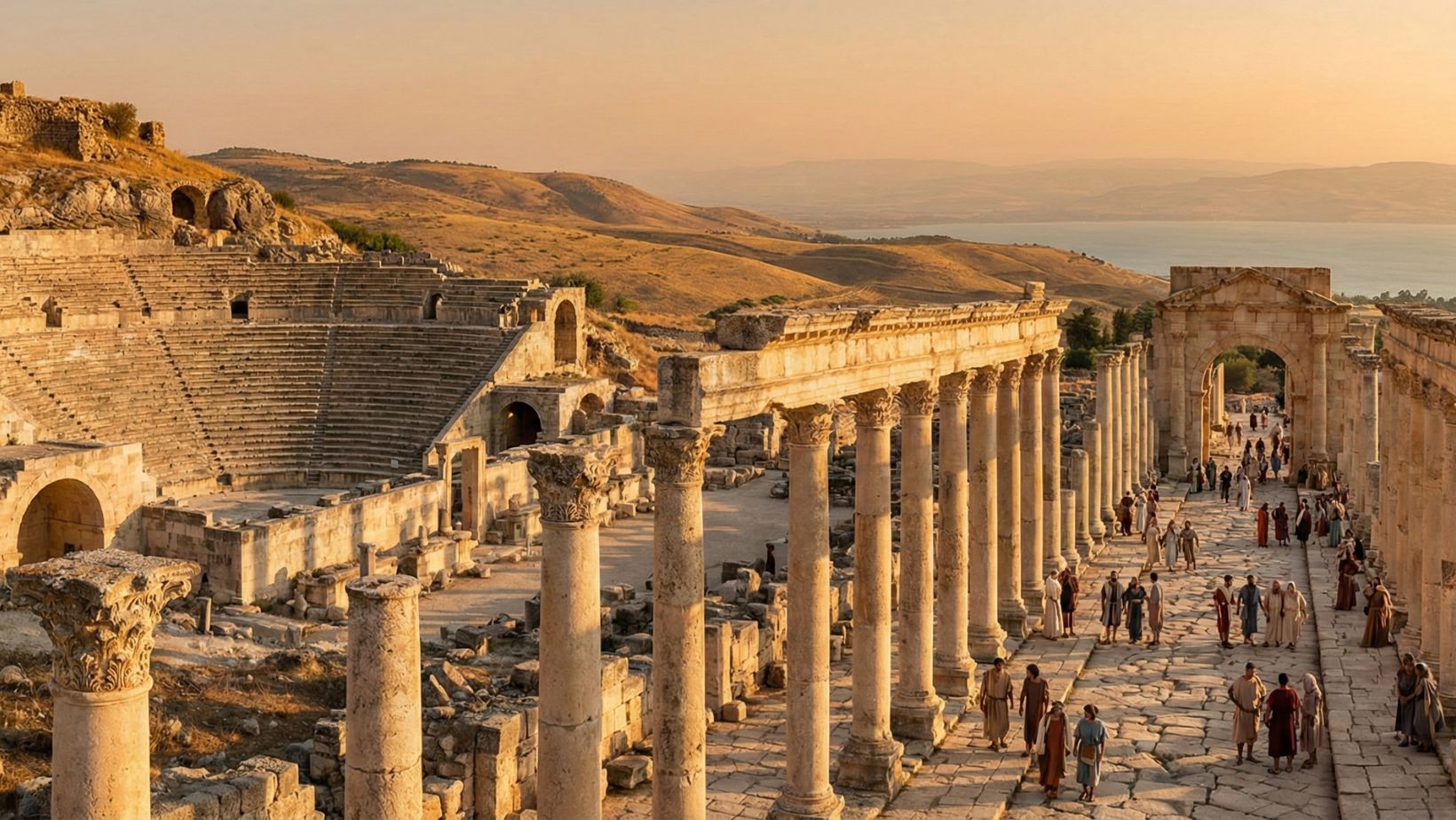
The Decapolis was not a single city, but a league of ten ancient cities situated on the eastern frontier of the Roman Empire, primarily in the region of modern-day Jordan, Syria, and Israel. In the New Testament, this region represents a cultural crossroads—a stronghold of Hellenistic (Greek) culture and pagan worship amidst the Semitic landscape of Judea and Galilee. It serves as a significant backdrop for Jesus Christ’s ministry, demonstrating His willingness to cross cultural and religious boundaries to bring healing and the Gospel to the Gentile world.
Quick Facts
- Name: Decapolis (Greek: Dekapolis, meaning “Ten Cities”)
- Region: Transjordan (East of the Jordan River), except for Scythopolis
- Era: Roman Period (Pompey’s conquest in 63 BCE through the 2nd Century CE)
- Primary Culture: Hellenistic (Greek language, religion, and architecture)
- Political Status: Autonomous city-states under Roman oversight (Syria province)
- Biblical Role: A Gentile region where Jesus ministered and crowds followed Him
- Key Cities: Damascus, Philadelphia (Amman), Scythopolis (Bet She’an), Gadara
- Symbol: The Roman Column or Theater—representing Greek order in the East
Name Meaning
Decapolis: Derived from two Greek words: deka (ten) and polis (city). The name literally translates to “The Ten Cities,” referring to the administrative grouping or league formed after the Roman general Pompey conquered the region in 63 BCE.
Origin / Historical Background
Formation: Established by the Roman general Pompey the Great to protect Hellenized populations against Jewish expansionism (under the Hasmoneans) and desert tribes.
Purpose: To serve as centers of Greek culture, trade, and Roman defense on the eastern frontier.
Administration: While subject to the Roman governor of Syria, these cities enjoyed a high degree of autonomy, minting their own coins and maintaining their own laws.
Biblical Era / Context
Time: First Century CE, during the life of Jesus and the early Apostolic age.
Setting: A region characterized by grand Roman architecture—temples, theaters, baths, and colonnaded streets—standing in stark contrast to the humbler Jewish villages of Galilee.
Cultural Context: This was “Gentile territory.” The presence of large herds of pigs (Mark 5:11) indicates the non-Jewish nature of the population, as pigs were unclean to Jews.
Major Roles / Identity
The Gentile Frontier: It represented “the other side” of the lake (Sea of Galilee), a place where the strict purity laws of Judaism were not observed.
Center of Commerce: Situated on key trade routes (like the King’s Highway), facilitating the flow of goods and ideas.
Refuge: Eusebius (an early church historian) records that Jewish Christians fled to Pella (one of the Decapolis cities) before the destruction of Jerusalem in 70 CE.
Key Characteristics
Hellenization: The cities were modeled after Greek poleis, featuring agoras, gymnasiums, and temples to Zeus, Artemis, and other Olympian gods.
Autonomy: They functioned as a federation of city-states rather than a unified country.
Cosmopolitanism: The population was a mix of Greeks, Romans, Nabataeans, and Jews, though the dominant culture was Greco-Roman.
The Ten Cities (According to Pliny the Elder)
Scythopolis (Bet She’an): The only city west of the Jordan River; the capital of the league.
Damascus: The oldest and most significant city, located in modern Syria.
Gerasa (Jerash): Famous for its well-preserved Roman ruins in modern Jordan.
Gadara (Umm Qais): Overlooking the Sea of Galilee; associated with the miracle of the swine.
Hippos (Sussita): Located on a hill overlooking the Sea of Galilee.
Pella: A place of refuge for early Christians.
Philadelphia (Amman): Modern capital of Jordan.
Dion, Canatha, and Raphana: Smaller, less clearly identified cities.
Main Biblical Events
The Fame of Jesus: Crowds from the Decapolis followed Jesus early in His ministry, showing His appeal extended beyond traditional Jewish boundaries (Matthew 4:25).
The Gerasene Demoniac: Jesus crossed the Sea of Galilee to the region of the Gerasenes (or Gadarenes) and cast a “Legion” of demons out of a man and into a herd of pigs. The man was then told to “go home to your own people and tell them how much the Lord has done for you,” becoming the first missionary to the Decapolis (Mark 5:1–20).
Healing of the Deaf and Mute Man: Jesus traveled through the region of the Decapolis and healed a man who was deaf and had a speech impediment, prompting the people to proclaim, “He has done everything well” (Mark 7:31–37).
Major Relationships
Jesus: He visited the region, demonstrating that the Kingdom of God was accessible to Gentiles.
The Herodian Rulers: The Decapolis cities were generally outside the jurisdiction of Herod Antipas (who ruled Galilee), making them a distinct political entity.
The Early Church: Served as a safe haven and a mission field for early Christianity expanding into the Gentile world.
Notable Passages
Matthew 4:25: “Large crowds from Galilee, the Decapolis, Jerusalem, Judea and the region across the Jordan followed him.”
Mark 5:20: “So the man went away and began to tell in the Decapolis how much Jesus had done for him. And all the people were amazed.”
Mark 7:31: “Then Jesus left the vicinity of Tyre and went through Sidon, down to the Sea of Galilee and into the region of the Decapolis.”
Legacy & Impact
Spiritual: The ministry in the Decapolis foreshadowed the Great Commission, signaling that the Gospel was intended for all nations, not just Israel.
Archaeological: The ruins of Jerash (Gerasa) and Bet She’an (Scythopolis) remain some of the best-preserved examples of Roman urban planning in the Middle East, testifying to the grandeur of the era.
Historical: The region’s history highlights the clash and eventual blending of Semitic and Greco-Roman cultures which characterized the world of the New Testament.
Symbolism / Typology
“The Other Side”: Crossing to the Decapolis symbolizes leaving one’s comfort zone to reach those who are culturally different or considered “unclean.”
The Demoniac: Represents the liberating power of Christ over total spiritual oppression, even in hostile territory.
Swine Herd: Symbolizes the Gentile nature of the region and the clash between Jewish purity laws and pagan culture.
Extra-Biblical References
Pliny the Elder (Natural History): Lists the ten cities originally comprising the league.
Josephus (Antiquities of the Jews): Frequent mentions of the cities, particularly regarding their liberation by Pompey and conflicts with Jewish rebels during the Great Revolt.
Strabo (Geographer): Discusses the region’s cultural significance and trade routes.







Leave a Reply