
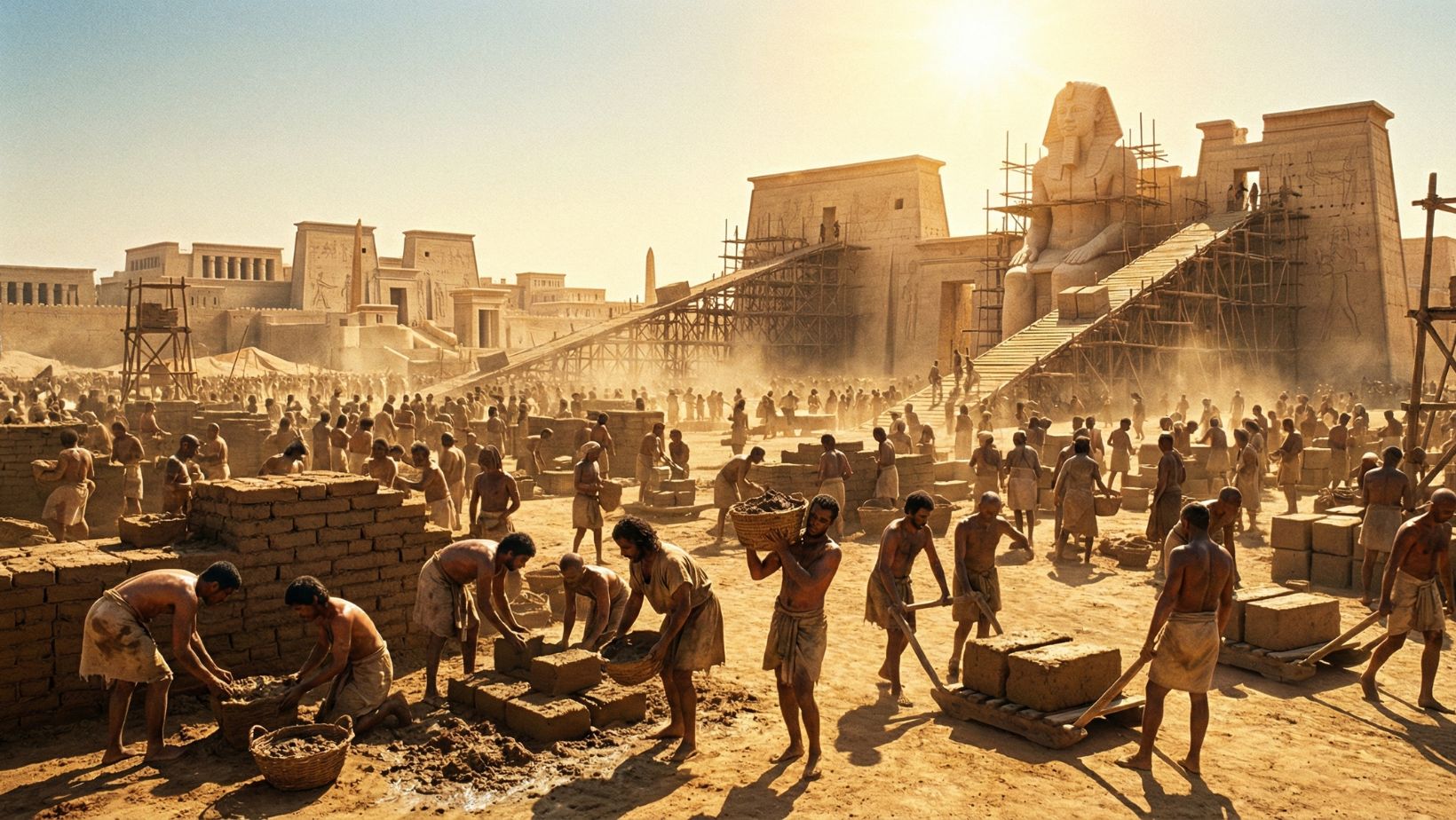
Rameses (or Raamses) serves as a potent symbol in the Exodus narrative, representing both the crushing weight of slavery and the glorious beginning of liberation. Geographically, it refers to a region in the northeastern Nile Delta (Goshen) and a specific “store city” that the Israelites were forced to build for Pharaoh. The name appears as the setting for Joseph’s family settlement (Genesis 47:11), the site of forced labor (Exodus 1:11), and the starting point of the Exodus journey (Exodus 12:37). It stands as a testament to human empire attempting to crush God’s people, only to become the launchpad for God’s deliverance.
1. The City of Oppression (Exodus 1:8–14 NLT)
8 Eventually, a new king came to power in Egypt who knew nothing about Joseph or what he had done. 9 He said to his people, “Look, the people of Israel now outnumber us and are stronger than we are. 10 We must make a plan to keep them from growing even more. If we don’t, and if war breaks out, they will join our enemies and fight against us. Then they will escape from the country.” 11 So the Egyptians made the Israelites their slaves. They appointed brutal slave drivers over them, hoping to wear them down with crushing labor. They forced them to build the cities of Pithom and Rameses as supply centers for the king. 12 But the more they were oppressed, the more they grew and spread, and the alarm of the Egyptians increased. 13 So the Egyptians worked the people of Israel without mercy. 14 They made their lives bitter, forcing them to mix mortar and make bricks and do all the work in the fields. They were ruthless in all their demands.
Commentary:
- The “New King” (v. 8): This marks a shift from the Hyksos period (Semitic rulers friendly to Joseph) to the native Egyptian New Kingdom (likely the 18th or 19th Dynasty), which was hostile to foreigners.
- Strategic paranoia (v. 10): The oppression wasn’t just hatred; it was national security policy. Pharaoh feared a “fifth column”—enemies within the borders.
- Store Cities (v. 11): The term “supply centers” (or store cities) suggests depots for military provisions or grain. This indicates Pharaoh was militarizing the region for campaigns into Canaan/Syria.
- Rameses – The Location (v. 11): Most scholars identify this with Pi-Ramesses (“House of Ramesses”), the grand capital built by Ramesses II (approx. 1279–1213 BC) in the Delta. The mention of the name here is often used to date the Exodus to the 13th century BC, though some view it as a later editorial update for a location known by an earlier name (like Avaris).
- Bricks and Mortar (v. 14): Unlike the stone pyramids of the Old Kingdom, Delta cities were built of mudbrick. This required immense, back-breaking labor—gathering straw, mixing mud, and molding bricks under the scorching sun.
- The Irony of Growth (v. 12): The city of Rameses was intended to be a monument to Pharaoh’s power and a tomb for Israel’s spirit. Instead, the oppression catalyzed Israel’s explosive growth. God’s blessing overpowered Pharaoh’s policy.
Insight: Rameses represents the “world system.” It uses human beings as fuel for the economy and military expansion. It seeks to build monuments to itself on the backs of the vulnerable.
2. The Departure Point (Exodus 12:37–41 NLT)
37 That night the people of Israel left Rameses and started for Succoth. There were about 600,000 men, plus all the women and children. 38 A rabble of non-Israelites went with them, along with great flocks and herds of livestock. 39 For bread they baked flat cakes from the dough without yeast they had brought from Egypt. It was made without yeast because the people were driven out of Egypt in such a hurry that they had no time to prepare the food or other provisions. 40 The people of Israel had lived in Egypt for 430 years. 41 In fact, it was on the last day of the 430th year that all the Lord’s forces left the land.
Commentary:
- From Rameses to Succoth (v. 37): The journey begins at the very site of their slavery. They did not flee into the desert from a hiding place; they marched out of the imperial capital.
- The Number (v. 37): “600,000 men” suggests a total population of over 2 million. This immense number leaving Rameses would have emptied the city of its workforce instantly, crippling the empire’s economy.
- The Mixed Multitude (v. 38): The “rabble of non-Israelites” indicates that the plagues proved Yahweh’s power to Egyptians and other enslaved groups who chose to leave Rameses with Israel. Salvation was open to all who walked away from Pharaoh.
- Unleavened Bread (v. 39): The haste of leaving Rameses was so great they couldn’t wait for bread to rise. This moment is memorialized in the Feast of Unleavened Bread. Rameses is the place where “waiting” ended and “moving” began.
- “The Lord’s Forces” (v. 41): In Exodus 1, they are described as slaves. As they leave Rameses in Exodus 12, God calls them His “forces” (or hosts/armies). Leaving Rameses changed their identity from captives to soldiers of Yahweh.
Insight: Rameses is the place of decision. You cannot stay in Rameses and serve God (Exodus 8:25-27). The Exodus demands a physical and spiritual relocation away from the systems of bondage.
3. The Itinerary Recorded (Numbers 33:3–4 NLT)
3 They set out from Rameses in the first month, on the fifteenth day of the first month. On the day after the Passover the people of Israel went out triumphantly in the sight of all the Egyptians, 4 while the Egyptians were burying all their firstborn, whom the Lord had struck down among them. On their gods also the Lord executed judgments.
Commentary:
- Triumph (v. 3): Numbers adds the detail that they left “triumphantly” (literally: with a high hand). They didn’t sneak out of Rameses; they marched out while their oppressors watched helplessly.
- The Context of Death (v. 4): As Israel marched out of Rameses, the city was likely filled with wailing (Exodus 12:30). The Egyptians were occupied burying their dead. Rameses, the city of life and power, had become a city of death because it resisted God.
- Judgment on Gods (v. 4): Rameses was named after Ra, the sun god. The darkness (9th plague) and the death of the firstborn (Pharaoh was considered a divine son of Ra) showed that the God of Israel had conquered the god of Rameses.
Theological Significance of Rameses
- The God Who Hears: Rameses is where the “groaning” of Israel rose to heaven (Exodus 2:23). It proves that God hears prayers even from the deepest pits of political and economic oppression.
- The Futility of Human Empire: Rameses was built to last forever, yet it is now an archaeological ruin, while the people who built it (Israel) still exist. The Kingdom of God outlasts the cities of men.
- Type of the World: In Christian typology, Rameses represents the world and sin. Just as Israel had to leave Rameses to head to the Promised Land, a believer must leave their old life of slavery to sin to follow Christ.
Practical Applications
- Identify Your “Rameses”: What is the thing that enslaves you or demands your labor without reward? Is it a career, a toxic relationship, or a sin habit?
- Don’t Settle in Oppression: The Israelites had lived in Rameses for generations. It felt “normal.” We must not normalize spiritual slavery.
- Walk Out Boldly: When God opens the door, we leave “with a high hand” (Numbers 33:3). We don’t need to apologize for our freedom.
- Transformation of Identity: Leaving Rameses changed Israel from brick-makers to God’s Army. Changing your location (spiritual or physical) can change your destiny.







Leave a Reply