
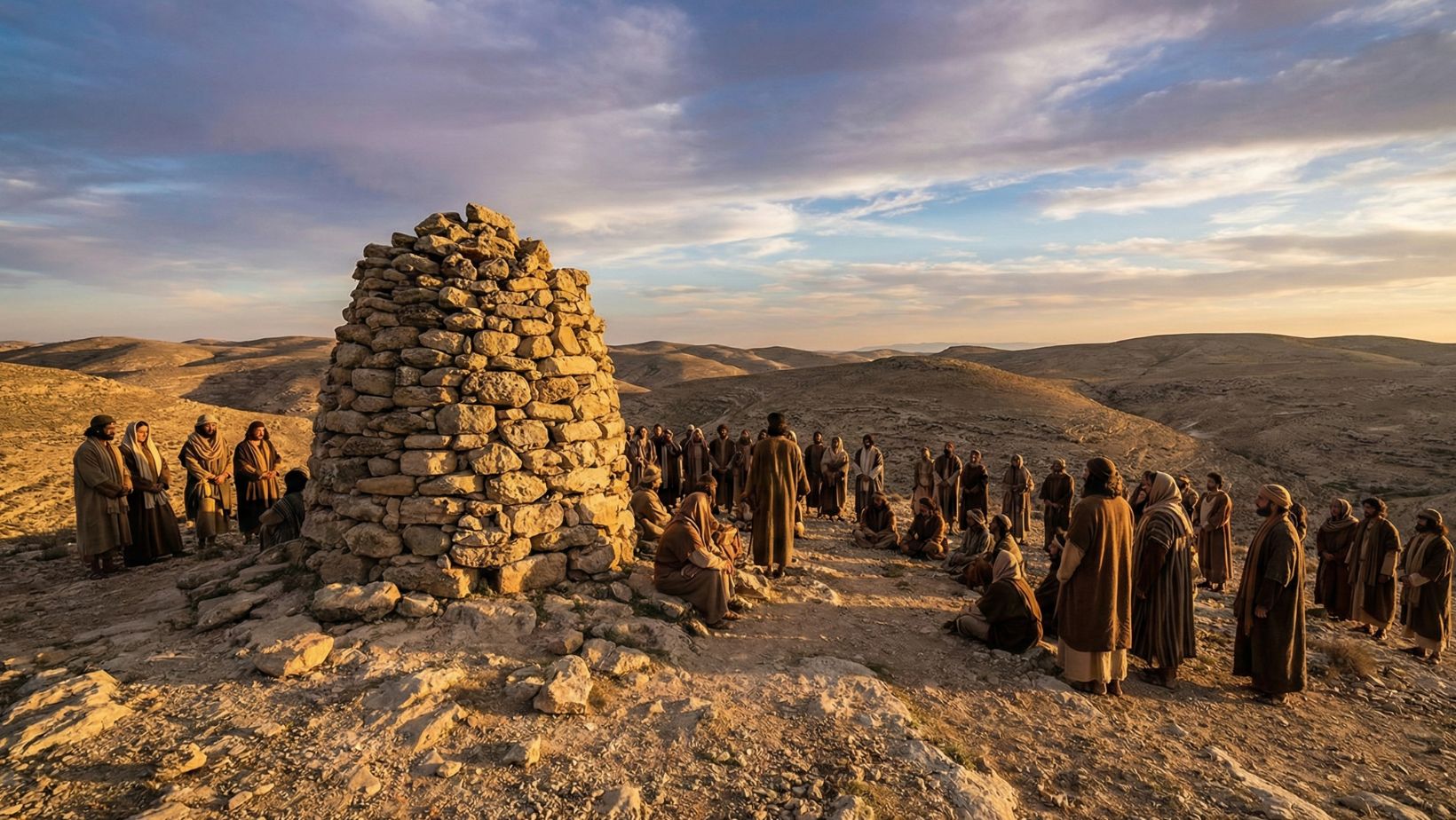
“Mizpah” (Hebrew: Mitzpah, meaning “Watchtower” or “Lookout”) is the name of several locations in the Old Testament, but it primarily refers to two distinct and significant sites:
- Mizpah of Gilead: The site of the covenant between Jacob and Laban (Genesis 31).
- Mizpah of Benjamin: A central political and religious gathering place for Israel, located just north of Jerusalem. It served as the site of national repentance under Samuel, the coronation of King Saul, and the administrative capital of Judah after the destruction of Jerusalem. The name symbolizes God’s watchful eye over covenants and His presence in times of national transition.
1. The Covenant of Separation (Genesis 31:44–50 NLT)
Context: Jacob is fleeing from his father-in-law Laban. Laban catches up, and after a confrontation, they agree to a truce in the region of Gilead.
44 “Come now, let’s make a covenant, you and I, and it will be a witness to our commitment.” 45 So Jacob took a stone and set it up as a monument. 46 Then he told his family members, “Gather some stones.” So they gathered stones and piled them in a heap. Then they ate there beside the pile of stones. 47 Laban called the pile Jegar-sahadutha (which means “pile of witness” in Aramaic), but Jacob called it Galeed (which means “pile of witness” in Hebrew). 48 Then Laban said, “This pile of stones will stand as a witness to remind us of the covenant we have made today.” This is why it was named Galeed. 49 But it was also called Mizpah (which means “watchtower”), for Laban said, “May the Lord keep watch between us to make sure that we keep this covenant when we are out of each other’s sight. 50 If you mistreat my daughters or if you marry other wives, God will see it even if no one else does. He is a witness to this covenant between us.”
Commentary:
- The Meaning of the Name (v. 49): This is the first biblical mention of Mizpah. It is named “Watchtower” because Laban invokes God as the watcher.
- The “Mizpah Benediction” (v. 49): Often used today as a warm parting blessing (“May the Lord watch between me and thee…”), in context, it was actually a warning. Laban did not trust Jacob. He was saying, “We are separating, and I can’t watch you anymore, so may God watch you to punish you if you break our deal.”
- The Heap of Stones (v. 46): The physical pile served as a boundary marker. Neither was to pass this point with hostile intent toward the other (v. 52). It represents a border of peace established by divine oversight.
2. The Center of Revival and Victory (1 Samuel 7:3–12 NLT)
Context: The Ark has returned, but Israel is still under Philistine oppression. Samuel calls the nation to Mizpah of Benjamin to repent.
5 Then Samuel told them, “Gather all of Israel to Mizpah, and I will pray to the Lord for you.” 6 So they gathered at Mizpah and, in a great ceremony, drew water from a well and poured it out before the Lord. They also went without food all day and confessed that they had sinned against the Lord. (It was at Mizpah that Samuel became Israel’s judge.) 7 When the Philistine rulers heard that Israel had gathered at Mizpah, they mobilized their army and advanced… 10 Just as Samuel was sacrificing the burnt offering, the Philistines arrived to attack Israel. But the Lord spoke with a mighty voice of thunder from heaven that day, and the Philistines were thrown into such confusion that the Israelites defeated them… 12 Samuel then took a large stone and placed it between the towns of Mizpah and Shen. He named it Ebenezer (which means “the stone of help”), for he said, “Up to this point the Lord has helped us!”
Commentary:
- National Repentance (v. 6): Mizpah serves as the spiritual heart of the nation here. The “pouring out of water” symbolized the pouring out of their hearts in grief and repentance (Lamentations 2:19).
- The Thunder of God (v. 10): Israel had no weapons mentioned; they were gathered for prayer, not war. God fought for them using “thunder,” reminiscent of His voice at Sinai.
- Ebenezer (v. 12): The famous “Stone of Help” was erected near Mizpah. Mizpah marks the turning point where Israel stopped relying on superstitious use of the Ark (1 Samuel 4) and started relying on repentance and prayer.
3. The Choice of the King (1 Samuel 10:17–24 NLT)
Context: Israel demands a king. Samuel summons the nation back to Mizpah to reveal God’s choice.
17 Later Samuel called all the people of Israel to meet before the Lord at Mizpah. 18 And he said… 19 “But today you have rejected your God, who saves you from all your disasters and calamities. You said, ‘No, we want a king!’ Now, therefore, present yourselves before the Lord by tribes and clans.” … 21 Finally, Saul son of Kish was chosen from among them. But when they looked for him, he had disappeared! 22 So they asked the Lord, “Where is he?” And the Lord replied, “He is hiding among the baggage.” 23 So they ran and brought him out… 24 Then Samuel said to all the people, “This is the man the Lord has chosen as your king. No one in all Israel is like him!” And all the people shouted, “Long live the king!”
Commentary:
- Political Center (v. 17): Mizpah acts as the “parliament” of ancient Israel. It was likely chosen because it had a sanctuary or an altar to Yahweh (judging by the phrase “before the Lord”).
- Rejection of God (v. 19): Even at this holy site, the transaction is tainted. They are at the “Watchtower,” but they are looking for a human king rather than looking to God.
- Hiding in the Baggage (v. 22): The irony is sharp. The man chosen to lead the nation is hiding among the supplies at Mizpah. It foreshadows Saul’s insecurity and future failure.
4. The Tragic Capital (Jeremiah 40:5–12; 41:1–3 NLT)
Context: Jerusalem has been destroyed by Babylon (586 BC). Nebuchadnezzar appoints Gedaliah as governor over the poor remnant left behind, headquartered at Mizpah.
40:6 So Jeremiah went to Gedaliah son of Ahikam at Mizpah and lived there with him and the few people still left in the land… 10 “As for me, I will stay at Mizpah to represent you before the Babylonians who come to meet with us. Settle in the towns you have taken, and live off the land. Harvest the grapes, summer fruits, and olive oil, and store them in your jars.” … 41:1 But in midautumn of that year, Ishmael… went to Mizpah to meet with Governor Gedaliah. As they were eating together, 2 Ishmael and his ten men suddenly jumped up, drew their swords, and killed Gedaliah… 3 Ishmael also killed all the Judeans and the Babylonian soldiers who were with Gedaliah at Mizpah.
Commentary:
- The New Jerusalem (40:6): With Jerusalem burned, Mizpah became the de facto capital of Judah. The prophet Jeremiah moved there.
- The Hope of Recovery (40:10): Gedaliah urged the people to “harvest.” There was a brief moment of hope that life could continue under judgment at Mizpah.
- The Assassination (41:1-3): This hope was shattered by Ishmael (a radical nationalist). The massacre at Mizpah marked the final collapse of organized Jewish life in the land until the return from exile.
Theological Significance of Mizpah
- The God Who Watches: The name Mizpah reminds us that God is the silent observer of all human agreements and actions. He watches between people when they are apart (Gen 31) and He watches over the destiny of nations (1 Sam 7).
- The Place of Reset: Mizpah often appears when Israel hits “reset.”
- Divine Help: The association with the Ebenezer stone teaches that when we gather to repent (as they did at Mizpah), God provides the “help” necessary to overcome enemies that previously defeated us.
Practical Applications
- Living Under the Gaze: We should live with the awareness of the “Mizpah principle”—that God is watching our integrity in business and relationships, even when no human authority is present.
- The Baggage Check: Like Saul at Mizpah, we often hide from God’s calling due to fear or insecurity (“hiding in the baggage”). We must allow God to bring us out and stand in our calling.
- Gathering for Repentance: Victory in 1 Samuel 7 came only after the people gathered at Mizpah to confess and pour out water. Spiritual victory often starts with collective humility and confession.







Leave a Reply