
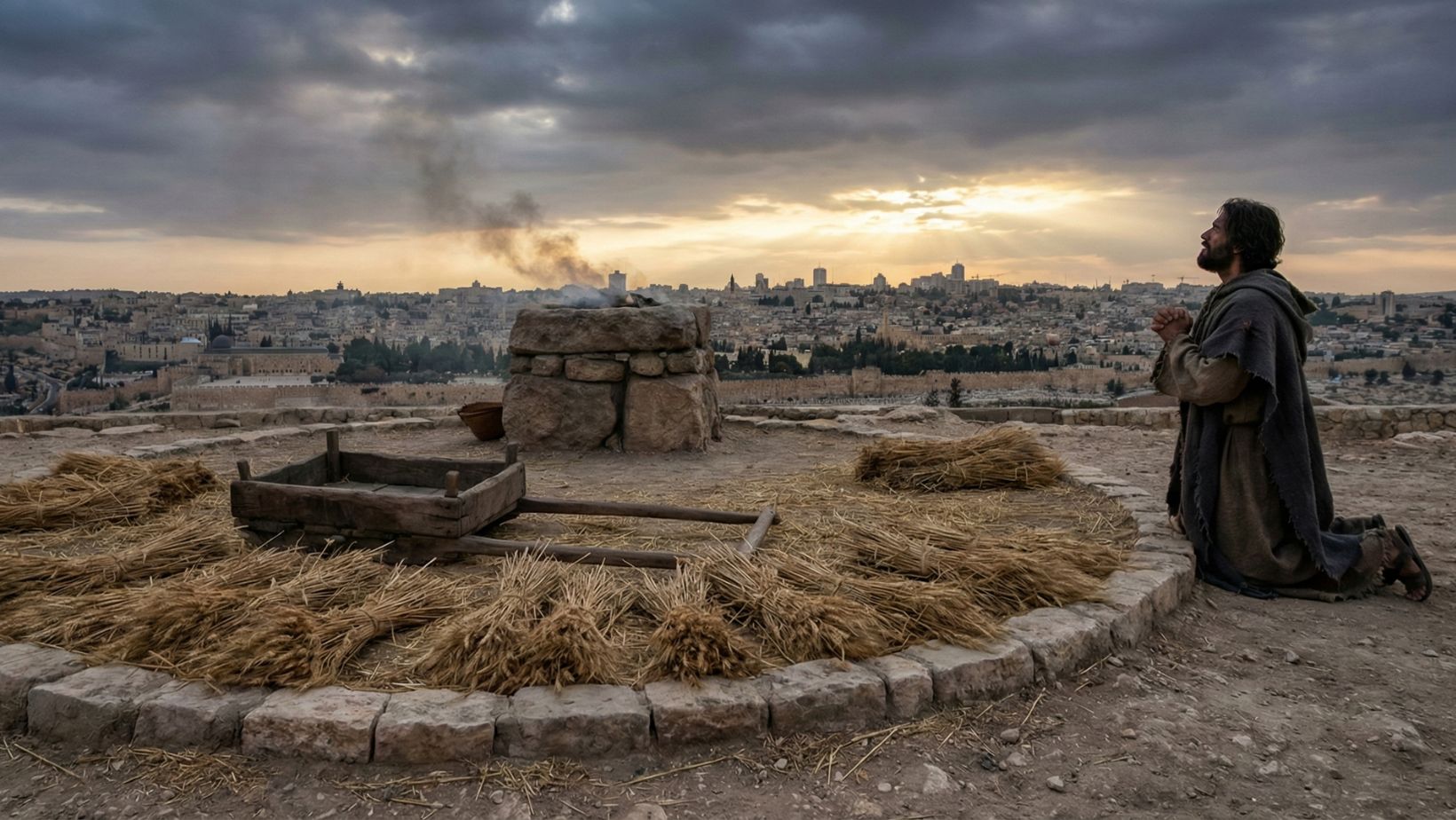
Mount Moriah is arguably the most sacred piece of geography in biblical history, serving as the stage for the most profound events of sacrifice, redemption, and divine presence. It is not merely a mountain, but a destination of testing and provision. From Abraham’s supreme test of faith to David’s purchase of a threshing floor to halt a plague, and finally to the construction of Solomon’s Temple, Moriah represents the specific place God chose to put His name and dwell among His people.
- Name: Mount Moriah (Hebrew: Môriyyāh)
- Meaning: “Seen by Yahweh,” “Chosen by Yahweh,” or “The Lord Will Provide”
- Location: The eastern hill of Jerusalem; the site of the Temple Mount
- Key Figures: Abraham, Isaac, David, Araunah (Ornan), Solomon
- Key Events: The binding of Isaac (Akedah), the halting of the plague, the building of the Temple
- First Mention: Genesis 22:2
- Modern Identity: The Temple Mount (Haram al-Sharif) in the Old City of Jerusalem
- Symbol: The Altar of Sacrifice / The Ram in the thicket
Name Meaning
The etymology of “Moriah” is rich with theological significance. It is derived from the verb ra’ah (to see) and Ya (the shortened name of Yahweh).
Jehovah Jireh: In Genesis 22:14, Abraham names the place Yahweh-Yireh, meaning “The LORD Will Provide” (literally, “The Lord will see to it”).
Instruction: Some scholars also link it to yarah (to teach/instruct), connecting it to the Torah going forth from Zion.
Location / Geographical Context
Region: Originally described as the “land of Moriah,” a mountainous region. Later identified specifically as the hill in Jerusalem north of the City of David.
Topography: It was originally a threshing floor—a high, windy, exposed bedrock used for separating grain from chaff. This physical elevation made it suitable for both a threshing floor and a highly visible temple.
Proximity: It is part of the same ridge system as Golgotha (Calvary), linking the Old Testament sacrifices geographically to the crucifixion of Jesus.
Major Roles / Identity
The Place of Ultimate Testing: It was here that God tested Abraham’s faith by asking for the life of his son, Isaac.
The Place of Divine Mercy: It was here that the Angel of the Lord sheathed his sword, stopping a plague that threatened to destroy Jerusalem during David’s reign.
The Place of Dwelling: It became the permanent site of the First and Second Temples, the “footstool” of God on earth.
Key Characteristics
Sacredness: God specifically directed His servants to this location. It was not chosen by human logic but by divine appointment.
Provision: It is the location where God provides the substitute for the sacrifice (the ram for Isaac).
Atonement: It is the site where blood was shed to cover sin, from the patriarchs to the daily temple sacrifices.
Main Biblical Events
The Binding of Isaac (Genesis 22): God commands Abraham to take Isaac to “the land of Moriah” and offer him as a burnt offering. At the last moment, the Angel of the Lord intervenes, and Abraham sacrifices a ram caught in a thicket instead.
David and the Threshing Floor (2 Samuel 24; 1 Chronicles 21): After David sins by counting the fighting men, a plague strikes Israel. The Angel of the Lord stands by the threshing floor of Araunah (Ornan) the Jebusite on Mount Moriah. David sees the angel, repents, and buys the floor to build an altar.
Building the Temple (2 Chronicles 3:1): “Then Solomon began to build the temple of the LORD in Jerusalem on Mount Moriah, where the LORD had appeared to his father David.” This verse explicitly links the Temple site to the specific location of David’s altar and Abraham’s test.
Legacy & Impact
Centrality of Worship: For over a millennium, Moriah was the only authorized place for Jewish sacrificial worship.
The Concept of Substitution: The events on Moriah established the theological principle that God accepts a substitute in place of the sinner (the ram instead of Isaac; the temple sacrifices for the people).
Inter-faith Significance: Today, it remains a focal point of tension and reverence for Judaism (Temple Mount), Islam (Dome of the Rock), and Christianity (associated with God’s redemptive plan).
Symbolism / Typology
The Father and Son: Abraham offering Isaac on Moriah is a profound type of God the Father offering His Son, Jesus. Isaac carrying the wood up the mountain parallels Jesus carrying His cross.
The Threshing Floor: Symbolizes judgment and separation (wheat from chaff). By building the Temple there, God turned a place of judgment into a place of mercy and grace.
The Third Day: Abraham arrived at Moriah on the “third day” (Genesis 22:4), foreshadowing the resurrection of Christ.
Extra-Biblical References
Jewish Tradition: The Talmud suggests that the “Foundation Stone” (Even ha-Shetiya) on Mount Moriah is the spot from which the world was created and where the dust was gathered to create Adam.
Josephus: The historian Josephus confirms the tradition linking the Temple Mount explicitly to the mountain where Abraham offered Isaac (Antiquities 1.13.2).







Leave a Reply