
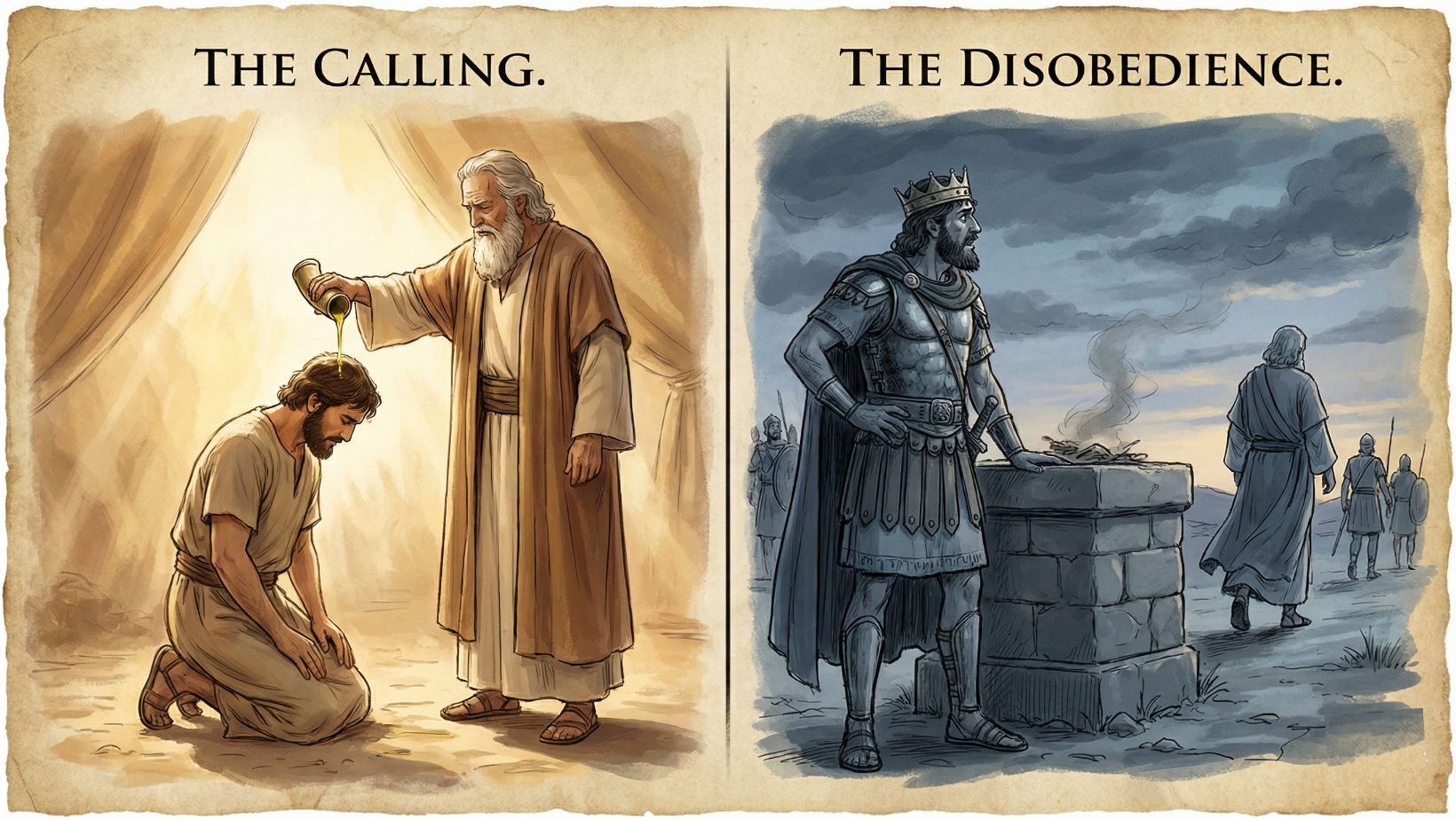
This period marks one of the most significant political and spiritual shifts in the Old Testament: the transition from a Theocracy (rule by God through Judges) to a Monarchy (rule by a human king). The events of Saul’s anointing and early reign reveal a dramatic tension between God’s sovereignty and human will. It is a story of divine selection, initial promise, and the tragic unraveling of a leader who possessed every physical qualification but lacked the internal spiritual fortitude to sustain his calling.
- Event: The Anointing and Coronation of Saul
- Scripture Reference: 1 Samuel 9–15
- Key Locations: Ramah (Private Anointing), Mizpah (Public Selection), Gilgal (Coronation), Jabesh-Gilead (First Battle)
- Primary Characters: Saul, Samuel, Nahash the Ammonite, Jonathan
- Theological Theme: God granting the people’s desire to their own detriment; the necessity of total obedience.
The Context: A Rejection of God
The events begin not with Saul, but with the people of Israel. Tired of the corruption of Samuel’s sons and fearful of the Philistines and Ammonites, the elders demand, “Appoint a king to lead us, such as all the other nations have” (1 Samuel 8:5).
The Sin: The request was not inherently wrong (Deuteronomy 17 had foreseen a king), but the motivation was. They wanted to rely on human military strength rather than divine protection. God tells Samuel: “It is not you they have rejected, but they have rejected me as their king.”
Event 1: The Private Anointing (1 Samuel 9–10)
The Setup: Saul, a Benjaminite, is searching for his father’s lost donkeys. This mundane task is guided by providence to lead him to the prophet Samuel in Ramah.
The Revelation: God reveals to Samuel that Saul is the chosen one. When they meet, Samuel treats Saul with great honor, seating him at the head of the table.
The Anointing: The next morning, Samuel takes a flask of oil and pours it on Saul’s head, kissing him and declaring, “Has not the Lord anointed you ruler over his inheritance?” (1 Samuel 10:1).
The Signs: To validate this secret anointing, Samuel predicts three specific signs, including Saul meeting a procession of prophets. When this happens, “the Spirit of God came powerfully upon him,” and he prophesied with them, signifying that God had given him a “new heart” for the task.
Event 2: The Public Selection at Mizpah (1 Samuel 10)
The Lottery: Samuel gathers the tribes at Mizpah to select the king publicly. Using a sacred lot (likely the Urim and Thummim), the tribe of Benjamin is chosen, then the clan of Matri, and finally Saul.
The Hiding King: When Saul’s name is called, he cannot be found. The Lord reveals, “He has hidden himself among the supplies.” This is a critical character insight—it indicates early modesty, shyness, or perhaps a deep-seated insecurity and fear of the responsibility.
The Acclamation: He is brought out, standing a head taller than everyone else. The people shout, “Long live the king!”
Event 3: The Validation at Jabesh-Gilead (1 Samuel 11)
The Crisis: Nahash the Ammonite besieges Jabesh-Gilead, threatening to gouge out the right eye of every man there. The town sends messengers to Saul.
The Response: The Spirit of God comes upon Saul in power. He slaughters a pair of oxen, sends the pieces throughout Israel as a summons to war, and rallies 330,000 men.
The Victory: Saul launches a surprise morning attack and completely routs the Ammonites. This victory silences his critics and cements his authority.
The Coronation: The people return to Gilgal to reaffirm the kingship with peace offerings. This is the high point of Saul’s reign.
Event 4: The Unraveling (The Two Rejections)
Saul’s reign deteriorates through two specific events where he acts out of fear and pragmatism rather than faith.
1. The Unlawful Sacrifice (1 Samuel 13): While waiting for Samuel at Gilgal before a battle with the Philistines, Saul’s men begin to desert him out of fear. Panicked, Saul takes the role of the priest and offers the burnt offering himself.
- The Analysis: Saul believed that the ritual was a “good luck charm” to win the battle, rather than an act of submission. He trusted the method rather than the commander.
- The Consequence: Samuel declares that Saul’s kingdom (dynasty) will not endure.
2. The War with Amalek (1 Samuel 15): God commands Saul to completely destroy the Amalekites (judgment for their ancient attack on Israel). Saul wins the battle but spares King Agag and the best of the livestock “to sacrifice to the Lord.”
- The Analysis: Saul tried to spiritualize his disobedience. When confronted, he blamed the soldiers (“the people took the plunder”). He feared the opinion of his army more than the command of Yahweh.
- The Consequence: Samuel utters the famous rebuke: “To obey is better than sacrifice.” God rejects Saul as king entirely.
Analysis of the Reign
The Fatal Flaw: Saul’s reign is a case study in insecurity. He constantly looked horizontally (at the people, his army, and his enemies) rather than vertically (at God). His disobedience wasn’t malicious rebellion; it was a weakness of faith. He could not trust God to come through unless he could see the solution himself.
The Contrast of Spirits:
- At the beginning, the Spirit of God came upon him to empower him for service (1 Sam 11:6).
- After his rejection, the Spirit departed, and a distressing spirit tormented him (1 Sam 16:14). This marks the shift from a divinely empowered king to a paranoid tyrant.
The People’s Lesson: Through Saul, God taught Israel that a human king could not save them. A king with the perfect “image” (tall, strong, handsome) is useless if he does not have a heart after God.







Leave a Reply