
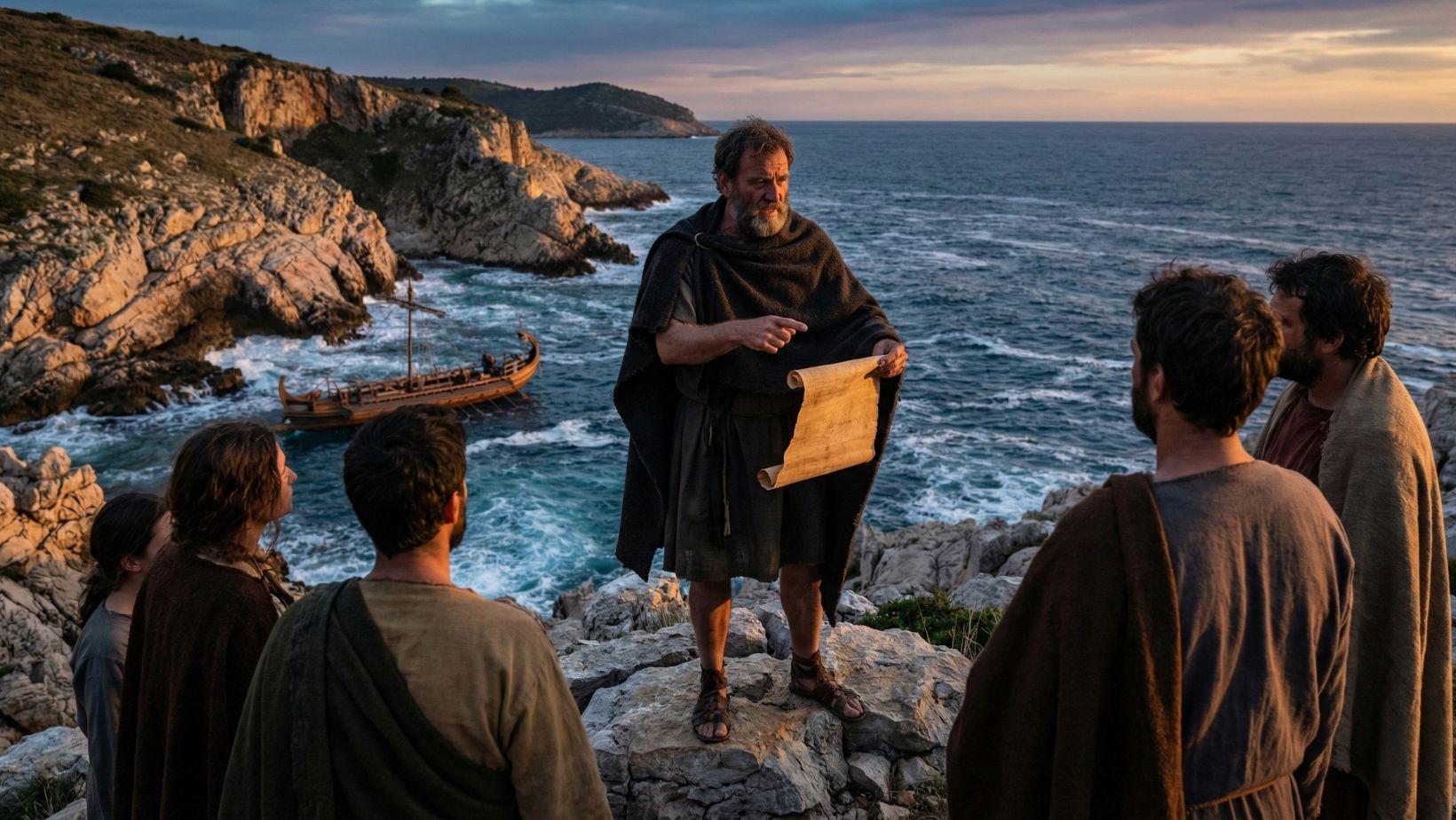
Titus was a Greek convert to Christianity who became one of the Apostle Paul’s most trusted companions and diplomatic envoys. Known for his strength of character and ability to handle difficult situations, Titus served as a “troubleshooter” for the early church, bringing order to chaotic congregations in Corinth and Crete. His journey eventually led him to the Roman province of Dalmatia (modern-day Croatia), demonstrating his enduring commitment to spreading the Gospel to new frontiers until the very end of the apostolic age.
Quick Facts
- Name: Titus (Latin: Titus, meaning “Honorable” or “Defender”)
- Nationality: Greek (Gentile by birth)
- Era: First Century AD (Early Church)
- Mentor: The Apostle Paul
- Key Locations: Jerusalem, Corinth, Crete, Nicopolis, Dalmatia
- Books: The Epistle to Titus; frequently mentioned in 2 Corinthians, Galatians, and 2 Timothy
- Key Virtues: Integrity, diplomacy, boldness, organizational leadership
- Legacy: First Bishop of Crete; patron saint of Crete; a key figure in establishing Gentile inclusion in the church
- Symbol: A pastoral staff or a ship (symbolizing his missionary voyages)
Name Meaning
“Titus” is a Roman name of uncertain origin, possibly meaning “Title of Honor” or “Defender.” In the New Testament, his name becomes synonymous with a “true son in the common faith” (Titus 1:4), representing the faithful Gentile believer who is fully accepted by God without needing to adhere to Jewish ceremonial law.
Lineage / Family Background
Origin: He was a Gentile (Greek) by birth, likely converted directly by Paul’s ministry.
Spiritual Lineage: Paul refers to him as “my true son” (Titus 1:4), indicating a deep spiritual father-son relationship similar to Paul’s bond with Timothy.
Significance: As an uncircumcised Greek accompanying Paul to Jerusalem (Galatians 2:1–3), Titus served as living proof that Gentiles could receive the Holy Spirit and be saved by grace alone, without becoming Jewish proselytes.
Biblical Era / Context
Time: The Apostolic Age (approx. 45–65 AD).
Setting: The expansion of the church from a Jewish sect into a global faith.
Cultural Context: Titus operated in a time of theological tension regarding whether Gentile converts needed to follow the Law of Moses. He also navigated the moral corruption of cities like Corinth and the “wild” reputation of the Cretans.
Major Roles / Identity
Diplomatic Envoy: Paul sent Titus to Corinth to resolve a painful conflict and collect the offering for the poor in Jerusalem.
Apostolic Delegate: He was given authority to appoint elders and organize the church structure in Crete.
Missionary to Dalmatia: In Paul’s final days, Titus was one of the few dispatched to open new mission fields, specifically going to Dalmatia (2 Timothy 4:10).
The “Test Case”: His presence at the Council of Jerusalem solidified the doctrine of justification by faith for Gentiles.
Key Character Traits
Reliability: Paul wrote, “I have no one else like him,” and relied on him to handle money and sensitive relationships (2 Corinthians 8:20–21).
Courage: He faced a hostile environment in Corinth and a culturally rough environment in Crete (“Cretans are always liars, evil brutes, lazy gluttons” – Titus 1:12) with firmness.
Affectionate: Despite his toughness, he is described as having deep affection for the believers (2 Corinthians 7:15).
Diligent: He accepted assignments voluntarily and with great enthusiasm (2 Corinthians 8:17).
Main Life Events
Conversion and Mentorship: Converted by Paul and brought to Antioch.
The Jerusalem Council: Traveled with Paul and Barnabas to Jerusalem; he was not compelled to be circumcised, securing a victory for Gentile freedom (Galatians 2).
Crisis Management in Corinth: Delivered a “severe letter” from Paul to the Corinthians and successfully restored the relationship between the church and the Apostle (2 Corinthians 7).
Ministry in Crete: Left by Paul on the island of Crete to “straighten out what was left unfinished” and appoint elders in every town (Titus 1:5).
Mission to Dalmatia: During Paul’s second Roman imprisonment, while others deserted or were sent away, Titus departed for Dalmatia (Illyricum) to evangelize the region (2 Timothy 4:10).
Major Relationships
Paul: His mentor and spiritual father; they shared a bond of absolute trust.
The Church in Corinth: A congregation that initially caused Paul grief but was won over by Titus’s tactful leadership.
Timothy: His counterpart; while Timothy was often described as more timid, Titus appears as the sturdier, older brother figure in Paul’s apostolic team.
Notable Passages
Galatians 2:3: “Yet not even Titus, who was with me, was compelled to be circumcised, even though he was a Greek.” (The proof of Gentile liberty).
2 Corinthians 8:23: “As for Titus, he is my partner and co-worker among you.”
Titus 1:5: “The reason I left you in Crete was that you might put in order what was left unfinished and appoint elders in every town, as I directed you.”
2 Timothy 4:10: “…for Demas, because he loved this world, has deserted me and has gone to Thessalonica. Crescens has gone to Galatia, and Titus to Dalmatia.”
Legacy & Impact
Organizational Structure: The Epistle to Titus provides crucial instructions on the qualifications for church leaders (elders/bishops), shaping church polity for centuries.
Evangelism of the Balkans: His journey to Dalmatia marks the apostolic expansion into the Adriatic region, planting seeds for Christianity in modern-day Croatia and the Balkans.
Gentile Inclusion: His life stands as a testament that the Gospel is for all nations, irrespective of ethnic heritage or ritual law.
Symbolism / Typology
The Peacemaker: Titus represents the ministry of reconciliation, repairing breaches between leadership and congregation.
The Administrator: He symbolizes the necessity of order, structure, and sound doctrine alongside spiritual passion.
The Uncircumcised Brother: He is a type of the Gentile church—accepted fully by grace.
Extra-Biblical References
Church Tradition: Eusebius reports that Titus served as the first bishop of Crete and lived to an old age, dying peacefully (unlike many other apostles who were martyred).
St. Titus Cathedral: His relics were historically venerated in Heraklion, Crete.
Patronage: He is the patron saint of Crete and the United States Army Chaplain Corps (due to his role as Paul’s assistant).







Leave a Reply