
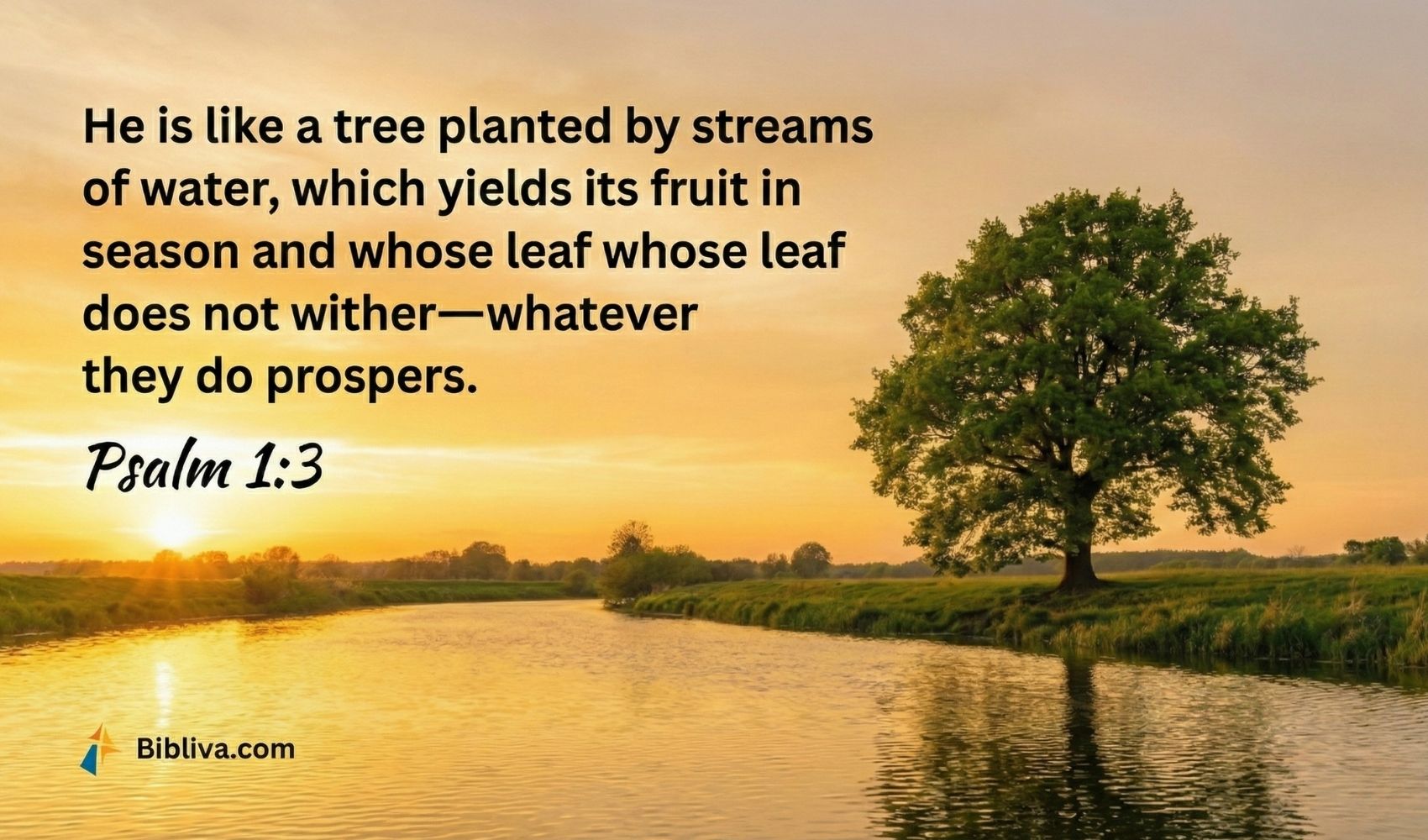
Psalm 1:3 provides a vivid metaphorical description of the “blessed man” introduced in verse 1. Utilizing imagery deeply rooted in ancient Near Eastern agriculture, the verse portrays the righteous individual as a flourishing tree. This tree is characterized by its strategic location (by streams of water), its timely productivity (yielding fruit in season), its enduring vitality (leaf does not wither), and its comprehensive success (prosperity in all endeavors). The verse serves as a stark contrast to the description of the wicked in verse 4 and illustrates the stability and vitality resulting from a life anchored in God’s Law.
1. The Stability of the Righteous (Psalm 1:3a NLT)
3 They are like trees planted along the riverbank,
Commentary:
- The Metaphor of the Tree: In Hebrew wisdom literature, a tree often symbolizes wisdom, stability, and life. Unlike the “chaff” (v. 4) which is dead and weightless, a tree is living, rooted, and substantial. This image recalls Jeremiah 17:7–8, which describes the man who trusts in the Lord as a tree planted by water.
- Planted (Transplanted): The Hebrew word used for “planted” (shathul) more accurately means “transplanted.” This implies intentionality and divine action. The tree did not grow wild by happenstance; it was deliberately chosen and moved to a location where it could thrive. This suggests that the believer’s stability is not an inherent trait but a result of God’s grace in positioning them within His will.
- Source of Life (Riverbank/Streams of Water): The phrase “streams of water” (palgei mayim) refers to irrigation canals or channels, not just natural rivers. In the arid climate of the Near East, proximity to a reliable water source was the difference between life and death.
- The Symbolism of Water: In Scripture, water often symbolizes the Holy Spirit (John 7:38–39) or the Word of God (Ephesians 5:26). The righteous man draws his sustenance deeply and continuously from an external, inexhaustible source—the Law of the Lord mentioned in verse 2.
- Insight: Spiritual stability is not about personal strength but about proximity to the Source. Just as a tree cannot survive without water, a believer cannot thrive without the continuous intake of God’s truth.
2. The Productivity of the Righteous (Psalm 1:3b NLT)
bearing fruit each season.
Commentary:
- Fruitfulness: The primary purpose of a fruit tree is production, not just existence. In the spiritual life, “fruit” generally refers to character (Galatians 5:22–23), good works (Colossians 1:10), and the praise of lips confessing His name (Hebrews 13:15).
- Seasonality (In Its Season): The phrase “each season” (or in its season) highlights the natural, rhythmic nature of spiritual growth. A tree does not produce fruit all year round; it has seasons of dormancy, growth, and harvest.
- Patience in Growth: This qualifier provides comfort against the expectation of instant results. It implies that there is a right time for every output. God does not demand incessant activity but timely maturity.
- Dependency on the Root: Fruit is the natural byproduct of a healthy root system. If the roots (meditation on the Law) are deep, the fruit (righteous living) is inevitable.
- Insight: Spiritual fruitfulness is organic, not forced. It is the natural consequence of a life rooted in God’s Word, appearing at the appropriate time designated by the divine Gardener.
3. The Vitality of the Righteous (Psalm 1:3c NLT)
Their leaves never wither,
Commentary:
- Endurance: The “leaf” represents the visible testimony and the overall health of the tree. A withering leaf indicates drought, disease, or death. A leaf that “never withers” signifies resilience and perennial life.
- Resilience in Drought: Even in dry seasons (trials and tribulations), this tree remains green because its roots tap into a deep water source that surface conditions cannot affect. This mirrors the promise that the righteous will have peace that passes understanding.
- Contrast to Ephemeral Success: Worldly success often fades like the flower of the field (Isaiah 40:6–8), but the vitality derived from Torah meditation is enduring.
- Perseverance: This part of the verse speaks to consistency. The righteous person maintains their spiritual vibrancy and testimony regardless of external circumstances.
- Insight: While the seasons change and the fruit comes and goes, the leaf remains. This points to the believer’s consistent character and testimony, which remains fresh and alive even when “fruit” (visible results) isn’t immediately apparent.
4. The Prosperity of the Righteous (Psalm 1:3d NLT)
and they prosper in all they do.
Commentary:
- Definition of Prosperity: The Hebrew word for “prosper” (tsalach) means “to push forward,” “to break out,” or “to succeed.” However, in the biblical context, this does not guarantee financial wealth or a problem-free life.
- Holistic Success: It refers to bringing things to a successful conclusion in accordance with God’s will. It aligns with Joshua 1:8, where meditation on the Law leads to being “prosperous and successful.”
- Scope of Blessing: “All they do” seems like a hyperbolic promise, but it is qualified by the context. Since this person delights in God’s Law (v. 2), “all they do” is shaped by that Law. Therefore, their actions are aligned with God’s will, ensuring their ultimate success.
- The Joseph Parallel: This word (tsalach) is used to describe Joseph in Egypt (Genesis 39:2, 3, 23). Joseph was a slave and a prisoner, yet the Lord made him “prosper.” This proves that biblical prosperity can exist amidst suffering and injustice.
- Insight: True prosperity is not the absence of adversity but the presence of God’s favor. It is the assurance that the righteous man’s life will not be wasted; his efforts will have eternal significance and will accomplish God’s purposes.
Theological Significance of Psalm 1:3
- The Doctrine of Sanctification: The verse illustrates the process of sanctification—growth over time through the intake of the Word.
- The Necessity of Grace: The imagery of being “transplanted” implies that the believer is placed in a position of grace by God, rather than growing there by their own merit.
- The Vitality of Scripture: It establishes the Word of God as the essential nutrient for spiritual life (the water).
- The Assurance of Purpose: It promises that a life lived in alignment with God is never futile; it yields fruit and succeeds in the ultimate sense.
Practical Applications
- Audit Your Water Source: We must ask ourselves what “stream” we are planted by. Are we drawing sustenance from social media, news, and secular culture, or from the deep reservoir of Scripture?
- Patience with Seasons: We should not be discouraged if we do not see immediate fruit in our ministries or personal lives. We must trust the “seasonality” of God’s work.
- Resilience in Hardship: When life gets dry and difficult, we must send our roots deeper into God’s promises to ensure our “leaves” do not wither.
- Redefining Success: We must align our definition of “prospering” with biblical success—which is doing God’s will—rather than worldly accumulation.
Final Insight
Psalm 1:3 offers a promise of organic, vibrant life. It teaches that the blessed life is not a result of striving and chasing, but of rooting and abiding. The most productive thing a believer can do is not to run faster, but to plant themselves deeper in the Word of God.







Leave a Reply