
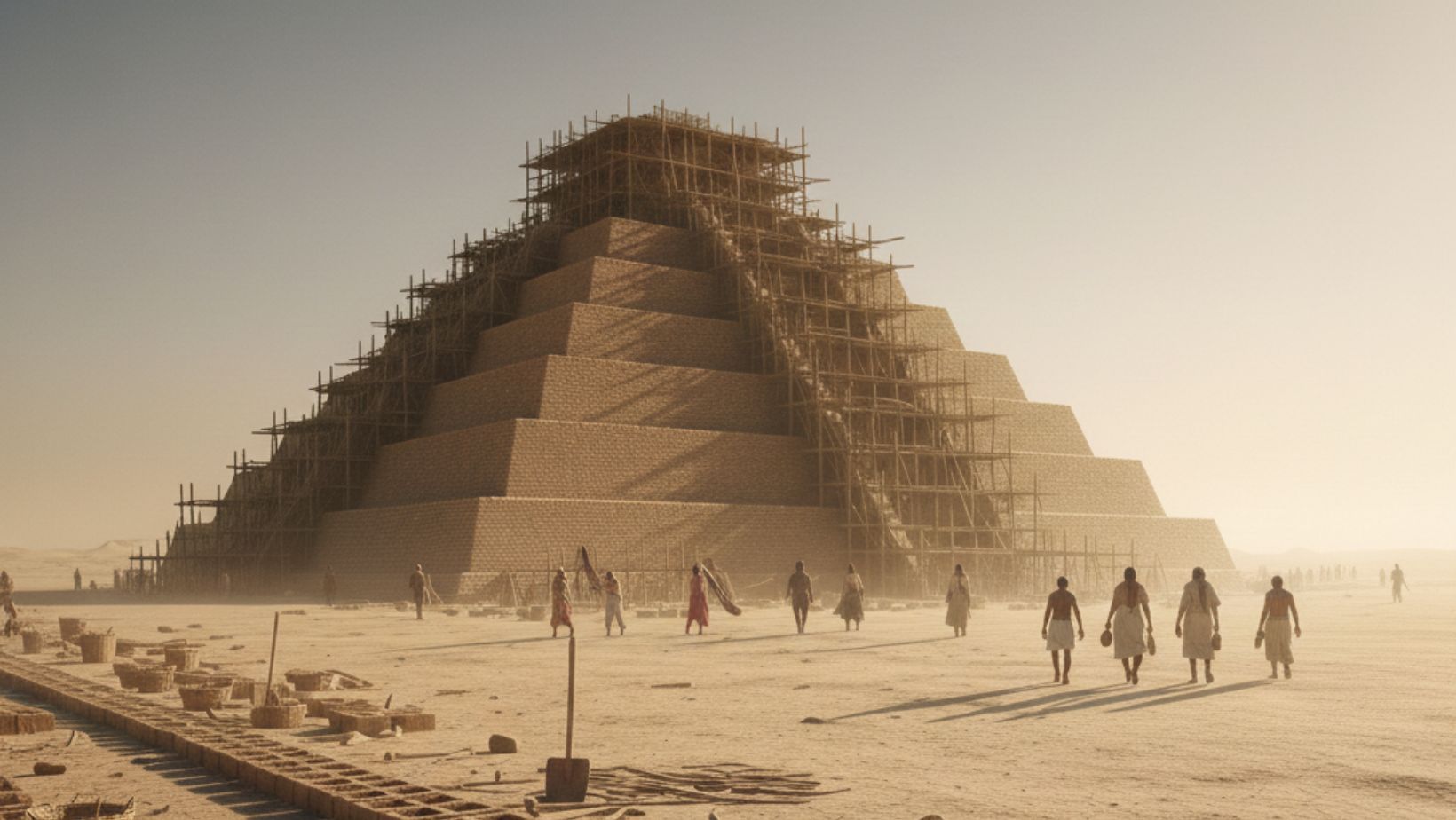
Genesis 11 serves as a pivotal bridge in the biblical narrative, marking the transition from the “Primeval History” of humanity (Genesis 1–11) to the “Patriarchal History” of Israel (Genesis 12–50). The chapter is divided into two distinct sections: the account of the Tower of Babel (vv. 1–9) and the genealogy of Shem leading to Abram (vv. 10–32). The first section depicts humanity’s unified rebellion against God’s command to scatter and fill the earth, resulting in divine judgment through the confusion of languages. The second section narrows the narrative focus from the scattered nations to a single family line—the descendants of Shem—ultimately introducing Terah and his son Abram (Abraham). This genealogy lays the groundwork for the Abrahamic Covenant in the following chapter, shifting the theme from judgment on the nations to blessing through a chosen family.
1. The Tower of Babel: Rebellion and Dispersion (Genesis 11:1–9 NIV)
1 Now the whole world had one language and a common speech. 2 As people moved eastward, they found a plain in Shinar and settled there. 3 They said to each other, “Come, let’s make bricks and bake them thoroughly.” They used brick instead of stone, and tar for mortar. 4 Then they said, “Come, let us build ourselves a city, with a tower that reaches to the heavens, so that we may make a name for ourselves; otherwise we will be scattered over the face of the whole earth.” 5 But the Lord came down to see the city and the tower the people were building. 6 The Lord said, “If as one people speaking the same language they have begun to do this, then nothing they plan to do will be impossible for them. 7 Come, let us go down and confuse their language so they will not understand each other.” 8 So the Lord scattered them from there over all the earth, and they stopped building the city. 9 That is why it was called Babel—because there the Lord confused the language of the whole world. From there the Lord scattered them over the face of the whole earth.
Commentary:
- Unified Language (v. 1): The chapter opens with humanity united by a single language. This indicates a cultural and social cohesion that, while potentially good, becomes a tool for collective rebellion.
- The Plain in Shinar (v. 2): “Shinar” is geographically identified with Babylon (modern southern Iraq). In biblical symbolism, moving “eastward” often denotes moving away from God (similar to Cain in Gen 4:16).
- Technological Innovation (v. 3): The use of kiln-fired bricks and bitumen (tar) represents a significant technological leap. Unlike stone which occurs naturally, bricks are man-made, symbolizing human self-reliance and the desire to create permanence where God intended pilgrimage.
- The Motives for Building (v. 4):
- Self-Exaltation: “Make a name for ourselves.” This is the antithesis of biblical faith, where one seeks to make God’s name great.
- Fear of Dispersion: “Otherwise we will be scattered.” This is direct disobedience to the Creation Mandate repeated to Noah in Genesis 9:1 (“Fill the earth”). They sought security in centralization rather than obedience in expansion.
- Religious Hubris: “A tower that reaches to the heavens.” This likely refers to a ziggurat—a temple tower designed as a stairway for gods to descend, but here usurped by humans trying to ascend to divine status.
- Divine Anthropomorphism (v. 5): “The Lord came down.” This is satirical irony. The builders thought their tower reached heaven, but God still had to “descend” just to see their puny effort. The distance between human achievement and God’s glory is infinite.
- The Power of Unity (v. 6): God acknowledges the potential of human unity. However, unity without submission to God accelerates the capacity for evil. Unchecked human potential, when misdirected, is dangerous.
- The “Let Us” (v. 7): God speaks in the plural (“Let us go down”), echoing the creation account (Gen 1:26). Christians often see this as an early hint of the Trinity, or it may refer to the heavenly court.
- Judgment as Mercy (v. 8): The scattering acts as a check on human pride. By creating linguistic barriers, God slows the progression of unified evil. They are forced to obey the command they tried to avoid: scattering over the earth.
- Babel (v. 9): The name is a play on words. The Akkadian Babilu means “Gate of God,” but the Hebrew balal means “confused.” God transforms their “Gate to Heaven” into a monument of confusion.
Insight: Babel represents the archetype of the secular city—humanity organized apart from God, seeking security in technology and unity, and driven by the desire for fame.
2. The Line of Shem: The Preservation of Hope (Genesis 11:10–26 NIV)
10 This is the account of Shem’s family line. Two years after the flood, when Shem was 100 years old, he became the father of Arphaxad. 11 And after he became the father of Arphaxad, Shem lived 500 years and had other sons and daughters. 12 When Arphaxad had lived 35 years, he became the father of Shelah. 13 And after he became the father of Shelah, Arphaxad lived 403 years and had other sons and daughters. 14 When Shelah had lived 30 years, he became the father of Eber. 15 And after he became the father of Eber, Shelah lived 403 years and had other sons and daughters. 16 When Eber had lived 34 years, he became the father of Peleg. 17 And after he became the father of Peleg, Eber lived 430 years and had other sons and daughters. 18 When Peleg had lived 30 years, he became the father of Reu. 19 And after he became the father of Reu, Peleg lived 209 years and had other sons and daughters. 20 When Reu had lived 32 years, he became the father of Serug. 21 And after he became the father of Serug, Reu lived 207 years and had other sons and daughters. 22 When Serug had lived 30 years, he became the father of Nahor. 23 And after he became the father of Nahor, Serug lived 200 years and had other sons and daughters. 24 When Nahor had lived 29 years, he became the father of Terah. 25 And after he became the father of Nahor, Nahor lived 119 years and had other sons and daughters. 26 After Terah had lived 70 years, he became the father of Abram, Nahor and Haran.
Commentary:
- The Shift in Focus: The narrative moves rapidly from the macroscopic view of the nations (Babel) to the microscopic view of one lineage (Shem).
- The Messianic Line (v. 10): Shem is the chosen son of Noah through whom the blessing continues. This genealogy traces the “seed of the woman” promised in Genesis 3:15.
- Diminishing Lifespans:
- Eber (v. 14): Eber is the etymological ancestor of the “Hebrews.”
- Structural Purpose: This genealogy is linear (father to son), designed specifically to bridge the gap of time and arrive at Terah and Abram. It demonstrates God’s faithfulness in preserving a remnant despite the worldwide rebellion at Babel.
Insight: While the world was busy building towers to make a name for themselves (Shem in Hebrew means “Name”), God was quietly preserving a “Shem” (Name/Lineage) through whom He would truly bless the world.
3. The Family of Terah: The Call Begins (Genesis 11:27–32 NIV)
27 This is the account of Terah’s family line. Terah became the father of Abram, Nahor and Haran. And Haran became the father of Lot. 28 While his father Terah was still alive, Haran died in Ur of the Chaldeans, in the land of his birth. 29 Abram and Nahor both married. The name of Abram’s wife was Sarai, and the name of Nahor’s wife was Milcah; she was the daughter of Haran, the father of both Milcah and Iscah. 30 Now Sarai was childless because she was not able to conceive. 31 Terah took his son Abram, his grandson Lot son of Haran, and his daughter-in-law Sarai, the wife of his son Abram, and together they set out from Ur of the Chaldeans to go to Canaan. But when they came to Haran, they settled there. 32 Terah lived 205 years, and he died in Haran.
Commentary:
- Introduction of Key Players (v. 27):
- Abram: The central figure of the Old Testament history from this point forward.
- Lot: Abram’s nephew, who becomes significant in later chapters (Sodom and Gomorrah).
- Tragedy in Ur (v. 28): Haran dies before his father, introducing the theme of death and family fragility even within the chosen line.
- The Barrenness of Sarai (v. 30): This is a crucial theological detail. “Sarai was childless because she was not able to conceive.”
- The promise of a great nation (Gen 12) will be given to a man with a barren wife.
- This sets the stage for the miraculous nature of God’s covenant; it must be by divine power, not human biology.
- The Migration (v. 31):
- Origin: Ur of the Chaldeans (a sophisticated, moon-worshiping Sumerian city).
- Destination: Canaan.
- The Stop: They settle in Haran. It is unclear why Terah stopped halfway. Some commentators suggest spiritual compromise or physical frailty.
- Death of the Old Era (v. 32): Terah dies in Haran. His death signals the end of the genealogical preamble and the necessity for Abram to step out in faith on his own, as detailed in Chapter 12.
Insight: The chapter ends in a graveyard (Terah’s death) and a barren womb (Sarai). This emphasizes that the hope of the world cannot come from natural human potential, which is dead and barren, but must come from the intervening grace of God.
Theological Significance of Genesis 11
- God’s Sovereignty over Nations: Babel proves that God is the Lord of history. No human coalition can thwart His plans to populate the earth.
- The Failure of Humanism: The Tower of Babel is the ultimate symbol of secular humanism—humanity attempting to solve its problems and reach “heaven” through technology, organization, and unity apart from God.
- The Necessity of Grace: The transition from Babel (man reaching up) to Abraham (God reaching down) highlights the essence of the Gospel. Religion is man building a tower; the Gospel is God coming down to save.
- Pentecost Reversal: In the New Testament, the Day of Pentecost (Acts 2) reverses the curse of Babel. At Babel, languages were confused to separate people; at Pentecost, the Spirit enabled understanding across languages to unite people in Christ.
Practical Applications
- Check Your Motives: Like the builders of Babel, we often engage in projects (career, ministry, family) to “make a name for ourselves.” We must ask if we are building for our glory or God’s.
- Unity in Truth vs. Unity in Error: Unity is not an absolute good. Unity in rebellion (Babel) is destructive; unity in the Spirit (Pentecost) is redemptive.
- Trusting God’s Timing: The genealogy shows a long period of waiting. God works across centuries. We must trust His long-term plan even when we only see our short lifespan.
- Hope in “Barren” Situations: God often begins His greatest works where human ability ends. Sarai’s barrenness was the canvas for God’s miracle.
Final Insight
Genesis 11 presents a stark contrast between two types of “names.” The builders of Babel sought to make a name for themselves through pride and were scattered. Abram, introduced at the end, will have a name made great by God through grace (Gen 12:2). The path to true greatness is not upward mobility, but faithful submission.







Leave a Reply