
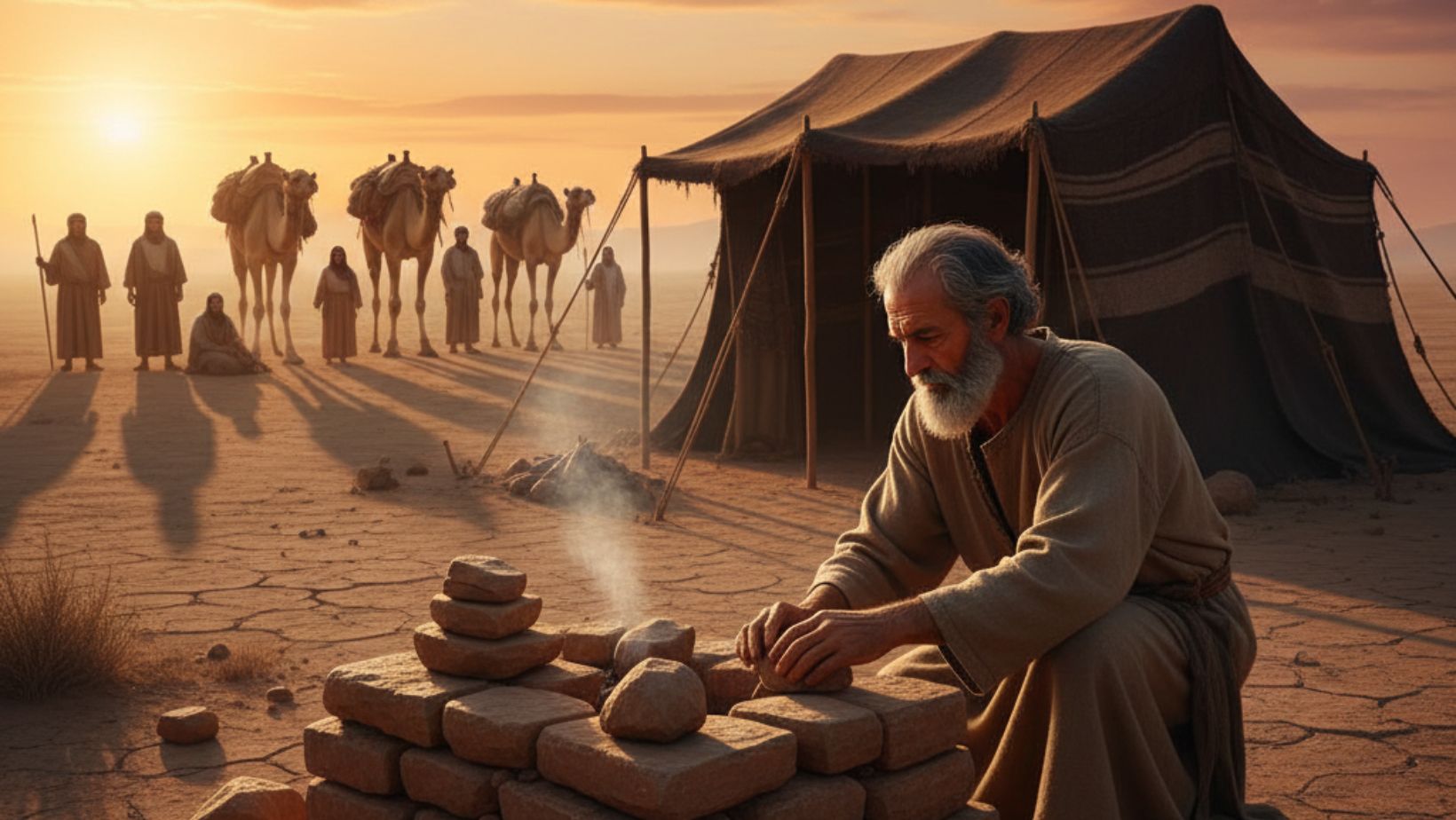
Genesis 12 is arguably one of the most significant chapters in the Bible. It marks the theological turning point from the “Problem” (Sin and Babel in Gen 1–11) to the “Solution” (The Covenant line). God selects one man, Abram, and through him promises to bless all nations. The chapter falls into three movements: The Divine Call and Promise (vv. 1–3), Abram’s Obedience and Worship in Canaan (vv. 4–9), and Abram’s Failure and Deliverance in Egypt (vv. 10–20). It establishes the pattern of the life of faith: great promises, obedient steps, severe testing, and divine grace covering human failure.
1. The Call and The Covenant (Genesis 12:1–3 NIV)
1 The Lord had said to Abram, “Go from your country, your people and your father’s household to the land I will show you. 2 “I will make you into a great nation, and I will bless you; I will make your name great, and you will be a blessing. 3 I will bless those who bless you, and whoever curses you I will curse; and all peoples on earth will be blessed through you.”
Commentary:
- The Command to “Go” (v. 1): The command requires a total break from the past. Abram is asked to leave his source of identity (“country”), security (“people/clan”), and inheritance (“father’s household”).
- Blind Faith (v. 1): God says, “to the land I will show you.” He does not give the destination immediately. He gives a compass, not a map. This highlights that the relationship with God is the security, not the destination.
- The Reversal of Babel (v. 2):
- At Babel, men tried to “make a name” for themselves (Gen 11:4).
- Here, God says, “I will make your name great.” True greatness is a gift of grace, not a grasp of pride.
- The Seven-Fold Blessing (vv. 2–3): This forms the backbone of the Abrahamic Covenant.
- National: “I will make you into a great nation.”
- Personal: “I will bless you.”
- Reputational: “I will make your name great.”
- Instrumental: “You will be a blessing.”
- Protection: “I will bless those who bless you.”
- Judgment: “Whoever curses you I will curse.”
- Universal: “All peoples on earth will be blessed through you.”
- The Gospel Seed (v. 3): The final phrase is the first clear promise of the Gospel in the post-flood world. The Apostle Paul identifies this as the gospel announced in advance (Galatians 3:8). The “blessing” culminates in Jesus Christ.
Insight: God blesses Abram not just for Abram’s sake, but so that he might be a conduit of blessing to others. Election is for the sake of mission.
2. The Obedience of Faith (Genesis 12:4–9 NIV)
4 So Abram went, as the Lord had told him; and Lot went with him. Abram was seventy-five years old when he set out from Haran. 5 He took his wife Sarai, his nephew Lot, all the possessions they had accumulated and the people they had acquired in Haran, and they set out for the land of Canaan, and they arrived there. 6 Abram traveled through the land as far as the site of the great tree of Moreh at Shechem. At that time the Canaanites were in the land. 7 The Lord appeared to Abram and said, “To your offspring I will give this land.” So he built an altar there to the Lord, who had appeared to him. 8 From there he went on toward the hills east of Bethel and pitched his tent, with Bethel on the west and Ai on the east. There he built an altar to the Lord and called on the name of the Lord. 9 Then Abram set out and continued toward the Negev.
Commentary:
- Age and Risk (v. 4): Abram is 75. In the ancient world, this was an age to settle down, not start over. Faith creates a willingness to change regardless of life stage.
- The Reality of Opposition (v. 6): “At that time the Canaanites were in the land.” The promise was not an empty vacuum; it was occupied territory. The promise of God often overlaps with the presence of problems.
- Shechem (v. 6): This location becomes central in Israel’s history (Jacob’s well, Joseph’s bones). It is geographically central in the land.
- The Vision (v. 7): This is the first time God appears in the land. The promise shifts from “the land I will show you” to “To your offspring I will give this land.”
- Altars and Tents (vv. 7–8):
- Calling on the Name (v. 8): This phrase implies public worship and proclamation. Abram was establishing a testimony in a pagan land.
Insight: Abram marked his journey with altars. He left a trail of worship wherever he went. While his home was portable (tent), his devotion was established (altar).
3. The Test in Egypt (Genesis 12:10–20 NIV)
10 Now there was a famine in the land, and Abram went down to Egypt to live there for a while because the famine was severe. 11 As he was about to enter Egypt, he said to his wife Sarai, “I know what a beautiful woman you are. 12 When the Egyptians see you, they will say, ‘This is his wife.’ Then they will kill me but will let you live. 13 Say you are my sister, so that I will be treated well for your sake and my life will be spared because of you.” 14 When Abram came to Egypt, the Egyptians saw that Sarai was a very beautiful woman. 15 And when Pharaoh’s officials saw her, they praised her to Pharaoh, and she was taken into his palace. 16 He treated Abram well for her sake, and Abram acquired sheep and cattle, male and female donkeys, male and female servants, and camels. 17 But the Lord inflicted serious diseases on Pharaoh and his household because of Abram’s wife Sarai. 18 So Pharaoh summoned Abram. “What have you done to me?” he said. “Why didn’t you tell me she was your wife? 19 Why did you say, ‘She is my sister,’ so that I took her to be my wife? Now then, here is your wife. Take her and go!” 20 Then Pharaoh gave orders about Abram to his men, and they sent him on his way, with his wife and everything he owned.
Commentary:
- The Famine (v. 10): A severe test immediately follows a great promise. The “land of flowing milk and honey” has no food. This tests Abram’s trust: Can God provide?
- The Descent (v. 10): “Went down to Egypt.” Throughout the Bible, going “down” to Egypt often symbolizes reliance on human resources rather than God (Isaiah 31:1).
- The Scheme (vv. 11–13): Abram acts out of fear, not faith. He fears the Egyptians’ immorality but resorts to deception himself.
- Half-Truth: Sarai was his half-sister (Gen 20:12), but the intent was deceptive.
- Self-Preservation: “That my life will be spared.” He risks the purity of the “mother of the promise” to save his own skin.
- Sarai’s Beauty (v. 14): Despite being 65 years old, Sarai is stunningly beautiful, attracting the attention of the highest court.
- The Threat to the Seed (v. 15): If Pharaoh takes Sarai as a wife, the promised line of Abram is corrupted or cut off. The famine threatened their lives; the compromise threatened the Covenant.
- God’s Intervention (v. 17): God protects the promise even when the recipient of the promise fails. He strikes Pharaoh with plagues (foreshadowing the Exodus).
- The Rebuke (vv. 18–19): It is humiliating that the pagan Pharaoh has to rebuke the prophet of God for a lack of ethics.
- The Departure (v. 20): Abram leaves wealthy but dismissed in disgrace. He failed the moral test, yet God remained faithful to His covenant.
Insight: This section proves that the Covenant depends on God’s faithfulness, not Abram’s perfection. If it depended on Abram, he would have lost Sarai to Pharaoh. God protects His plan despite His people’s failures.
Theological Significance of Genesis 12
- Unconditional Election: God chose Abram not because he was righteous (he came from an idol-worshiping family, Josh 24:2) but because of sovereign grace.
- The Covenant Structure: The Abrahamic Covenant is the foundation of the rest of the Bible. Israel’s existence, the land, the monarchy, and the Messiah all flow from Genesis 12:1–3.
- Justification by Faith: Abram believed the call. His journey is the model of the Christian walk—leaving the world (Ur) to seek a heavenly city (Hebrews 11:10).
- Providence: Even in Egypt, when Abram’s faith wavered, God’s providence overruled human error to preserve the messianic line.
Practical Applications
- Leaving Comfort Zones: Following God often requires leaving behind sources of false security (career, location, toxic relationships) to step into the unknown.
- Trusting the Compass, Not the Map: We often want detailed 5-year plans. God usually gives just enough light for the next step (“to the land I will show you”).
- The Danger of Fear: Fear causes us to compromise. When we panic about “famines” (financial lacks, crises), we are tempted to use worldly schemes (Egypt) rather than trusting God.
- Grace for Failures: When we stumble in our walk of faith, God does not void His promises. He disciplines us, rescues us, and puts us back on the path.
Final Insight
Genesis 12 presents a realistic hero. Abram is a giant of faith who leaves everything for God, yet he is also a flawed man who lies to save his neck. This encourages us that God uses imperfect people to accomplish His perfect will. The hero of Genesis 12 is ultimately not Abram, but the Lord who calls, guides, and protects him.







Leave a Reply