
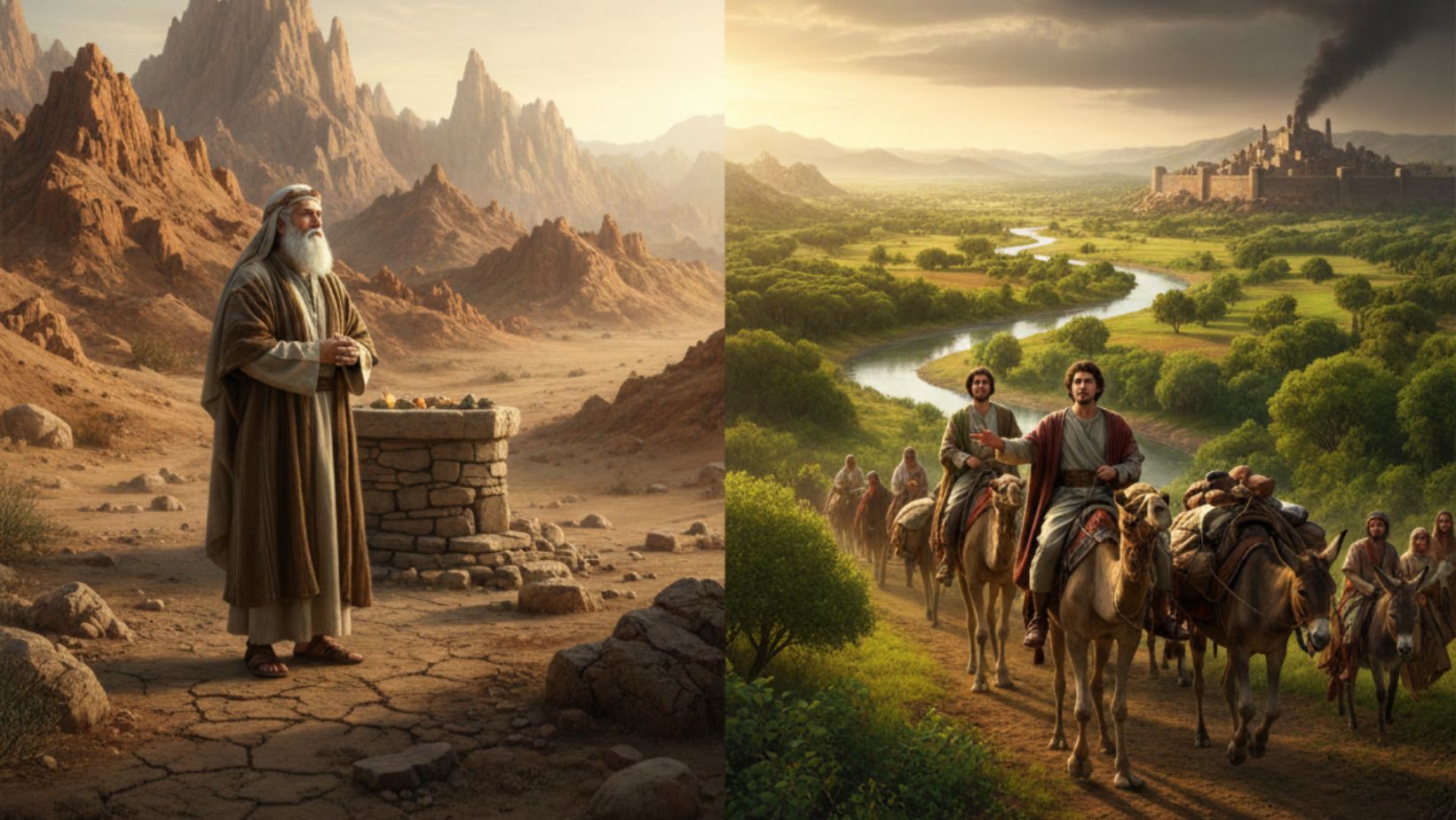
Genesis 13 serves as a study in contrast between two men: Abram, the man of faith, and Lot, the man of sight. Following the “Egypt fiasco” of Chapter 12, Abram returns to the Promised Land, spiritually restored. The chapter details a crisis of prosperity—both men have become so wealthy that the land cannot support them together. This leads to a necessary separation. While Lot chooses the best land for himself based on visual appeal (which leads him toward Sodom), Abram trusts God to provide and settles in the less attractive hill country. The chapter concludes with God expanding His covenant promise to Abram, rewarding his faith and generosity.
1. The Return to the Altar (Genesis 13:1–4 NIV)
1 So Abram went up from Egypt to the Negev, with his wife and everything he had, and Lot went with him. 2 Abram had become very wealthy in livestock and in silver and gold. 3 From the Negev he went from place to place until he came to Bethel, to the place between Bethel and Ai where his tent had been earlier 4 and where he had first built an altar. There Abram called on the name of the Lord.
Commentary:
- “Went Up” (v. 1): Geographically, traveling from Egypt to Canaan is an ascent in elevation. Spiritually, it symbolizes Abram climbing out of his moral failure in Egypt and returning to the place of God’s will.
- Burden of Wealth (v. 2): The Hebrew word for “wealthy” (kaved) literally means “heavy.” Abram is “heavy” with livestock and gold. While wealth is a blessing, the narrative hints that this “heaviness” will soon cause a rift. Much of this wealth was likely acquired from Pharaoh (12:16) as a result of the deception, adding a layer of irony—the spoils of his failure become the source of his next trial.
- Retracing Steps (v. 3): Abram goes back to “the place where his tent had been earlier.” He returns to his last point of spiritual success before his detour to Egypt.
- Restoration (v. 4): He returns to the altar. Repentance often involves going back to the basics—prayer, worship, and the covenant. He “called on the name of the Lord” again, re-establishing his testimony.
Insight: Spiritual restoration is always possible. No matter how far “down” to Egypt we go, we can always go “up” to the altar.
2. The Conflict and the Choice (Genesis 13:5–13 NIV)
5 Now Lot, who was moving about with Abram, also had flocks and herds and tents. 6 But the land could not support them while they stayed together, for their possessions were so great that they were not able to stay together. 7 And quarreling arose between Abram’s herders and Lot’s herders. The Canaanites and Perizzites were also living in the land at that time.
8 So Abram said to Lot, “Let’s not have any quarreling between you and me, or between your herders and mine, for we are close relatives. 9 Is not the whole land before you? Let’s part company. If you go to the left, I’ll go to the right; if you go to the right, I’ll go to the left.”
10 Lot looked around and saw that the whole plain of the Jordan toward Zoar was well watered, like the garden of the Lord, like the land of Egypt. (This was before the Lord destroyed Sodom and Gomorrah.) 11 So Lot chose for himself the whole plain of the Jordan and set out toward the east. The two men parted company: 12 Abram lived in the land of Canaan, while Lot lived among the cities of the plain and pitched his tents near Sodom. 13 Now the people of Sodom were wicked and were sinning greatly against the Lord.
Commentary:
- The Problem of Prosperity (v. 6): The blessing of wealth creates a practical crisis. The resources (water and pasture) are insufficient for their combined herds.
- The Witness Problem (v. 7): The text notes “The Canaanites… were also living in the land.” This implies that the pagan neighbors were watching. Internal strife within the family of God ruins their testimony to the watching world.
- Abram’s Meekness (vv. 8–9):
- Lot’s “Look” (v. 10): “Lot looked around and saw.” This is the key phrase. Lot walks by sight, not by faith.
- The Direction (v. 11): Lot moves “east.” As seen in Gen 3:24 (Adam/Eve), Gen 4:16 (Cain), and Gen 11:2 (Babel), moving east in Genesis often symbolizes moving away from God’s presence.
- The Danger (vv. 12–13):
- Abram stays in Canaan (the rugged hills, the actual Promised Land).
- Lot moves to the Cities of the Plain (outside the primary promised boundaries).
- He “pitched his tents near Sodom.” He didn’t move into Sodom yet, but he moved toward sin.
- Verse 13 gives the ominous foreshadowing: Sodom is wicked. Lot chooses economic advantage over moral safety.
Insight: The eyes are the gateway to the heart. Lot chose what looked good (like Eve saw the fruit was “pleasing to the eye”). He chose the lush valley without asking why the wicked people lived there.
3. The Promise Expanded (Genesis 13:14–18 NIV)
14 The Lord said to Abram after Lot had parted from him, “Lift up your eyes from where you are and look north and south, east and west. 15 All the land that you see I will give to you and your offspring forever. 16 I will make your offspring like the dust of the earth, so that if anyone could count the dust, then your offspring could be counted. 17 Go, walk through the length and breadth of the land, for I am giving it to you.” 18 So Abram went to live near the great trees of Mamre at Hebron, where he pitched his tents. There he built an altar to the Lord.
Commentary:
- God Speaks (v. 14): God was silent during the quarrel, but immediately after Abram passes the test of generosity, God speaks.
- Abram’s “Look” (v. 14): Compare God’s command to Lot’s action.
- Dust of the Earth (v. 16): In Gen 12, God promised a “great nation.” Here, he uses a metaphor of biological impossibility—numbering the dust. This emphasizes the magnitude of the future nation.
- Walking the Land (v. 17): In ancient legal custom, walking through a property was a symbolic act of claiming ownership. God invites Abram to “tour” his future estate.
- Hebron and Mamre (v. 18):
Insight: Lot grabbed the best for himself and eventually lost everything in Sodom. Abram gave up the best for peace and was given the whole land by God. “Blessed are the meek, for they will inherit the earth” (Matthew 5:5).
Theological Significance of Genesis 13
- Sanctification: The journey of faith is not linear. It involves failures (Egypt) and returns (Bethel). God is patient with the process of restoring His saints.
- Faith vs. Sight: This chapter is the classic biblical dichotomy.
- Separation: Sometimes, separation is necessary for spiritual survival. Lot represented a “worldly believer” who was dragging Abram down. The separation allowed Abram to fully inhabit his role as the Patriarch of the promise.
Practical Applications
- Handling Conflict: When money or property causes family strife, the believer should take the “high road” of generosity, trusting that God can make up the difference.
- Decision Making: Do not make major life decisions (where to live, what job to take) based solely on the “lushness of the plain” (money/perks). Consider the spiritual environment (“Is Sodom nearby?”).
- The “Lot” progression: Lot’s slide into sin was gradual:
- He looked at Sodom (v. 10).
- He chose the direction of Sodom (v. 11).
- He pitched his tent near Sodom (v. 12).
- Later, he lives in Sodom (Gen 14:12).
- Lesson: Don’t pitch your tent near the edge of a cliff.
- God’s Mathematics: In God’s economy, you gain by giving away. Abram gave away the fertile valley and received the title deed to the whole land.
Final Insight
Genesis 13 teaches us that what we grab for ourselves, we often lose; but what we surrender to God, He keeps for us forever. Lot chose the garden of plenty but found a city of destruction. Abram chose the barren hills with God and found the path to an eternal legacy.
Possible Sermon Titles from the Chapter
- The High Cost of the Low Road.
- Faith is Blind, But Greed Has 20/20 Vision.
- How to Win a Fight by Losing.
- Pitching Your Tent Too Close to Sodom.
- The Tale of Two Travelers.
- Restoration: From Egypt to the Altar.







Leave a Reply