
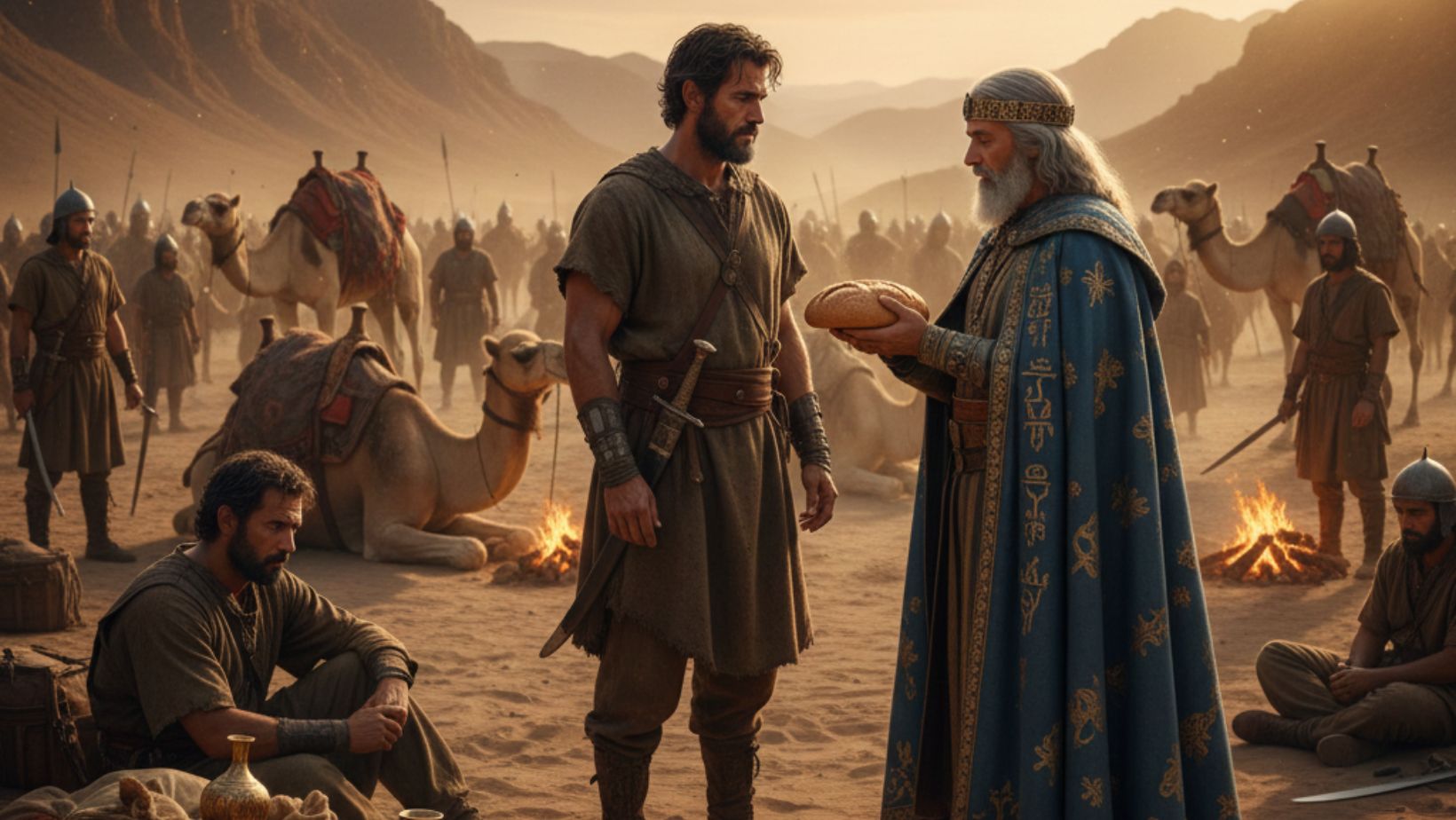
Genesis 14 represents a shift in genre from family narrative to international military history. It records the first war in the Bible, involving a coalition of nine kings. The narrative serves two primary purposes: First, it highlights Abram’s loyalty and military prowess as he rescues his nephew Lot, who had foolishly settled in Sodom. Second, it introduces the mysterious figure of Melchizedek, a priest-king who blesses Abram. The chapter concludes with a dramatic spiritual test where Abram must choose between the blessing of the King of Salem (God’s representative) and the wealth of the King of Sodom (the world’s representative).
1. The War of the Kings and Lot’s Capture (Genesis 14:1–12 NKJV)
1 And it came to pass in the days of Amraphel king of Shinar, Arioch king of Ellasar, Chedorlaomer king of Elam, and Tidal king of nations, 2 that they made war with Bera king of Sodom, Birsha king of Gomorrah, Shinab king of Admah, Shemeber king of Zeboiim, and the king of Bela (that is, Zoar). 3 All these joined together in the Valley of Siddim (that is, the Salt Sea). 4 Twelve years they served Chedorlaomer, and in the thirteenth year they rebelled. 5 In the fourteenth year Chedorlaomer and the kings that were with him came and attacked the Rephaim in Ashteroth Karnaim, the Zuzim in Ham, the Emim in Shaveh Kiriathaim, 6 and the Horites in their mountain of Seir, as far as El Paran, which is by the wilderness. 7 Then they turned back and came to En Mishpat (that is, Kadesh), and attacked all the country of the Amalekites, and also the Amorites who dwelt in Hazezon Tamar. 8 And the king of Sodom, the king of Gomorrah, the king of Admah, the king of Zeboiim, and the king of Bela (that is, Zoar) went out and joined together in battle in the Valley of Siddim 9 against Chedorlaomer king of Elam, Tidal king of nations, Amraphel king of Shinar, and Arioch king of Ellasar—four kings against five. 10 Now the Valley of Siddim was full of asphalt pits; and the kings of Sodom and Gomorrah fled; some fell there, and the remainder fled to the mountains. 11 Then they took all the goods of Sodom and Gomorrah, and all their provisions, and went their way. 12 They also took Lot, Abram’s brother’s son who dwelt in Sodom, and his goods, and departed.
Commentary:
- Historical Validation (v. 1): The mention of specific kings (Amraphel, Chedorlaomer) and nations (Shinar/Babylon, Elam/Persia) grounds the biblical narrative in real history. This was not a myth; it was a geopolitical conflict.
- The Rebellion (v. 4): The five kings of the plain (Sodom, Gomorrah, etc.) were vassals paying tribute to Chedorlaomer. Their refusal to pay triggered a punitive military campaign.
- The Route of Conquest (vv. 5–7): The eastern coalition moved south along the “King’s Highway” (east of the Jordan), systematically crushing the giant clans (Rephaim, Zuzim, Emim). This demonstrates the terrifying power of Chedorlaomer’s army.
- Valley of Siddim (v. 10): Located at the southern end of the Dead Sea. The “asphalt pits” (tar pits) acted as natural traps. The terrain meant to protect the kings of Sodom actually entrapped them.
- Lot’s Progression (v. 12): This is the critical tragedy of the section.
Insight: Neutrality is often impossible. Lot tried to live as a righteous man in a wicked city without being part of it, but when judgment came to the city, he was swept away with it.
2. Abram the Warrior (Genesis 14:13–16 NKJV)
13 Then one who had escaped came and told Abram the Hebrew, for he dwelt by the terebinth trees of Mamre the Amorite, brother of Eshcol and brother of Aner; and they were allies with Abram. 14 Now when Abram heard that his brother was taken captive, he armed his three hundred and eighteen trained servants who were born in his own house, and went in pursuit as far as Dan. 15 He divided his forces against them by night, and he and his servants attacked them and pursued them as far as Hobah, which is north of Damascus. 16 So he brought back all the goods, and also brought back his brother Lot and his goods, as well as the women and the people.
Commentary:
- “Abram the Hebrew” (v. 13): This is the first time the word “Hebrew” (Ivri) appears in the Bible. It likely means “one from the other side” (of the Euphrates River), marking him as distinct from the Canaanites.
- Strategic Alliances (v. 13): Although separate in faith, Abram was not an isolationist. He had a defense treaty with his Amorite neighbors (Mamre, Eshcol, Aner).
- The Private Army (v. 14): That Abram had 318 trained men born in his house suggests he was a powerful sheik, not just a simple shepherd. He had the resources and leadership to maintain a militia.
- Brother (v. 14): Though Lot was his nephew, Abram calls him “brother.” In crisis, technicalities disappear; Abram is moved by familial loyalty and love.
- Military Tactics (v. 15): Abram utilizes advanced tactics:
- Speed: A forced march north to Dan.
- Surprise: Attacking at night.
- Division: Splitting forces to create panic.
- Total Victory (v. 16): Abram defeats the coalition that had just crushed five nations. He recovers everything. This victory would have made Abram famous and feared in the region.
Insight: Faith is not passive. Abram did not stay in his tent and pray for Lot; he prayed, armed himself, and went to work. Trusting God does not negate the need for courage and action.
3. The Priest-King and the King of Sodom (Genesis 14:17–24 NKJV)
17 And the king of Sodom went out to meet him at the Valley of Shaveh (that is, the King’s Valley), after his return from the defeat of Chedorlaomer and the kings who were with him. 18 Then Melchizedek king of Salem brought out bread and wine; he was the priest of God Most High. 19 And he blessed him and said: “Blessed be Abram of God Most High, Possessor of heaven and earth; 20 And blessed be God Most High, Who has delivered your enemies into your hand.” And he gave him a tithe of all. 21 Now the king of Sodom said to Abram, “Give me the persons, and take the goods for yourself.” 22 But Abram said to the king of Sodom, “I have raised my hand to the Lord, God Most High, the Possessor of heaven and earth, 23 that I will take nothing, from a thread to a sandal strap, and that I will not take anything that is yours, lest you should say, ‘I have made Abram rich’— 24 except only what the young men have eaten, and the portion of the men who went with me: Aner, Eshcol, and Mamre; let them take their portion.”
Commentary:
- The Tale of Two Kings (v. 17-18): Abram is met by two monarchs representing two spiritual realities:
- Melchizedek (v. 18):
- El Elyon (v. 18): Melchizedek introduces a new name for God: El Elyon (God Most High). This affirms that Yahweh is supreme over all local Canaanite deities.
- The First Tithe (v. 20): Abram gives a tenth (tithe) of the spoils to Melchizedek.
- The Temptation of Sodom (v. 21): The King of Sodom offers a deal: “Give me the souls (people), you take the stuff (goods).” This is the classic temptation of the world—trade spiritual influence for material gain.
- Abram’s Refusal (vv. 22–23): Abram rejects the loot.
- He uses Melchizedek’s terminology (“God Most High, Possessor of heaven and earth”), showing he has accepted the priest’s instruction.
- Reason: He refuses to let the world take credit for God’s blessing (“Lest you should say, ‘I have made Abram rich’”). He wants his prosperity to be clearly traceable to God alone.
- Integrity (v. 24): While Abram refuses his share, he defends the rights of his allies (Aner, Eshcol, Mamre) to take theirs. He does not force his personal convictions on others.
Insight: This section is the spiritual climax. Defeating the army of Chedorlaomer was a physical victory; defeating the offer of the King of Sodom was a spiritual victory. Abram refused to be bought.
Theological Significance of Genesis 14
- Typology of Christ: Melchizedek is one of the strongest “types” of Christ in the Old Testament. As explained in Hebrews 7, Jesus is a priest “according to the order of Melchizedek”—eternal, preceding the Levites, and holding the dual office of King of Peace and King of Righteousness.
- The Origin of Tithing: Tithing begins here as a voluntary response to grace and victory, not as a legalistic requirement. It is an act of worship acknowledging God as the “Possessor of heaven and earth.”
- God as Possessor: The title El Elyon (God Most High) establishes monotheism’s claim. God is not just a tribal deity; He owns the universe.
- Separation from the World: Abram’s refusal to align with Sodom, even when it would profit him, sets the standard for holiness. Believers are in the world, but not of it.
Practical Applications
- Loyalty in Crisis: Like Abram, we should stand up for family and brothers/sisters in faith who have fallen into trouble (“captured by the enemy”), rather than judging them for being there.
- Worship After Victory: It is easy to become proud after a success. Abram’s first act after the war was to tithe and receive a blessing, keeping his perspective humble.
- Refusing Compromise: We must be wary of “gifts” from the world that come with strings attached. If a promotion, relationship, or opportunity requires us to compromise our testimony or owe a debt to “Sodom,” we must reject it.
- Who is Your Source? Abram wanted to make sure everyone knew God made him rich, not a pagan king. We should live so that our success can only be explained by God’s hand.
Final Insight
Genesis 14 shows Abram passing the test of strength (defeating the kings) and the test of wealth (rejecting Sodom’s gold). He stands in the valley between a wicked king and a holy priest, and by tithing to one and rebuking the other, he declares his allegiance to the Kingdom of God over the kingdoms of men.







Leave a Reply