
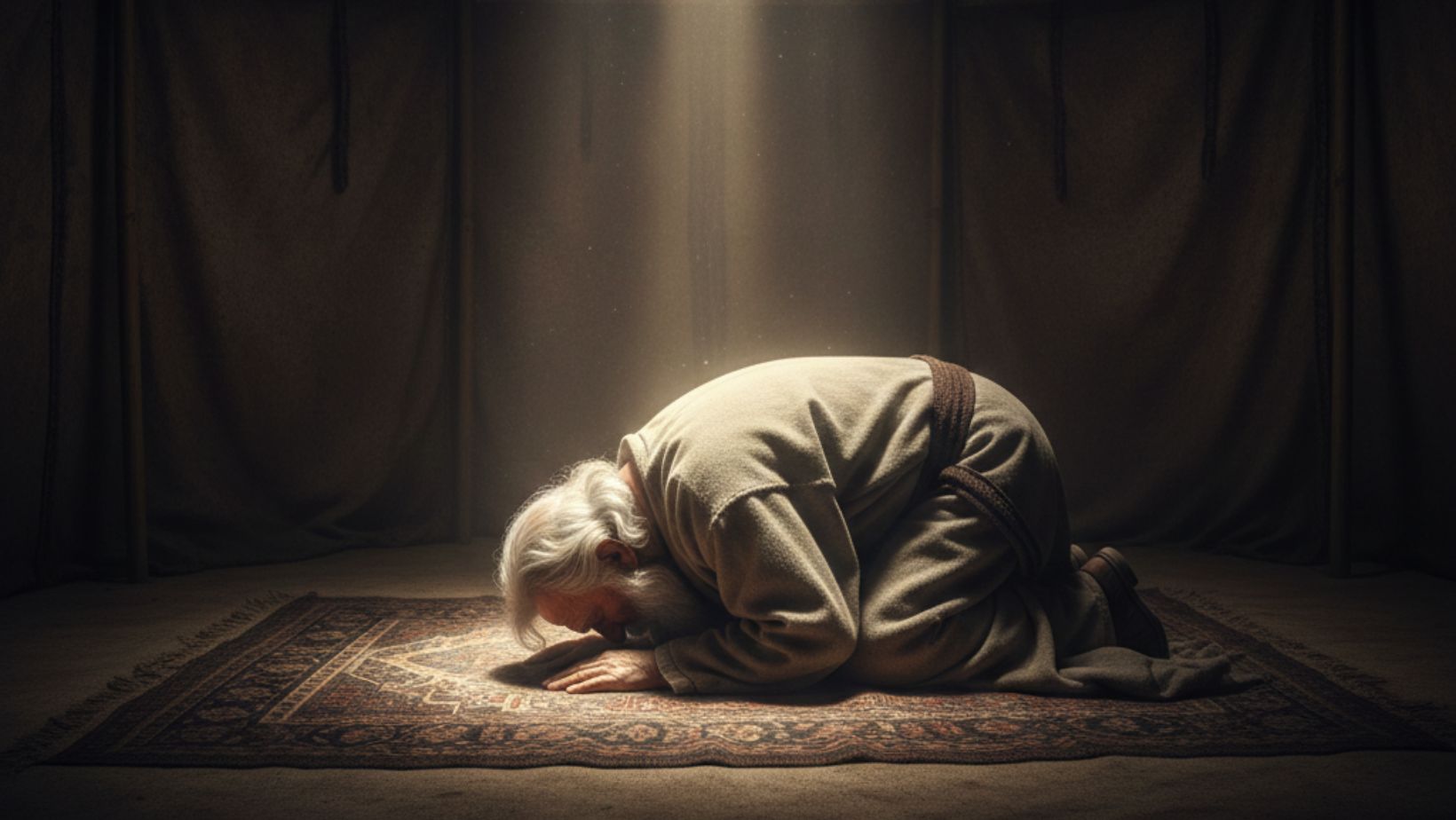
Summary of Genesis 17 Genesis 17 breaks a thirteen-year silence in the narrative. Abram is now ninety-nine years old, and Ishmael is thirteen. While Abram may have settled into the idea that Ishmael was the fulfillment of the promise, God reappears to expand and ratify the covenant in a physical and permanent way. This chapter introduces the title El Shaddai (God Almighty), changes the names of Abram and Sarai to define their new destinies, and institutes circumcision as the mandatory sign of the covenant. It draws a sharp line of distinction: while Ishmael will be blessed, the covenant line will proceed exclusively through a miraculous son, Isaac, to be born of Sarah.
1. El Shaddai and the Name Change (Genesis 17:1–8 NLT)
1 When Abram was ninety-nine years old, the Lord appeared to him and said, “I am El-Shaddai—‘God Almighty.’ Serve me faithfully and live a blameless life. 2 I will make a covenant with you, by which I will guarantee to make you into a mighty nation.” 3 At this, Abram fell face down on the ground. Then God said to him, 4 “This is my covenant with you: I will make you the father of a multitude of nations! 5 What’s more, I am changing your name. It will no longer be Abram. Instead, you will be called Abraham, for you will be the father of many nations. 6 I will make you extremely fruitful. Your descendants will become many nations, and kings will be among them! 7 “I will confirm my covenant with you and your descendants after you, from generation to generation. This is the everlasting covenant: I will always be your God and the God of your descendants after you. 8 And I will give the entire land of Canaan, where you now live as a foreigner, to you and your descendants. It will be their possession forever, and I will be their God.”
Commentary:
- The Silence Broken (v. 1): Thirteen years have passed since the birth of Ishmael (Gen 16:16). This silence likely tested Abram’s faith, perhaps leading him to believe God was content with the status quo.
- El Shaddai (v. 1): God introduces a new name: El Shaddai. While traditionally translated “God Almighty,” the root suggests “All-Sufficient” or “Overpowering.” God is asserting His power to overcome the biological impossibility of a 99-year-old man and a 90-year-old woman conceiving.
- The Command (v. 1): “Serve me faithfully and live a blameless life” (literally: “Walk before me”). In Chapter 15, God took the responsibility of the covenant alone. Now, in Chapter 17, He demands a response of holiness and wholehearted devotion.
- Name Change (v. 5): In the ancient world, to name something was to claim authority over it and define its essence.
- Kings and Nations (v. 6): The promise expands beyond just one nation (Israel) to “many nations” and “kings.” This foreshadows the Edomites (through Esau), Arab tribes (through Keturah), and ultimately the spiritual multitude of believers in Christ (Galatians 3:29).
- Everlasting Covenant (v. 7): The relationship is permanent (“everlasting”). The core of the covenant is relational: “I will be their God.”
2. The Sign of the Covenant: Circumcision (Genesis 17:9–14 NLT)
9 Then God said to Abraham, “Your responsibility is to obey the terms of the covenant. You and all your descendants have this continual responsibility. 10 This is the covenant that you and your descendants must keep: Each male among you must be circumcised. 11 You must cut off the flesh of your foreskin as a sign of the covenant between me and you. 12 From generation to generation, every male must be circumcised on the eighth day after his birth. This applies not only to members of your family but also to the servants born in your household and the foreign-born servants whom you have purchased. 13 All must be circumcised. Your bodies will bear the mark of my everlasting covenant. 14 Any male who fails to be circumcised will be cut off from the covenant family for breaking the covenant.”
Commentary:
- The Physical Sign (v. 11): God institutes circumcision. Unlike the rainbow (a sign in the sky for Noah), this sign is carved into the male flesh. It concerns the organ of procreation, symbolizing that the seed of Abraham is set apart and that fertility is a divine gift, not a natural right.
- The Eighth Day (v. 12): Medical science notes that Vitamin K and prothrombin levels (clotting agents) peak on the eighth day of a newborn’s life, making it the safest time for the procedure—a detail consistent with divine design.
- Inclusion of Servants (v. 12-13): The covenant was not strictly biological from the start; it included “foreign-born servants.” This hints at the inclusivity of God’s people, foreshadowing the grafting in of the Gentiles.
- “Cut Off” (v. 14): There is a serious play on words. If a man does not “cut off” the foreskin, he will be “cut off” (excommunicated or killed) from his people. The rejection of the sign is a rejection of the covenant relationship.
3. Sarah’s Blessing and Isaac’s Promise (Genesis 17:15–22 NLT)
15 Then God said to Abraham, “Regarding Sarai, your wife—her name will no longer be Sarai. From now on her name will be Sarah. 16 And I will bless her and give you a son from her! Yes, I will bless her richly, and she will become the mother of many nations. Kings of nations will be among her descendants.” 17 Then Abraham bowed down to the ground, but he laughed to himself in disbelief. “How could I become a father at the age of 100?” he thought. “And how can Sarah have a baby when she is ninety years old?” 18 So Abraham said to God, “May Ishmael live under your special blessing!” 19 But God replied, “No—Sarah, your wife, will give birth to a son for you. You will name him Isaac, and I will confirm my covenant with him and his descendants as an everlasting covenant. 20 As for Ishmael, I will bless him also, just as you have asked. I will make him extremely fruitful and multiply his descendants. He will become the father of twelve princes, and I will make him a great nation. 21 But my covenant will be confirmed with Isaac, who will be born to you and Sarah about this time next year.” 22 When God had finished speaking, he left Abraham.
Commentary:
- Sarai to Sarah (v. 15): Both names mean “Princess,” but the change likely signifies a shift from being “My Princess” (local/particular) to “Princess” (universal/matriarch of nations). She is brought into the covenant explicitly as the mother of the heir.
- Abraham’s Laughter (v. 17): Abraham’s laughter is a mix of shock and skepticism. It is the laughter of human limitation confronting divine possibility. This laughter gives the future child his name: Isaac means “He laughs.”
- The Plea for Ishmael (v. 18): Abraham loves Ishmael. He has spent 13 years raising him as the heir. He essentially asks, “God, can’t we just use the son I already have? The plan is working fine.” He struggles to let go of his own solution.
- Divine Specificity (v. 19): God is emphatic (“No”). The covenant is not just about having a son; it is about having the son of promise. Supernatural intervention is required.
- Blessing vs. Covenant (v. 20-21): God distinguishes between blessing (provision, multiplication, nationhood—given to Ishmael) and covenant (messianic line, land, unique relationship—given to Isaac).
4. Immediate Obedience (Genesis 17:23–27 NLT)
23 On that very day, then, Abraham took his son Ishmael and every male in his household, including those born there and those he had bought. So he circumcised them, cutting off their foreskins, just as God had told him. 24 Abraham was ninety-nine years old when he was circumcised. 25 And Ishmael, his son, was thirteen. 26 Both Abraham and his son, Ishmael, were circumcised on that same day, 27 along with all the other men and boys of the household, whether they were born there or bought from outsiders.
Commentary:
- “On that very day” (v. 23): This phrase underscores Abraham’s immediate, unquestioning obedience. Despite the pain, the potential tactical weakness it caused (men recovering from surgery are vulnerable, see Gen 34), and the awkwardness of explaining this to his household, he acted instantly.
- Solidarity (v. 26): Abraham, the patriarch, submits to the same painful sign as the lowest servant. It is a communal act of dedication.
- Ishmael’s Age (v. 25): At thirteen, Ishmael is old enough to remember this event. He carries the mark of Abraham’s God, even though the covenant line passes to Isaac.
Theological Significance of Genesis 17
- El Shaddai: The revelation of God as Almighty teaches that God’s promises often wait until human strength is exhausted (Abraham is 99) so that the glory belongs solely to Him.
- Sacramental Theology: Circumcision is the Old Testament antecedent to Baptism (Colossians 2:11-12). It is an outward sign of an inward reality—a cutting away of the flesh (sin nature) and a mark of belonging to God’s people.
- Election and Grace: God chooses Isaac over Ishmael before either has done anything. This emphasizes that the covenant is based on God’s sovereign choice, not human effort or birth order.
- Identity Transformation: The name changes indicate that an encounter with the living God changes who we are at a fundamental level. We are no longer defined by our past (Abram) but by God’s promise (Abraham).
Practical Applications
- Walking Blamelessly: Grace (Chapter 15) leads to a call for holiness (Chapter 17). We are saved by faith, but we are saved for a life of wholehearted devotion (“Walk before me”).
- Letting Go of “Ishmaels”: We often have our own “Ishmaels”—plans or solutions we have nurtured and love, but which are not God’s best. We must be willing to let God establish His “Isaac” in our lives, even if it seems impossible.
- Painful Obedience: Sometimes obedience hurts. Circumcision was painful and humiliating. True submission to God often requires cutting away things we hold dear or enduring discomfort to be marked as His.
- God’s Silence: If God seems silent in your life (like the 13-year gap), it does not mean He has forgotten His promise. He may be preparing you for a revelation of His power (El Shaddai).
Final Insight
Genesis 17 transforms the private faith of Abraham into a public, corporate institution. It moves from “Abram believing God” to “Abraham walking blamelessly.” The knife of circumcision symbolizes that approaching a holy God requires a costly consecration—a shedding of confidence in the flesh to rely wholly on the Almighty.
Possible Sermon Titles
- When God Changes Your Name.
- The God of the Impossible (El Shaddai).
- Letting Go of Ishmael.
- The Mark of the Covenant.
- Laughter in the Face of God.
- Ninety-Nine and Beginning Again.







Leave a Reply